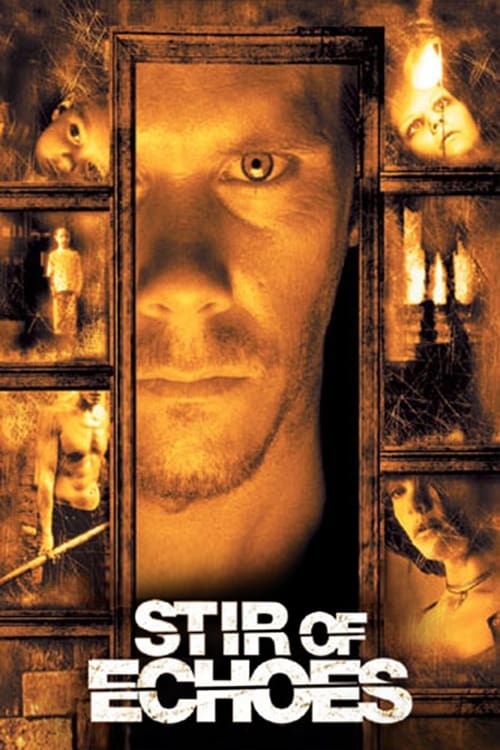
Stir of Echoes (1999)
Directed by David Koepp
No — Stir of Echoes is not woke, scoring 3 out of 100 on our wokeness meter.
Stir of Echoes arrives from 1999, a lean supernatural thriller directed by David Koepp from Richard Matheson's 1958 novel, and it conducts itself with a discipline that modern audiences may find jarring.
Consciousness Markers
The cast is uniformly white and the working-class Chicago setting is incidental; the intellectually disabled character functions as a plot device rather than a representation statement.
Maggie is a present and capable spouse, but the film offers no feminist critique or agenda; she largely serves the husband's supernatural arc.
No LGBTQ+ characters or themes appear anywhere in the film.
Race is never a subject of the film; the community is homogeneous and the narrative is indifferent to racial dynamics.
No environmental or climate themes are present.
The working-class milieu is texture, not argument; there is no eat-the-rich messaging or economic critique.
No body-positivity themes or messaging.
Samantha's intellectual disability and Jake's psychic sensitivity are plot mechanics of a 1999 ghost story, not a modern neurodivergence sensibility.
The film is a contemporary supernatural mystery with no historical revisionism.
The film is a genre thriller that never pauses to deliver social or political instruction.
Why it received this score
Stir of Echoes arrives from 1999, a lean supernatural thriller directed by David Koepp from Richard Matheson's 1958 novel, and it conducts itself with a discipline that modern audiences may find jarring. Tom Witzky is a phone lineman in a working-class Chicago neighborhood. He is hypnotized at a party by his sister-in-law, and afterward he sees a dead girl. That is the entire proposition. The film does not pause to explain what any of this says about society. It follows a man as he tears up his basement and loses his mind.
The cast is white, the neighborhood is white, and nobody remarks upon it. Samantha Kozac, the murdered seventeen-year-old, has an intellectual disability, a detail the plot requires so that she might trust strangers and be lured into a house. Her condition is a mechanism, not a statement. Maggie Witzky is a capable and pregnant spouse who spends most of the runtime being supportive, then briefly being a hostage. The film offers no critique of this arrangement and appears unaware that such a critique was ever expected. The working-class texture of the setting is just that: texture. Nobody eats any rich people.
There is no sermon here. The camera observes a psychic child, a mummified body, a guilt-ridden father, and two young men who committed an atrocity and were protected by their parents. Koepp keeps it sad and small and occasionally cruel. This is a ghost story that trusts its own genre, delivered before the culture decided every ghost must also carry a message. On the classification scale, the picture registers as a near-total nullity. It is, in the end, merely a good film about a man who hears things. That used to be sufficient.
[thematic_tags: book_adaptation]
Analysis generated by our Consciousness Algorithm


Synopsis
After being hypnotized by his sister-in-law, Tom Witzky begins seeing haunting visions of a girl's ghost and a mystery begins to unfold around her.
Questions about Stir of Echoes
Is Stir of Echoes woke?
No — Stir of Echoes is not woke, scoring 3 out of 100 on our wokeness meter. That earns it a verdict of Ultra Based.
Does Stir of Echoes have any woke elements?
Very few. None of the 10 markers reaches 30, the level where a marker counts as present; the highest is Representation Casting at 5.
How does Stir of Echoes compare to other 1999 movies?
It ranks #88 of the 103 films from 1999 we've scored; their average is 14. The wokest is Boys Don't Cry (60).
How is the Woke Score calculated?
An AI-assisted process researches the film and its reception, scores it 0–100 on ten markers, then combines those into one 0–100 Woke Score. It measures a specific set of 2020s cultural themes, not film quality.