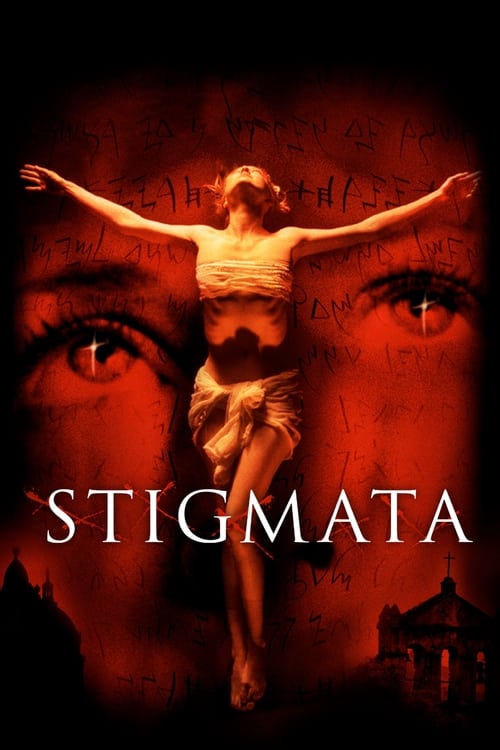
Stigmata (1999)
Directed by Rupert Wainwright
No — Stigmata is not woke, scoring 12 out of 100 on our wokeness meter.
Stigmata arrives from 1999 with the confidence of a music video and the theology of a bumper sticker.
Consciousness Markers
The plot hinges on a suppressed 'lost gospel' (the Gospel of Thomas) that the Church allegedly buried, offering a revisionist account of early Christian history, though framed as supernatural thriller rather than social-justice revisionism.
The film closes with on-screen text asserting the Church rejects the Gospel of Thomas as heresy, and its message that 'the Kingdom of God is within you' carries a mild sermonizing tone.
The cast includes Nia Long in a supporting role and a generally mixed ensemble, but this is incidental 1990s ensemble casting with no deliberate representation agenda or commentary.
Frankie is a female protagonist, but she functions largely as a possessed victim and object of investigation rather than a vehicle for any feminist thesis.
The film critiques the Vatican as a corrupt, truth-suppressing institution, but this is anti-clerical rather than an anti-capitalist or 'eat the rich' argument.
No LGBTQ+ characters, themes, or subtext appear in the film; Portia de Rossi's presence in the cast is not reflected in any on-screen content.
Race is never addressed or thematized; the film's concerns are entirely theological and supernatural.
No environmental or climate themes whatsoever.
No body-positivity themes; the film's bodily focus is on wounds and horror imagery.
No neurodivergent characters or themes are present.
Why it received this score
Stigmata arrives from 1999 with the confidence of a music video and the theology of a bumper sticker. Patricia Arquette plays Frankie Paige, a Pittsburgh hairdresser who acquires a rosary and a set of bleeding wounds, plus an Aramaic vocabulary she did not order. Gabriel Byrne is the Jesuit sent by Rome to investigate. Jonathan Pryce plays the cardinal who would prefer the matter go away, which it will not. The film was a surprise commercial success, opening above The Sixth Sense, and critics greeted it with the enthusiasm of a man reviewing his own biopsy. Roger Ebert found it hilarious. He was not being kind.
On the matter of representation, the ensemble is mixed in the manner of a late-1990s studio picture, with Nia Long in a supporting role and no commentary attached. Portia de Rossi appears in the cast list, which is the closest the film comes to any queer content, since none exists on screen. Frankie sits at the center of the story, though she spends most of it convulsing and levitating while men in collars examine her; the film has no thesis about her beyond her usefulness as a vessel. Race never enters the conversation, and neither does the environment. Nobody here is fat or autistic, and nobody is poor in a way the script cares to examine. The villain is an institution, but the grievance is doctrinal, not economic. Rome suppresses a text, not a workforce.
The film's one genuine provocation is textual. A lost gospel, the Gospel of Thomas, surfaces in Aramaic scrawls on an apartment wall, and the Church would rather it stayed lost. That is a real revisionist gesture, delivered through possession mechanics instead of argument. Then the credits roll and a caption informs us that the Catholic Church rejects the document as heresy, which is the film's way of making sure we got the point. It is a light touch of sermonizing, no more. A curious artifact: a horror film that wants to scandalize the Curia and settles for rattling the pews.
Analysis generated by our Consciousness Algorithm


Synopsis
A young woman with no strong religious beliefs, Frankie Paige begins having strange and violent experiences, showing signs of the wounds that Jesus received when crucified. When the Vatican gets word of Frankie's situation, a high-ranking cardinal requests that the Rev. Andrew Kiernan investigate her case. Soon Kiernan realizes that very sinister forces are at work, and tries to rescue Frankie from the entity that is plaguing her.
Questions about Stigmata
Is Stigmata woke?
No — Stigmata is not woke, scoring 12 out of 100 on our wokeness meter. That earns it a verdict of Ultra Based.
Does Stigmata have any woke elements?
1 of the 10 markers register at 30 or above, led by Revisionist History (30). On Revisionist History: The plot hinges on a suppressed 'lost gospel' (the Gospel of Thomas) that the Church allegedly buried, offering a revisionist account of early Christian history, though framed as supernatural thriller rather than social-justice revisionism.
How does Stigmata compare to other 1999 movies?
It ranks #39 of the 103 films from 1999 we've scored; their average is 14. The wokest is Boys Don't Cry (60).
How is the Woke Score calculated?
An AI-assisted process researches the film and its reception, scores it 0–100 on ten markers, then combines those into one 0–100 Woke Score. It measures a specific set of 2020s cultural themes, not film quality.