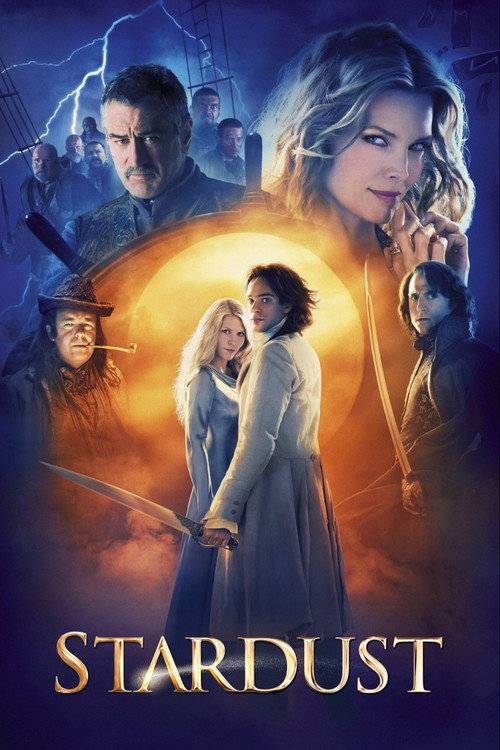
Stardust (2007)
Directed by Matthew Vaughn
No — Stardust is not woke, scoring 9 out of 100 on our wokeness meter.
The production presents a rather conventional tapestry of high fantasy, a film that appears acutely aware of its own escapist nature.
Consciousness Markers
Captain Shakespeare is a cross-dressing sky-pirate who keeps his flamboyant feminine persona hidden from his crew, a genuine strand of gender-nonconformity played largely for whimsical comedy rather than as an identity thesis.
Yvaine is largely a prize to be won and rescued, though the witch Lamia and the enslaved princess Una wield real power and menace; the film offers no coherent feminist argument.
The ensemble is overwhelmingly white and Anglo, with no evident attempt at inclusive or color-conscious casting; the leads and supporting players are drawn from a conventional British-American pool.
The tone is light, romantic, and comedic, with no preachy or didactic messaging; it aims to entertain rather than instruct.
The film engages no racial themes whatsoever; its fantasy kingdom is a uniformly white European milieu with no commentary on race.
No environmental or climate themes appear; the falling star is a plot device, not an ecological parable.
There is no economic critique; the story concerns royal succession, witches, and romance, with no engagement with class or capital.
No body-positivity themes; the witches' quest for youth is a vanity-and-power motif, not a body-image statement.
No neurodivergent characters or themes are present.
The film is set in a wholly invented fantasy world and makes no historical claims to revise.
Why it received this score
The production presents a rather conventional tapestry of high fantasy, a film that appears acutely aware of its own escapist nature. We find ourselves in a milieu defined by a uniformly Anglo-centric visual style, where the ensemble remains comfortably drawn from a familiar British and American casting pool. The narrative lacks any serious engagement with contemporary social dynamics. The thematic landscape is dominated by the pursuit of romantic destiny and the retrieval of a celestial object, leaving virtually no room for political critique or socio-economic commentary.
Subtle moments of progressive sensibility exist, though they are often utilized for tonal levity. A cross-dressing sky-pirate figure serves as a marker of gender non-conformity, yet this trait functions primarily as a source of whimsical comedy rather than a deep identity statement. Similarly, the female characters, while possessing agency, are generally situated within established power structures that offer limited space for truly subversive messaging. The film avoids any heavy-handed sermonizing, preferring a light, adventurous atmosphere that prioritizes spectacle over progressive discourse.
Ultimately, this is a work of pure, unadulterated fantasy. It operates within its own self-contained rules, concerned with the perilous journey across a magical boundary. The sheer lack of commentary on global issues, whether racial, climatic, or financial, places it firmly in the realm of traditional genre fare. It is a competent piece of filmmaking, but culturally, it is profoundly unchallenging.
Analysis generated by our Consciousness Algorithm
Part of


Synopsis
In a countryside town bordering on a magical land, a young man makes a promise to his beloved that he'll retrieve a fallen star by venturing into the magical realm. His journey takes him into a world beyond his wildest dreams and reveals his true identity.
Questions about Stardust
Is Stardust woke?
No — Stardust is not woke, scoring 9 out of 100 on our wokeness meter. That earns it a verdict of Ultra Based.
Does Stardust have any woke elements?
1 of the 10 markers register at 30 or above, led by LGBTQ+ Themes (30). On LGBTQ+ Themes: Captain Shakespeare is a cross-dressing sky-pirate who keeps his flamboyant feminine persona hidden from his crew, a genuine strand of gender-nonconformity played largely for whimsical comedy rather than as an identity thesis.
How does Stardust compare to other 2007 movies?
It ranks #86 of the 201 films from 2007 we've scored; their average is 12. The wokest is Like Stars on Earth (92).
How is the Woke Score calculated?
An AI-assisted process researches the film and its reception, scores it 0–100 on ten markers, then combines those into one 0–100 Woke Score. It measures a specific set of 2020s cultural themes, not film quality.