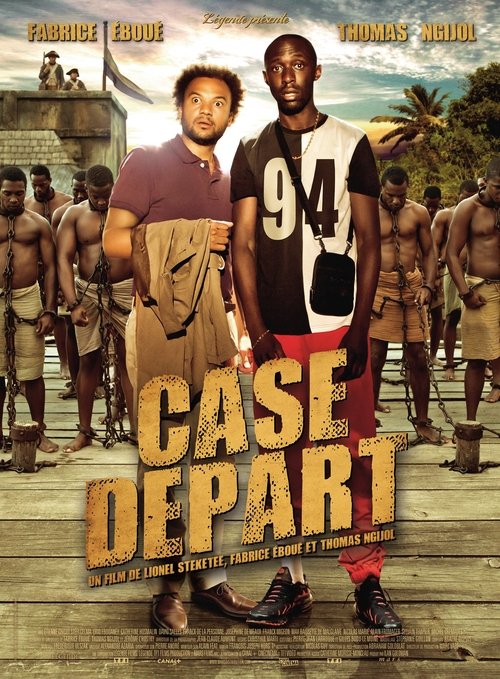
Case départ (2011)
Directed by Lionel Steketee
Yes — Case départ is woke, scoring 60 out of 100 on our wokeness meter.
There is a genre of French comedy that treats the colonial past as a family inconvenience, and Case départ sits near the top of it.
Consciousness Markers
Slavery, the manumission certificate, the Antillean legacy, and the brothers' confrontation with their enslaved ancestors are the film's entire thematic engine.
The film is headlined by Black French comedians Thomas Ngijol and Fabrice Eboué, with a predominantly Antillean/Black principal cast, placing Black leads at the center of a mainstream French comedy.
The film reframes the French colonial slavery era through a modern comedic, time-travel lens and a 'change the past' conceit, lightly revising how the period is conventionally portrayed.
The film carries an implicit moral about honoring ancestral suffering, but it delivers this through broad comedy rather than preachy sermonizing.
Female characters (Rosalie, Joséphine) exist within the story but the narrative is driven by two brothers and their ancestral romance plot, with no feminist framing.
The slave economy is depicted as brutal, but the film offers no coherent anti-capitalist critique or eat-the-rich framing.
No LGBTQ+ characters, themes, or subtext appear anywhere in the plot or cast.
No environmental or climate themes are present.
No body-positivity themes or messaging appear.
No neurodivergent characters or themes are present.
Why it received this score
There is a genre of French comedy that treats the colonial past as a family inconvenience, and Case départ sits near the top of it. Two half-brothers, Régis and Joël Grosdésir, are summoned to a deathbed in the Antilles to inherit a manumission certificate, the only treasure their ancestor left behind. They tear it up. Their aunt curses them. They wake in the eighteenth century and are sold as slaves within the hour. The plot is Back to the Future with the DeLorean swapped for a malediction, and the courtship of their own great-grandparents standing between them and the present.
The film's center of gravity is the slave economy and the ancestral debt, and it does not flinch from either. Putting two Black French comedians at the head of a mainstream commercial comedy was not the default arrangement in 2011, and the film knows it. The period is reframed through a modern, irreverent lens, and the brothers are forced to negotiate with the very ancestors they mocked. Rosalie and Joséphine exist, but the engine remains two brothers and the romance they must engineer. There is no LGBTQ material, no environmental concern, no body-positive messaging, no neurodivergent character. The plantation is rendered as brutal, though the film has no economic thesis to offer; the cruelty is atmosphere, not argument.
The moral lands, but it lands gently, folded into slapstick and delivered with a shrug. Anyone hoping for a lecture will have to settle for a whipping scene played for discomfort and a final act that asks the audience to honor suffering without ever naming the bill. A modest, good-natured artifact of its moment.
Analysis generated by our Consciousness Algorithm
Synopsis
Two contempo Frenchmen of Antillean descent visit their ancestor's time as well as their land in the slavery-themed French era.
Questions about Case départ
Is Case départ woke?
Yes — Case départ is woke, scoring 60 out of 100 on our wokeness meter. That earns it a verdict of Woke.
What makes Case départ woke?
4 of the 10 markers register at 30 or above, led by Racial Consciousness (85), Representation Casting (68) and Revisionist History (35). On Racial Consciousness: Slavery, the manumission certificate, the Antillean legacy, and the brothers' confrontation with their enslaved ancestors are the film's entire thematic engine.
How does Case départ compare to other 2011 movies?
It ranks #2 of the 245 films from 2011 we've scored; their average is 11. The wokest is Paul (68).
How is the Woke Score calculated?
An AI-assisted process researches the film and its reception, scores it 0–100 on ten markers, then combines those into one 0–100 Woke Score. It measures a specific set of 2020s cultural themes, not film quality.