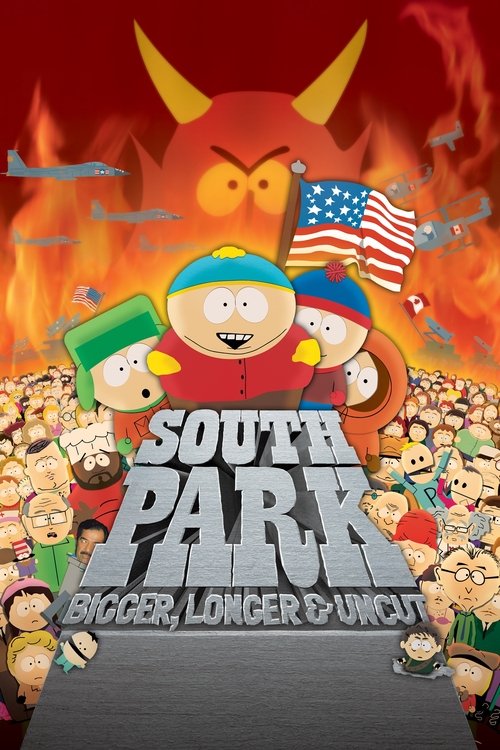
South Park: Bigger, Longer & Uncut (1999)
Directed by Trey Parker
No — South Park: Bigger, Longer & Uncut is not woke, scoring 14 out of 100 on our wokeness meter.
South Park: Bigger, Longer & Uncut arrives as a 1999 animated musical about profanity, parental panic, and the MPAA, and it remains a strange artifact of its era.
Consciousness Markers
Features Big Gay Al and a gay relationship between Satan and Saddam Hussein, but it is played for shock and satire rather than progressive affirmation.
The film has a clear free-speech and anti-censorship message delivered through songs and dialogue, but it remains comedic rather than preachy.
The voice cast is dominated by white creators Trey Parker and Matt Stone, with Isaac Hayes as the Black character Chef and Mary Kay Bergman voicing the female roles; diversity is incidental rather than a conscious casting priority.
Female characters like Sheila Broflovski and Wendy exist, but the film has no feminist agenda; Sheila is largely a satirical antagonist.
No meaningful engagement with racial justice or racial identity beyond incidental characters.
No climate themes.
Satirizes censorship and corporate Hollywood, but not capitalism or wealth inequality.
Cartman's weight is a running joke; no body-positive messaging.
No neurodivergence themes.
Uses historical figures like Saddam Hussein and Adolf Hitler for absurdist humor, not historical revisionism.
Why it received this score
South Park: Bigger, Longer & Uncut arrives as a 1999 animated musical about profanity, parental panic, and the MPAA, and it remains a strange artifact of its era. The film has a clear anti-censorship thesis, delivered through Terrance and Phillip, Sheila Broflovski's Mothers Against Canada, and a war with Canada that escalates with deadpan stupidity. Its cultural awareness is selective. The satire aims at scapegoating and corporate entertainment, not at the modern constellation of social justice causes. The result is rude, tuneful, and less socially conscious than its reputation as a taboo-breaker might suggest.
Representation here is incidental. The voice cast is dominated by its white creators, with Isaac Hayes as Chef and Mary Kay Bergman handling the female roles; the film does not treat casting as a statement. Big Gay Al appears, and Satan's abusive relationship with Saddam Hussein supplies a running gay joke, but the queerness is used for shock and absurdity, not affirmation. Female characters exist, chiefly Sheila as a satirical antagonist and Wendy as a minor romantic note, and the film has no feminist program. Racial justice, climate anxiety, economic inequality, body acceptance, neurodivergence, and historical revisionism are absent. Cartman's weight remains a punchline. Hitler and Saddam are dropped in for surreal comedy, not to revise the record.
The film's lecture energy is modest. It has a message about free speech and censorship, and the songs carry it with more conviction than subtlety, but the delivery stays comic. The film argues through jokes, musical numbers, and a child's sacrifice, not through sermonizing. That keeps the thesis palatable even when the material is deliberately juvenile. Viewed today, it reads as a product of its moment: a rude, anti-censorship comedy that flirts with gay panic and fat jokes while declining to organize itself around any broader progressive program. The sacred duty of classification yields a low overall grade, with a few marks for sheer nerve.
Analysis generated by our Consciousness Algorithm
Part of


Synopsis
The third graders of South Park sneak into an R-rated film by ultra-vulgar Canadian television personalities Terrance and Phillip, and emerge with expanded vocabularies that leave their parents and teachers scandalized. When outraged Americans try to censor the film, the controversy spirals into a call to wage war on Canada and Terrance and Phillip end up on death row, with the kids their only hope of rescue.
Questions about South Park: Bigger, Longer & Uncut
Is South Park: Bigger, Longer & Uncut woke?
No — South Park: Bigger, Longer & Uncut is not woke, scoring 14 out of 100 on our wokeness meter. That earns it a verdict of Ultra Based.
Does South Park: Bigger, Longer & Uncut have any woke elements?
1 of the 10 markers register at 30 or above, led by LGBTQ+ Themes (35). On LGBTQ+ Themes: Features Big Gay Al and a gay relationship between Satan and Saddam Hussein, but it is played for shock and satire rather than progressive affirmation.
How does South Park: Bigger, Longer & Uncut compare to other 1999 movies?
It ranks #35 of the 103 films from 1999 we've scored; their average is 14. The wokest is Boys Don't Cry (60).
How is the Woke Score calculated?
An AI-assisted process researches the film and its reception, scores it 0–100 on ten markers, then combines those into one 0–100 Woke Score. It measures a specific set of 2020s cultural themes, not film quality.