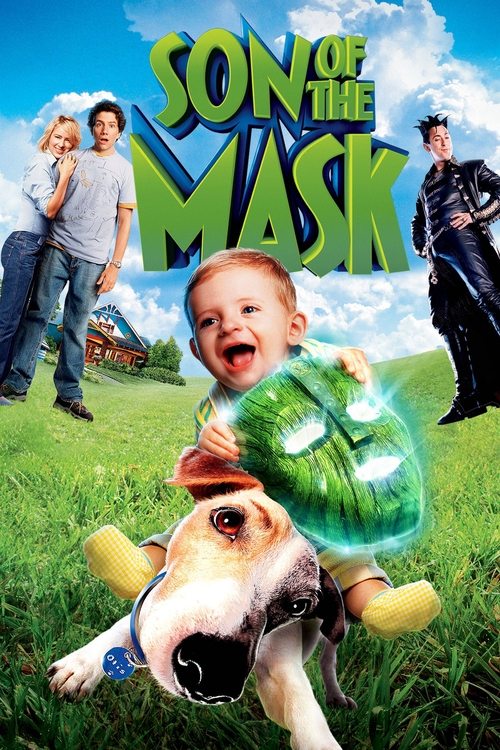
Son of the Mask (2005)
Directed by Lawrence Guterman
No — Son of the Mask is not woke, scoring 4 out of 100 on our wokeness meter.
The film arrives as a sequel to The Mask, itself a Dark Horse comic adaptation, and it stands as a case study in what happens when a franchise continues past the departure of its only reason for existing.
Consciousness Markers
The protagonist faces professional failure and dismissal, offering a minor, non-systemic critique of corporate pressures.
The film utilizes standard Hollywood casting for a family fantasy comedy, offering no specific focus on diverse representation beyond the general ensemble.
Female characters, such as Tonya, function primarily as plot mechanisms (wife, mother) and do not drive a feminist agenda.
There are no LGBTQ+ themes, characters, or subtext present in the film's narrative or character development.
The film does not engage with racial issues or offer specific commentary on race.
The film contains no messaging or plot points related to environmentalism or climate change.
The film does not address body image or promote body positivity.
There is no character representation or thematic exploration of neurodivergence within the narrative.
The film uses Norse mythology in a fictional, comedic context and does not attempt to revise historical or established narratives.
The film does not employ didactic sequences or lengthy monologues to explain complex social or philosophical concepts.
Why it received this score
The film arrives as a sequel to The Mask, itself a Dark Horse comic adaptation, and it stands as a case study in what happens when a franchise continues past the departure of its only reason for existing. Jim Carrey declined. The role then passed through a parade of comedians who also declined, until Jamie Kennedy accepted. The production notes recount this with the flat affect of a coroner's report. The result is ninety-four minutes about a cartoonist, a dog, and an infant wielding the powers of a Norse god, assembled from slapstick and computer imagery at a cost near ninety million dollars.
On the matter of social consciousness, the ledger is nearly blank. The film engages no racial questions, offers no LGBTQ themes, carries no environmental messaging, and makes no attempt at historical revision. Female characters exist to be wives and mothers, and the screenplay does not pretend otherwise. A faint murmur of corporate critique surfaces when Tim is dismissed and his pitch rejected, but it amounts to a shrug. The film has no interest in the systems that grind him down. It simply needs him unemployed for a montage. Norse mythology serves as set dressing, Loki and Odin as squabbling relatives in a domestic comedy, with no ambition to reinterpret anything.
The remainder is noise. Roger Ebert compared the plot to Wile E. Coyote running into a wall, and the comparison holds. The film collected eight Razzie nominations and won for Worst Remake or Sequel, a category it technically should not have qualified for, which is its own small tragedy. It is not offensive. It is not preachy. It is a void, a special effects reel with no argument behind it, and the culture has already rendered its verdict. We classify it accordingly and move on.
Analysis generated by our Consciousness Algorithm


Synopsis
Tim Avery, an aspiring cartoonist, finds himself in a predicament when his dog stumbles upon the mask of Loki. Then after conceiving an infant son "born of the mask", he discovers just how looney child raising can be.
Questions about Son of the Mask
Is Son of the Mask woke?
No — Son of the Mask is not woke, scoring 4 out of 100 on our wokeness meter. That earns it a verdict of Ultra Based.
Does Son of the Mask have any woke elements?
Very few. None of the 10 markers reaches 30, the level where a marker counts as present; the highest is Eat the Rich at 10.
How does Son of the Mask compare to other 2005 movies?
It ranks #131 of the 181 films from 2005 we've scored; their average is 13. The wokest is The Constant Gardener (72).
How is the Woke Score calculated?
An AI-assisted process researches the film and its reception, scores it 0–100 on ten markers, then combines those into one 0–100 Woke Score. It measures a specific set of 2020s cultural themes, not film quality.