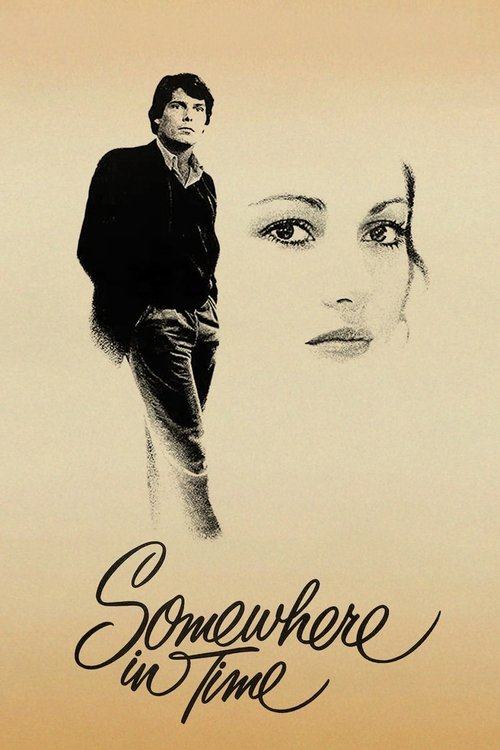
Somewhere in Time (1980)
Directed by Jeannot Szwarc
No — Somewhere in Time is not woke, scoring 2 out of 100 on our wokeness meter.
Somewhere in Time is a 1980 romantic fantasy in which Christopher Reeve's playwright wills himself back to 1912 for Jane Seymour's stage actress.
Consciousness Markers
The cast is overwhelmingly white and conventional for 1980; any minority or female presence is incidental and uncommented upon, not a modern representation-casting statement.
There are no LGBTQ+ characters, themes, or subtexts in the film.
Elise is a romantic ideal and a stage actress whose arc revolves around choosing love; the film does not advance a feminist critique or agenda.
Race is not a thematic concern, and the film contains no racial-consciousness commentary or critique.
Environmental themes or climate advocacy are entirely absent.
The film has no eat-the-rich messaging or anti-capitalist critique; its conflicts are romantic and supernatural.
There is no body-positivity theme or challenge to conventional body standards.
The protagonist's obsession and self-hypnosis are treated as romantic fantasy devices, not as neurodivergence representation.
The 1912 setting is nostalgic romantic backdrop, not a revisionist or counter-narrative historical project.
The film aims for sweeping romance and melancholy, not social or political lecturing.
Why it received this score
Somewhere in Time is a 1980 romantic fantasy in which Christopher Reeve's playwright wills himself back to 1912 for Jane Seymour's stage actress. It is a swooning, melancholy affair of pocket watches, hotel registers, and Rachmaninoff. The film has no interest in modern social instruction. Its concerns are love, fate, sacrifice, and the cruelty of time. The cast is white and conventional, and the film treats that as unremarkable. There is no identity-based commentary, no political subtext, no environmental or economic sermon. Elise's arc is about choosing love. Richard's obsession is a romantic device. The 1912 setting is a nostalgic backdrop. The movie wants us to sigh, not to organize.
The conflict is personal. Christopher Plummer's manager wants to protect Elise's career, and the film sides with the heart. There is no systemic critique, no economic inequality, no environmental collapse, no social reform. The time-travel mechanism is self-hypnosis and a penny, not a metaphor for marginalization. The photograph and the pocket watch are fetish objects of longing. The cult following at the Grand Hotel is about nostalgia, not activism. Even the afterlife reunion is private, not political. The score by John Barry does the heavy lifting, and the film's sincerity is total.
As a piece of cultural classification, this is an old-fashioned tearjerker with no modern social consciousness. That is not a moral judgment. It is a description. The film was critically derided and underperformed, then found devotees. Its lack of contemporary progressive sensibilities is consistent from first frame to last. A sommelier of such vintages would note the absence of modern tannins. The bottle is pure romance, no additives.
Analysis generated by our Consciousness Algorithm
Part of


Synopsis
Young writer Richard Collier is met on the opening night of his first play by an old lady who begs him to "Come back to me". Mystified, he tries to find out about her, and learns that she is a famous stage actress from the early twentieth century. Becoming more and more obsessed with her, by self-hypnosis he manages to travel back in time—where he meets her.
Questions about Somewhere in Time
Is Somewhere in Time woke?
No — Somewhere in Time is not woke, scoring 2 out of 100 on our wokeness meter. That earns it a verdict of Ultra Based.
Does Somewhere in Time have any woke elements?
No. All 10 markers score zero.
How does Somewhere in Time compare to other 1980 movies?
It ranks #29 of the 37 films from 1980 we've scored; their average is 10. The wokest is Nine to Five (42).
How is the Woke Score calculated?
An AI-assisted process researches the film and its reception, scores it 0–100 on ten markers, then combines those into one 0–100 Woke Score. It measures a specific set of 2020s cultural themes, not film quality.