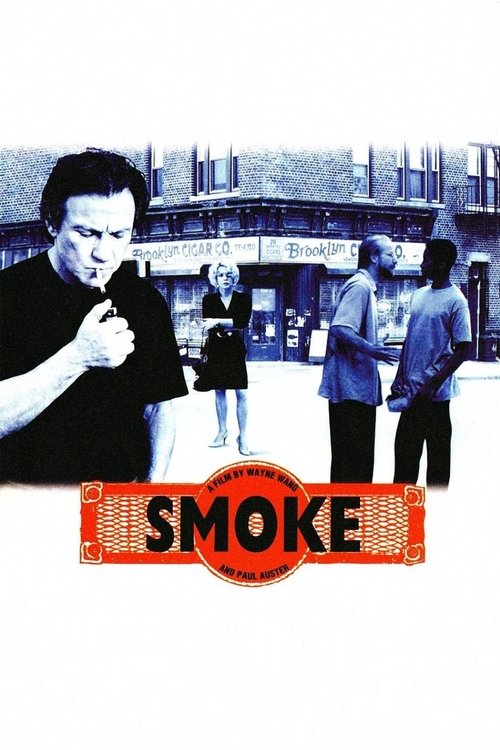
Smoke (1995)
Directed by Wayne Wang
No — Smoke is not woke, scoring 16 out of 100 on our wokeness meter.
Smoke is a 1995 independent drama that moves at the pace of a man deciding whether to buy another pack.
Consciousness Markers
The central relationship between the white writer and the Black man from an underprivileged background explores class and racial dynamics with nuance.
The film features a diverse ensemble cast, including prominent Black actors in key roles, which was progressive for 1995 cinema.
The plot touches upon economic disparity and the struggles of small businesses, but it does not offer a strong systemic critique of capitalism.
The female characters are complex and active in the plot, but the film does not engage in overt feminist critique or agenda setting.
While the film is meditative and dialogue-heavy, the conversations are character-driven and poetic rather than didactic or preachy.
There are no discernible LGBTQ+ themes or characters present in the narrative.
The film contains no commentary or visual representation of environmental issues or climate change.
There is no focus on body image, size, or challenging conventional beauty standards.
No characters are portrayed with explicit neurodivergent traits or conditions.
The film is a fictional drama and does not attempt to rewrite established historical events.
Why it received this score
Smoke is a 1995 independent drama that moves at the pace of a man deciding whether to buy another pack. Its cultural awareness is real but modest, the kind that arrives through casting and conversation instead of a podium. Wayne Wang assembles a diverse ensemble and gives Black actors substantial roles without turning them into symbols. The central bond between William Hurt's grieving white writer and Harold Perrineau's young Black stranger carries a quiet racial and class charge. The film notices the distance between them. It does not lecture about it.
Economic life matters here. A Brooklyn tobacconist frets over Cuban cigars and five thousand dollars of savings, and the story understands how fragile small business can be. That is not a systemic indictment of capital. It is a mood of precarity. The women, Stockard Channing and Ashley Judd among them, are active and complicated, though the film has no interest in feminist argument. The dialogue is poetic and character driven. When Auggie tells his Christmas story, the film earns its sentiment without mounting a sermon. The lecture energy is nearly absent, which is a relief in any decade.
Other contemporary markers simply do not appear. There are no LGBTQ themes, no climate concerns, no body positivity, no neurodivergent characters, and no revisionist history. The film is fiction about grief, chance, and small acts of repair. It treats its people with dignity and lets their differences exist in the room. That is not the same as a program. Smoke is socially conscious in the way a good neighborhood movie can be. It notices who is standing behind the counter and who is sleeping on the couch. Then it lets them talk.
Analysis generated by our Consciousness Algorithm


Synopsis
Writer Paul Benjamin is nearly hit by a bus when he leaves Auggie Wren's smoke shop. Stranger Rashid Cole saves his life, and soon middle-aged Paul tells homeless Rashid that he wouldn't mind a short-term housemate. Still grieving over his wife's murder, Paul is moved by both Rashid's quest to reconnect with his father and Auggie's discovery that a woman who might be his daughter is about to give birth.
Questions about Smoke
Is Smoke woke?
No — Smoke is not woke, scoring 16 out of 100 on our wokeness meter. That earns it a verdict of Ultra Based.
Does Smoke have any woke elements?
2 of the 10 markers register at 30 or above, led by Racial Consciousness (40) and Representation Casting (35). On Racial Consciousness: The central relationship between the white writer and the Black man from an underprivileged background explores class and racial dynamics with nuance.
How does Smoke compare to other 1995 movies?
It ranks #24 of the 108 films from 1995 we've scored; their average is 12. The wokest is Total Eclipse (60).
How is the Woke Score calculated?
An AI-assisted process researches the film and its reception, scores it 0–100 on ten markers, then combines those into one 0–100 Woke Score. It measures a specific set of 2020s cultural themes, not film quality.