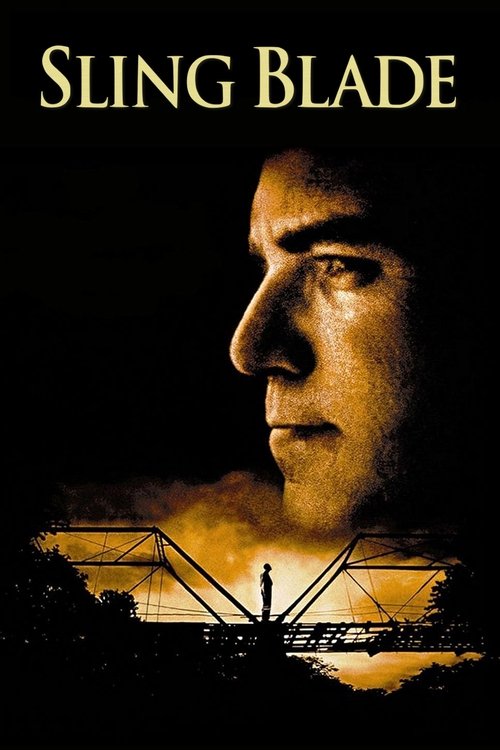
Sling Blade (1996)
Directed by Billy Bob Thornton
No — Sling Blade is not woke, scoring 14 out of 100 on our wokeness meter.
Sling Blade arrives from 1996, a year when a low-budget Southern Gothic could still be sold on the strength of a performance and a haircut.
Consciousness Markers
Vaughan, Linda's gay best friend and boss, is a genuine and sympathetically drawn gay character whose orientation is treated matter-of-factly rather than as a plot device. However, he largely fills the 'sensitive gay confidant' archetype and the film makes no argument about LGBTQ+ identity.
Karl's intellectual disability is the emotional and moral center of the film, portrayed with unusual dignity and interiority for 1996. It is a character study rather than advocacy, and the framing leans on pity and childlike innocence rather than a neurodiversity-conscious perspective.
Linda is a battered woman whose abusive boyfriend is the film's villain, but the narrative resolves her plight through Karl's paternalistic violence rather than any feminist agency. Domestic abuse is depicted, not critiqued as a systemic feminist issue.
The cast is almost entirely white, and the intellectually disabled protagonist is played by an able-bodied actor in a performance that predates any modern casting-conscience conversation. No deliberate representational agenda is present.
The film is a quiet, observational character piece that never turns to the camera to deliver a thesis. Any moralizing is embedded in the story rather than preached.
The film is set in rural Arkansas with an all-white principal cast and engages no racial themes whatsoever.
No environmental or climate content of any kind.
Small-town poverty and a repair-shop setting provide texture but no critique of capitalism or class structures.
No body-positivity themes are present.
The film is a fictional Southern Gothic character drama with no historical revisionism.
Why it received this score
Sling Blade arrives from 1996, a year when a low-budget Southern Gothic could still be sold on the strength of a performance and a haircut. Billy Bob Thornton wrote, directed, and stars as Karl Childers, a developmentally disabled man released from a state hospital after serving time for a childhood killing. The film observes him. That is the entire method. No thesis is announced, no lesson is distributed, and the camera never turns to address us. Thornton's screenplay won an Academy Award, which tells you that quiet craft still had currency in that decade.
Karl's intellectual disability sits at the moral center, handled with an interiority that was uncommon for the period. He is a full person with grievances and appetites, not a symbol, though the script leans on childlike innocence and pity when it needs our sympathy. On the matter of casting, the role went to an able-bodied actor and nobody at the time thought to ask a question. The surrounding ensemble is white and rural. Vaughan, Linda's gay friend and employer, is drawn with genuine warmth and his orientation is treated as unremarkable, an early instance of matter-of-fact inclusion. He still functions as the sensitive confidant who exists to support the straight characters.
Linda's abusive boyfriend Doyle is the villain, and the film resolves her danger through Karl's blade instead of through her own agency. Domestic violence is presented as a fact of the landscape, never as a systemic complaint. There is no racial argument, no environmental concern, no economic critique, no body politics. The poverty of the town is set dressing. This is a character piece, and it knows it. The cultural ledger here is thin, but so is the film's interest in the ledger. It wants to be a parable. It mostly is one.
Analysis generated by our Consciousness Algorithm
Synopsis
Karl Childers, a mentally disabled man, has been in the custody of the state mental hospital since the age of 12 for killing his mother and her lover. Although thoroughly institutionalized, he is deemed fit to be released into the outside world.
Questions about Sling Blade
Is Sling Blade woke?
No — Sling Blade is not woke, scoring 14 out of 100 on our wokeness meter. That earns it a verdict of Ultra Based.
Does Sling Blade have any woke elements?
1 of the 10 markers register at 30 or above, led by LGBTQ+ Themes (32). On LGBTQ+ Themes: Vaughan, Linda's gay best friend and boss, is a genuine and sympathetically drawn gay character whose orientation is treated matter-of-factly rather than as a plot device.
How does Sling Blade compare to other 1996 movies?
It ranks #23 of the 93 films from 1996 we've scored; their average is 11. The wokest is Bound (60).
How is the Woke Score calculated?
An AI-assisted process researches the film and its reception, scores it 0–100 on ten markers, then combines those into one 0–100 Woke Score. It measures a specific set of 2020s cultural themes, not film quality.