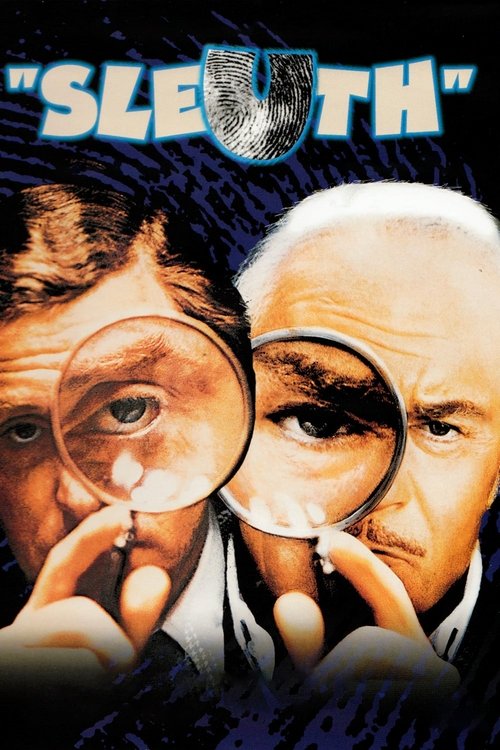
Sleuth (1972)
Directed by Joseph L. Mankiewicz
No — Sleuth is not woke, scoring 4 out of 100 on our wokeness meter.
Joseph L. Mankiewicz's Sleuth arrives from 1972 with the confidence of a drawing-room duel and the social vocabulary of an earlier era.
Consciousness Markers
The script foregrounds class and ethnic prejudice through Andrew's sneering at Milo as the 'un-English' son of an Italian immigrant, but this is a character-driven class conflict rather than modern racial consciousness.
The cast consists of two white British leads (Olivier and Caine); the only diversity-adjacent element is Milo's Italian-immigrant background, which functions as a class/ethnicity plot point rather than modern representation casting.
There is a class-conflict undercurrent between the landed gentleman and the self-made salon owner, but it is deployed as personal humiliation rather than an 'eat the rich' critique.
The film is a twisty game of cat-and-mouse rather than a sermon; any social commentary on class is embedded in dialogue and character rather than delivered as a lecture.
No LGBTQ+ characters, themes, or subtext appear anywhere in the film.
The two women in the story (Marguerite and Téa) are entirely off-screen objects of male rivalry; the film is a masculine battle of wits with no feminist framing.
No environmental or climate themes are present.
No body-positivity themes; the film's one body-adjacent jab is a cruel remark about Andrew's impotence used as a weapon.
No neurodivergence themes or characters are present.
The film is a contemporary (1972) fictional thriller with no historical revisionism.
Why it received this score
Joseph L. Mankiewicz's Sleuth arrives from 1972 with the confidence of a drawing-room duel and the social vocabulary of an earlier era. Laurence Olivier's Andrew Wyke and Michael Caine's Milo Tindle spend the running time circling each other in a country manor stocked with automata, games, and the kind of upper-class contempt that passes for wit. The film's one live cultural wire is class and ethnic friction. Andrew sneers at Milo as the un-English son of an Italian immigrant, a salon owner with money but not breeding. That is character-driven snobbery, not a modern representation project. The cast remains two white British men, and the diversity ledger stays closed.
The women in this arrangement, Marguerite and Téa, are spoken about, fought over, and used as props in a masculine contest. They never become subjects. The film has no interest in feminist reframing, no LGBTQ subtext, no racial consciousness beyond Andrew's periodic nativist jabs. Environmental concerns are absent. Body positivity is absent, unless we count a cruel remark about Andrew's impotence, which is a weapon not a theme. Neurodivergence does not enter the conversation. The film is a fictional thriller from its own moment, so historical revisionism has no purchase. Its anti-capitalist energy is a mild hum: the landed gentleman versus the self-made tradesman, settled through humiliation instead of politics.
The film avoids sermonizing through its commitment to gamesmanship. The screenplay by Anthony Shaffer is twisty, theatrical, and almost entirely uninterested in instructing the audience. Any social observation arrives through dialogue and character, not through a lecture. The result is a sharp, cruel, beautifully performed entertainment that belongs to a different cultural accounting. It has class on the brain and little else on the agenda. For those of us who classify such things, Sleuth is a low-yield vintage: dry, acidic, and best appreciated for its craft, not its conscience.
Analysis generated by our Consciousness Algorithm
Synopsis
A man who loves games and theatre invites his wife's lover to meet, setting up a battle of wits with potentially deadly results.
Questions about Sleuth
Is Sleuth woke?
No — Sleuth is not woke, scoring 4 out of 100 on our wokeness meter. That earns it a verdict of Ultra Based.
Does Sleuth have any woke elements?
Very few. None of the 10 markers reaches 30, the level where a marker counts as present; the highest is Racial Consciousness at 10.
How does Sleuth compare to other 1972 movies?
It ranks #12 of the 24 films from 1972 we've scored; their average is 14. The wokest is Silent Running (69).
How is the Woke Score calculated?
An AI-assisted process researches the film and its reception, scores it 0–100 on ten markers, then combines those into one 0–100 Woke Score. It measures a specific set of 2020s cultural themes, not film quality.