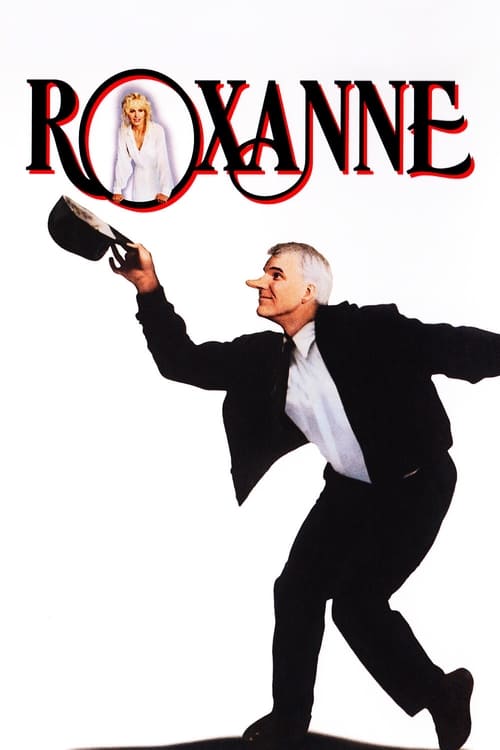
Roxanne (1987)
Directed by Fred Schepisi
No — Roxanne is not woke, scoring 6 out of 100 on our wokeness meter.
Roxanne arrives in 1987 with a prosthetic nose, a small Pacific Northwest town, and a screenplay Steve Martin rewrote roughly twenty-five times.
Consciousness Markers
The plot centers on C.D.'s insecurity about his large nose, and he ultimately wins Roxanne through his words. This is a classic inner-beauty narrative rather than a modern body-positivity statement.
The cast is predominantly white, with Damon Wayans in a minor supporting role. No modern diversity-conscious casting or commentary is present.
There are no LGBTQ+ characters, themes, or subtext in the film.
Roxanne is an astronomy student, but the film does not engage with feminist themes or critique patriarchal structures.
Race is not a thematic concern, and no racial consciousness or commentary appears in the story.
The film includes firefighting scenes but no environmental or climate-crisis messaging.
There is no critique of capitalism, wealth inequality, or economic systems.
No characters are coded or identified as neurodivergent, and the film does not explore neurodiversity.
The film is a contemporary adaptation of a play, not a historical revision or reimagining of real events.
The film is a romantic comedy and does not contain preachy or lecture-like social messaging.
Why it received this score
Roxanne arrives in 1987 with a prosthetic nose, a small Pacific Northwest town, and a screenplay Steve Martin rewrote roughly twenty-five times. The premise is Cyrano de Bergerac relocated to a fire hall, with the poetry replaced by romantic letters and a man who can out-talk anyone in the room. C.D. Bales is athletic, witty, and well-liked. His nose is the single obstacle standing between him and the woman he loves. The film treats this as tragedy, though it plays as comedy.
There is one faint gesture toward the contemporary inner-beauty narrative. C.D. wins Roxanne through his words, and she tells him plainly that it was the letters she fell in love with. This is a centuries-old device, not a modern statement about bodies. The film never interrogates why a large nose should disqualify a man, nor does it extend sympathy to anyone outside its handsome lead. Roxanne's confession that the letters made her feel intelligent and feminine is the closest the screenplay comes to a thesis, and it passes quickly.
Everywhere else the cupboard is bare. Firefighters appear without a whisper of climate anxiety. A bartender, a dimwitted recruit, and a visiting astronomer populate the town without a single line of social commentary. The supporting cast, including a briefly employed Damon Wayans, exists to service the mechanics of the plot and nothing more. There is no economic critique, no racial reckoning, no queer subtext, no neurodivergent coding, no historical revision, and no sermonizing of any kind. What remains is a gentle, well-built romantic comedy that wants only to be liked. It succeeds. The classification is straightforward, and the score sits near the floor.
Analysis generated by our Consciousness Algorithm


Synopsis
In this modern take on Edmond Rostand's classic play "Cyrano de Bergerac," C. D. Bales is the witty, intelligent, and brave fire chief of a small Pacific Northwest town who, due to the size of his enormous nose, declines to pursue the girl of his dreams, lovely Roxanne Kowalski. Instead, when his shy underling Chris McConnell becomes smitten with Roxanne, C.D. feeds the handsome young man the words of love to win her heart.
Questions about Roxanne
Is Roxanne woke?
No — Roxanne is not woke, scoring 6 out of 100 on our wokeness meter. That earns it a verdict of Ultra Based.
Does Roxanne have any woke elements?
Very few. None of the 10 markers reaches 30, the level where a marker counts as present; the highest is Body Positivity at 10.
How does Roxanne compare to other 1987 movies?
It ranks #26 of the 59 films from 1987 we've scored; their average is 8. The wokest is Maurice (68).
How is the Woke Score calculated?
An AI-assisted process researches the film and its reception, scores it 0–100 on ten markers, then combines those into one 0–100 Woke Score. It measures a specific set of 2020s cultural themes, not film quality.