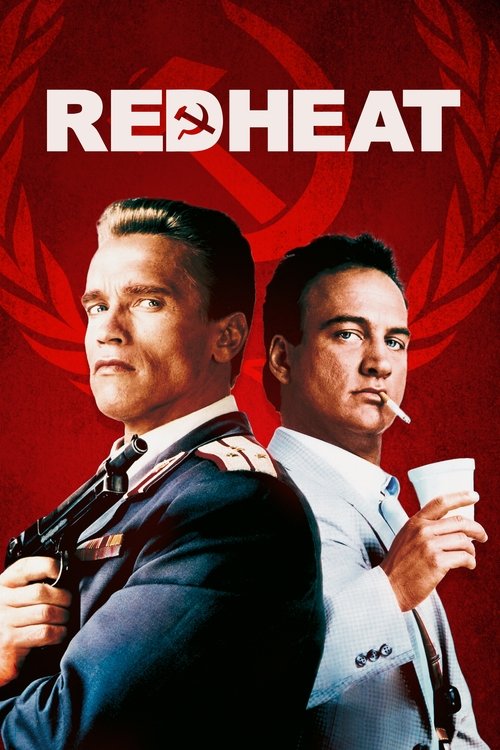
Red Heat (1988)
Directed by Walter Hill
No — Red Heat is not woke, scoring 7 out of 100 on our wokeness meter.
Walter Hill's Red Heat arrives from 1988 with a premise no studio would greenlight today and a tone no committee could reproduce.
Consciousness Markers
The cast includes Laurence Fishburne in a supporting police role and Gina Gershon as a female character, alongside a Georgian villain and Black gang members, but diversity is incidental rather than a stated representational aim.
The film features Black police officers and Black drug dealers, but it does not engage with racial inequality, systemic racism, or racial identity as a theme.
The film ends with a mild line about policemen not being politicians, but it is not built around didactic social or political lecturing.
There are no LGBTQ+ characters, themes, or subtext in the film.
Gina Gershon's character is a dance instructor and wife who is ultimately murdered; the film offers no feminist critique or female-driven agency.
There is no environmental or climate-related content in the film.
The Cold War contrast between a Soviet cop and American police is played for culture-clash comedy, not as an anti-capitalist or eat-the-rich statement.
The naked bathhouse brawl is an action-comedy set piece, not a body-positive or body-acceptance message.
No neurodivergent characters or themes are present.
The film is a contemporary Cold War buddy-cop story, not a historical revision or reimagining of past events.
Why it received this score
Walter Hill's Red Heat arrives from 1988 with a premise no studio would greenlight today and a tone no committee could reproduce. Arnold Schwarzenegger plays Ivan Danko, a Moscow policeman dispatched to Chicago to retrieve a Georgian drug kingpin who murdered his partner. Jim Belushi plays the Chicago detective assigned to mind him. The two men grunt, brawl, and eventually exchange wristwatches. The film opens with a naked bathhouse fight, Budapest standing in for Moscow, which is a set piece about choreography and steam. Nobody in that room is inviting us to reconsider our relationship with our own physiques. They are inviting us to watch a large Austrian throw a man through a wall.
On the matter of casting, the film assembles a supporting roster that includes Laurence Fishburne as a fellow officer and Gina Gershon as the villain's American wife, a dance instructor who is killed with little ceremony. Black gang members operate alongside Black police officers. The antagonist is Georgian. None of this is framed as a statement. The film lets the demographics sit there, unremarked, which is its own kind of period artifact. There is no racial thesis, no feminist counterweight, no environmental conscience, no economic grievance. The Cold War is played for banter. The Soviet and the American dislike each other's methods, then they like each other. That is the entire politics.
The closing exchange offers a single line about policemen not being politicians, a shrug of a sentiment that lands well short of a sermon. Red Heat is a genre machine that reached the top of the domestic box office and then faded, and it lectures no one about anything. It simply lets two large men drive a bus into a train. The classification is straightforward, and the sommelier's notes are brief: oak, gunpowder, and a faint finish of glasnost.
Thematic tags: box_office_number_one.
Analysis generated by our Consciousness Algorithm


Synopsis
A tough Russian policeman is forced to partner up with a cocky Chicago police detective when he is sent to Chicago to apprehend a Georgian drug lord who killed his partner and fled the country.
Questions about Red Heat
Is Red Heat woke?
No — Red Heat is not woke, scoring 7 out of 100 on our wokeness meter. That earns it a verdict of Ultra Based.
Does Red Heat have any woke elements?
Very few. None of the 10 markers reaches 30, the level where a marker counts as present; the highest is Representation Casting at 25.
How does Red Heat compare to other 1988 movies?
It ranks #35 of the 73 films from 1988 we've scored; their average is 10. The wokest is Stand and Deliver (58).
How is the Woke Score calculated?
An AI-assisted process researches the film and its reception, scores it 0–100 on ten markers, then combines those into one 0–100 Woke Score. It measures a specific set of 2020s cultural themes, not film quality.