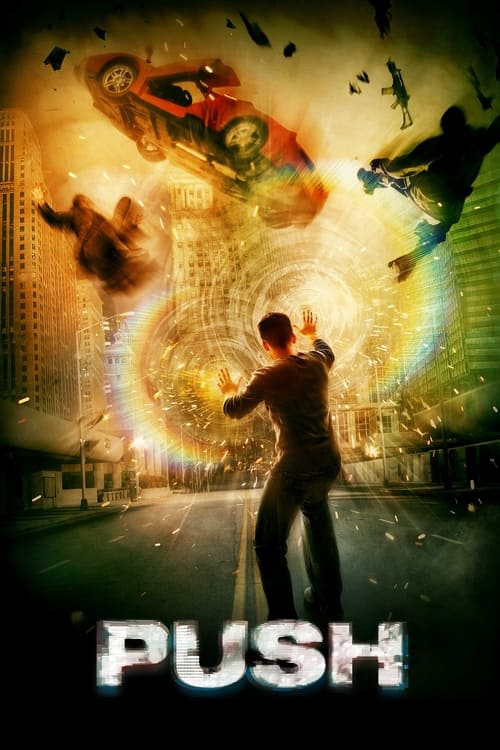
Push (2009)
Directed by Paul McGuigan
No — Push is not woke, scoring 11 out of 100 on our wokeness meter.
Push arrives from 2009, a year in which a studio could still release a hyperkinetic science fiction thriller set in Hong Kong's psychic underworld and expect nobody to ask what it all meant.
Consciousness Markers
The Hong Kong setting supplies a genuinely polyglot ensemble — Djimon Hounsou, Ming-Na Wen, Cliff Curtis, Li Xiaolu and a largely Asian supporting cast — but this is genre-standard globe-trotting casting, never framed as a statement or commented upon.
Cassie is a capable teen Watcher and Kira is a high-level Pusher with her own escape arc, but the climax still belongs to Chris Evans punching a Russian, and no gender politics are articulated.
A multiracial cast inhabits Hong Kong's psychic underworld naturally, with zero racial commentary, critique, or thematic weight attached.
The antagonist is a covert government agency running super-soldier experiments, not a corporation; capitalism is never the target.
A hyperkinetic 2009 genre picture that explains its rules through expository dialogue about Movers, Pushers and Sniffers rather than moral instruction; it has no interest in telling the audience how to think.
No LGBTQ+ characters, subtext, or themes anywhere in the plot or cast.
No environmental themes, imagery, or messaging.
No body-image, size-diversity, or self-acceptance themes.
Psychic powers and memory erasure are treated as genre mechanics, not as neurodivergence or mental-health representation.
Entirely fictional Cold War-era Division mythology; no historical revisionism of any kind.
Why it received this score
Push arrives from 2009, a year in which a studio could still release a hyperkinetic science fiction thriller set in Hong Kong's psychic underworld and expect nobody to ask what it all meant. Paul McGuigan's film assembles a taxonomy of the gifted: Movers, Pushers, Watchers, Sniffers, Bleeders, Stitchers, Wipers, Shadows. Each gets a name, a demonstration, and a line of dialogue explaining it. The plot concerns a covert government agency, a stolen syringe, and a missing girl, and it moves through all three with the breathless indifference of a production that has read the manual and skipped the thesis.
The cultural ledger here is thin and mostly incidental. The cast is genuinely polyglot, with Djimon Hounsou, Ming-Na Wen, Cliff Curtis and Li Xiaolu populating the margins, though the film never pauses to remark on it. Dakota Fanning's Cassie is a capable thirteen-year-old Watcher with a deadpan delivery and a plan of her own, and Camilla Belle's Kira escapes a government facility through her own wits. Neither development is framed as an argument about anything. The villain is a secret agency running super-soldier experiments, which places the film's suspicion on state power, not on capital. The climax, meanwhile, belongs to Chris Evans and a man named Victor, as the genre demanded in that decade.
What the film does not do is instruct. There is no sermon, no moral appendix, no scene in which a character explains to the audience how they ought to feel. It explains the rules of telekinesis and then lets them collide. This is not restraint in any conscious sense. It is simply an older commercial grammar, and the picture wears it without embarrassment. We are left with a brisk, handsome, largely incoherent entertainment that asks nothing of us but attention, and does not always earn that either.
Analysis generated by our Consciousness Algorithm


Synopsis
After his father, an assassin, is brutally murdered, Nick Gant vows revenge on Division, the covert government agency that dabbles in psychic warfare and experimental drugs. Hiding in Hong Kong's underworld, Nick assembles a band of rogue psychics dedicated to destroying Division. Together with Cassie, a teenage clairvoyant, Nick goes in search of a missing girl and a stolen suitcase that could be the key to accomplishing their mutual goal.
Questions about Push
Is Push woke?
No — Push is not woke, scoring 11 out of 100 on our wokeness meter. That earns it a verdict of Ultra Based.
Does Push have any woke elements?
1 of the 10 markers register at 30 or above, led by Representation Casting (42). On Representation Casting: The Hong Kong setting supplies a genuinely polyglot ensemble — Djimon Hounsou, Ming-Na Wen, Cliff Curtis, Li Xiaolu and a largely Asian supporting cast — but this is genre-standard globe-trotting casting, never framed as a statement or commented upon.
How does Push compare to other 2009 movies?
It ranks #94 of the 230 films from 2009 we've scored; their average is 14. The wokest is Home (79).
How is the Woke Score calculated?
An AI-assisted process researches the film and its reception, scores it 0–100 on ten markers, then combines those into one 0–100 Woke Score. It measures a specific set of 2020s cultural themes, not film quality.