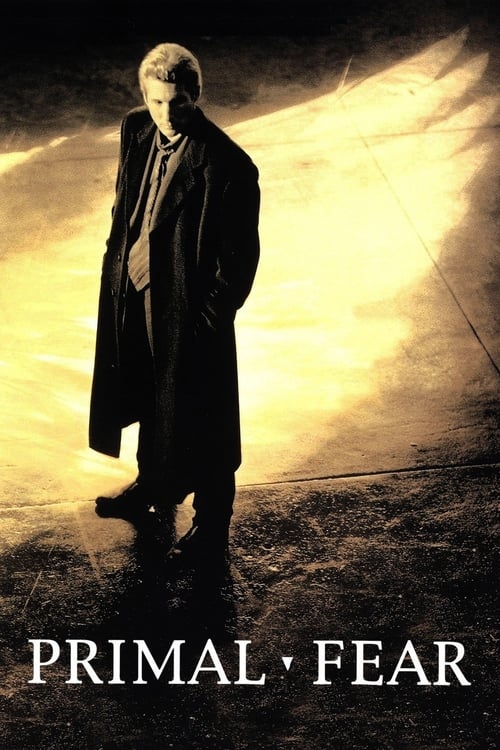
Primal Fear (1996)
Directed by Gregory Hoblit
No — Primal Fear is not woke, scoring 13 out of 100 on our wokeness meter.
It is 1996, and the legal thriller has settled into comfortable upholstery.
Consciousness Markers
Features Black actors Alfre Woodard as a judge and Andre Braugher as an investigator, plus Cuban-American Steven Bauer, but these are supporting roles presented without commentary on identity.
Laura Linney's prosecutor and Frances McDormand's neuropsychologist are competent professionals, but the film remains a male-driven legal thriller with no feminist critique.
Critiques institutional corruption and a $60 million real estate deal involving the Church and civic leaders, but this is a plot mechanism rather than an anti-capitalist thesis.
The courtroom drama exposes Church abuse and corruption, but it prioritizes suspense and character over didactic social messaging.
The film's sexual abuse subplot involves altar boys but frames it as predation and corruption, not LGBTQ+ identity or themes.
No engagement with racial politics or systemic racism; minority characters are present but race is not a theme.
No environmental or climate-related content.
No body positivity themes or commentary on body image.
Dissociative identity disorder is central to the plot, but it is ultimately revealed as a manipulation and portrayed as villainous, not as neurodivergent advocacy.
Based on a fictional novel, with no revisionist historical narrative.
Why it received this score
It is 1996, and the legal thriller has settled into comfortable upholstery. Primal Fear gives us Richard Gere as a defense attorney who works for money and the magazine profile, Edward Norton as the stuttering altar boy he defends for free, and a Chicago archbishop who turns up butchered in his own bedroom. The film moves with the confidence of a machine that knows its gears. Alfre Woodard sits on the bench, Andre Braugher works the investigation, Steven Bauer appears in the margins. Nobody remarks on any of this. The picture simply casts capable actors and lets them do the job, which is either an older Hollywood habit or an absence of interest. Laura Linney prosecutes with real steel, Frances McDormand interviews the defendant with professional calm, and still the camera keeps drifting back to the men arguing in corridors.
The plot eventually uncovers what the archbishop was doing in the rectory, and what he was doing with the land. A sixty million dollar development deal collapsed because he refused to sell, so civic leaders with bruised portfolios get folded into the mystery. This is corruption as mechanism, not as thesis. The videotape in the closet is predation and institutional rot, filmed as horror, never as identity. And the dissociative condition at the center of the case turns out to be a performance, a mask worn by a killer who brags about it in the final minutes. Any film that treats the diagnosis as a con cannot be said to advocate for anything.
What remains is a well-oiled thriller that prefers suspense to sermon. Its social awareness extends about as far as noticing that a church can be a corporation and a bishop can be a predator, which is a plot twist, not a position. The courtroom scenes expose a cover-up and then move on. Norton's performance is the reason to watch, and the reason the film endures. Everything else is furniture: handsome, period-appropriate, and quietly indifferent to the cultural conversation that had not yet arrived.
Analysis generated by our Consciousness Algorithm
Part of


Synopsis
Defense attorney Martin Vail takes on jobs for money and prestige rather than any sense of the greater good. His latest case involves an altar boy, accused of brutally murdering the archbishop of Chicago. Vail finds himself up against his ex-pupil and ex-lover, but as the case progresses and the Church's dark secrets are revealed, Vail finds that what appeared a simple case takes on a darker, more dangerous aspect.
Questions about Primal Fear
Is Primal Fear woke?
No — Primal Fear is not woke, scoring 13 out of 100 on our wokeness meter. That earns it a verdict of Ultra Based.
Does Primal Fear have any woke elements?
1 of the 10 markers register at 30 or above, led by Representation Casting (30). On Representation Casting: Features Black actors Alfre Woodard as a judge and Andre Braugher as an investigator, plus Cuban-American Steven Bauer, but these are supporting roles presented without commentary on identity.
How does Primal Fear compare to other 1996 movies?
It ranks #26 of the 93 films from 1996 we've scored; their average is 11. The wokest is Bound (60).
How is the Woke Score calculated?
An AI-assisted process researches the film and its reception, scores it 0–100 on ten markers, then combines those into one 0–100 Woke Score. It measures a specific set of 2020s cultural themes, not film quality.