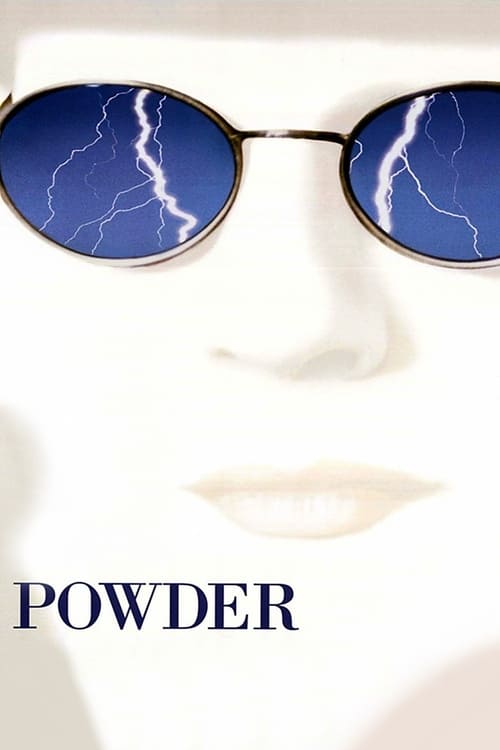
Powder (1995)
Directed by Victor Salva
No — Powder is not woke, scoring 9 out of 100 on our wokeness meter.
Powder arrives from 1995, a year in which a pale young man with a record IQ and an electromagnetic aura could still be sold as a Christ figure without anyone in the room flinching.
Consciousness Markers
The film is steeped in a heavy-handed Christ allegory, complete with a lightning-borne messiah, healing touch, and monologues about how all people are secretly connected; critics called it 'intensely self-important.'
The protagonist is an albino outcast, a form of appearance-based minority representation, though played by a non-albino actor and framed as a supernatural 'freak' rather than a community. The largely white cast offers little else.
The story hinges on a character ostracized for his pale, hairless body, and gestures toward inner worth over appearance, but it treats his difference as a supernatural affliction rather than a body-acceptance message.
Mary Steenburgen's Jessie Caldwell is a competent professional psychologist, but the film advances no feminist thesis and her role is largely caretaker to the male protagonist.
The hunting-trip sequence in which Jeremy feels the dying doe's pain carries a faint animal-welfare and nature-empathy note, but it is not a climate or environmentalist crusade.
The family farm falls into bank probate and is stripped of its possessions, a minor anti-institutional beat, but the film has no economic critique or eat-the-rich posture.
Jeremy is depicted as a record-IQ genius and social misfit, but the film frames this as supernatural giftedness rather than neurodivergence in any contemporary sense.
A male student accuses Jeremy of homosexuality after catching him staring, but this is deployed purely as a homophobic taunt and humiliation device, not as positive or affirming LGBTQ+ content.
The film engages no racial themes whatsoever; its concerns are metaphysical and small-town rather than about race or systemic inequality.
The film is a work of original fantasy with no historical claims to revise.
Why it received this score
Powder arrives from 1995, a year in which a pale young man with a record IQ and an electromagnetic aura could still be sold as a Christ figure without anyone in the room flinching. Victor Salva's film concerns Jeremy Reed, an albino teenager raised in a basement, whose gifts include telepathy, healing, and the ability to make light fixtures misbehave whenever his feelings get the better of him. The film regards him with the reverence normally reserved for stained glass. It is, by any measure, a solemn piece of work.
The social consciousness on display is thin and mostly incidental. Jeremy's albinism functions as a supernatural affliction instead of a lived identity, and the camera treats his body as a spectacle to be pitied. A brief homophobic taunt from a classmate is deployed as a humiliation device, not as anything resembling affirming content. Mary Steenburgen's psychologist is competent and professional, yet she exists to shepherd the male protagonist toward his transcendence. Race goes unmentioned entirely. There is a dying doe, and a family farm lost to bank probate, and these gestures toward animal empathy and institutional indifference amount to little more than set dressing.
Where the film does exert pressure is in its sermonizing. The lightning-borne messiah heals the sick, revives the dead, and delivers monologues about how every person is secretly connected to everything that exists. Critics at the time found it self-important, and they were correct. The whole enterprise strains for uplift with the grim determination of a man assembling furniture without instructions. It is earnest, humorless, and convinced of its own profundity, which makes it its own kind of period piece.
Analysis generated by our Consciousness Algorithm


Synopsis
Harassed by classmates who won't accept his shocking appearance, a shy young man known as "Powder" struggles to fit in. But the cruel taunts stop when Powder displays a mysterious power that allows him to do incredible things. This phenomenon changes the lives of all those around him in ways they never could have imagined.
Questions about Powder
Is Powder woke?
No — Powder is not woke, scoring 9 out of 100 on our wokeness meter. That earns it a verdict of Ultra Based.
Does Powder have any woke elements?
1 of the 10 markers register at 30 or above, led by Lecture Energy (35). On Lecture Energy: The film is steeped in a heavy-handed Christ allegory, complete with a lightning-borne messiah, healing touch, and monologues about how all people are secretly connected; critics called it 'intensely self-important.'
How does Powder compare to other 1995 movies?
It ranks #44 of the 108 films from 1995 we've scored; their average is 12. The wokest is Total Eclipse (60).
How is the Woke Score calculated?
An AI-assisted process researches the film and its reception, scores it 0–100 on ten markers, then combines those into one 0–100 Woke Score. It measures a specific set of 2020s cultural themes, not film quality.