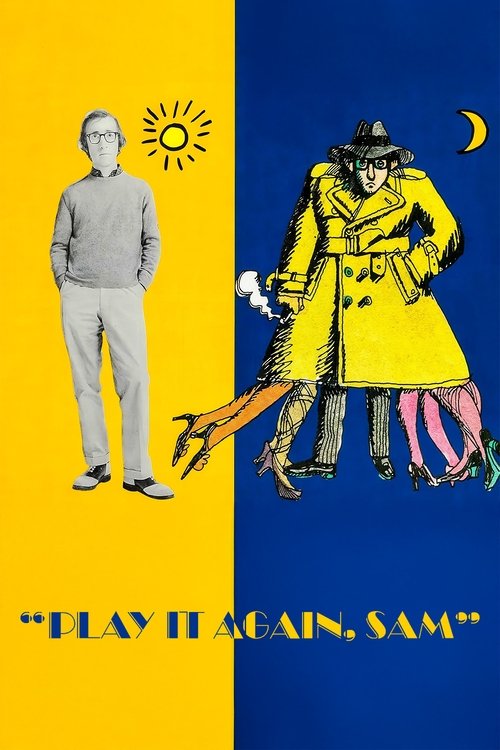
Play It Again, Sam (1972)
Directed by Herbert Ross
No — Play It Again, Sam is not woke, scoring 2 out of 100 on our wokeness meter.
Play It Again, Sam arrives from 1972 with the confidence of a Broadway hit and the anxieties of a man who has been left by his wife.
Consciousness Markers
The premise revolves around a man receiving Bogart's ghostly advice on 'how to treat women,' a thoroughly male-gaze framing. Linda is largely a romantic object, though she is given some agency in the Casablanca-style ending.
The cast is uniformly white, and the film predates any conscious effort at diverse or inclusive casting. No representation markers present.
No LGBTQ+ characters, themes, or subtext appear anywhere in the film.
No engagement with race, racial identity, or racial politics whatsoever.
No environmental or climate themes present.
No critique of wealth, capitalism, or class structures. Dick is a real-estate businessman played without satirical edge.
No body-positivity themes; the film's humor about sexual inadequacy runs in the opposite direction.
Allan's 'neurotic' persona is a comedic trope of self-deprecation, not a modern neurodivergence-affirming portrayal.
No historical revisionism; the film merely homages Casablanca rather than reinterpreting history.
A light romantic comedy with no didactic or preachy messaging.
Why it received this score
Play It Again, Sam arrives from 1972 with the confidence of a Broadway hit and the anxieties of a man who has been left by his wife. Allan Felix, film critic, sits in a cinema watching Casablanca and concludes he will never be Humphrey Bogart. There follows a series of blind dates, each a small catastrophe, punctuated by the ghost of Bogart in a trenchcoat offering romantic instruction. Woody Allen wrote the thing and stars in it; Herbert Ross directs. The film is funny, though that is not the matter before us. The matter before us is classification.
The social consciousness on display is minimal and mostly accidental. The cast is white from top to bottom, with no comment made and none required, since the film has no interest in the question. There is no engagement with race, no environmental concern, no critique of the real-estate business that employs Dick Christie, and no affirmation of bodily variety. The neurotic persona at the center is a vaudeville inheritance, self-deprecating in a way that modern sensibilities would treat quite differently. The one area where any progressive reading might be attempted is gender. Allan's entire project is learning how to treat women, which places the female characters at a certain distance, as objects of technique. Linda, played by Diane Keaton, does get a moment of choice in the fog-drenched finale, and she takes it. That earns a small entry in the ledger.
The film homages Casablanca without reinterpreting a single frame of history, and it lectures no one about anything. It wants to be a romantic comedy and it succeeds. For the purposes of the present exercise, it is a period piece in more ways than one, and the period is not ours.
Analysis generated by our Consciousness Algorithm
Part of


Synopsis
A neurotic film critic obsessed with the movie Casablanca attempts to get over his wife leaving him by dating again with the help of a married couple and his illusory idol, Humphrey Bogart.
Questions about Play It Again, Sam
Is Play It Again, Sam woke?
No — Play It Again, Sam is not woke, scoring 2 out of 100 on our wokeness meter. That earns it a verdict of Ultra Based.
Does Play It Again, Sam have any woke elements?
Very few. None of the 10 markers reaches 30, the level where a marker counts as present; the highest is Feminist Agenda at 3.
How does Play It Again, Sam compare to other 1972 movies?
It ranks #18 of the 24 films from 1972 we've scored; their average is 14. The wokest is Silent Running (69).
How is the Woke Score calculated?
An AI-assisted process researches the film and its reception, scores it 0–100 on ten markers, then combines those into one 0–100 Woke Score. It measures a specific set of 2020s cultural themes, not film quality.