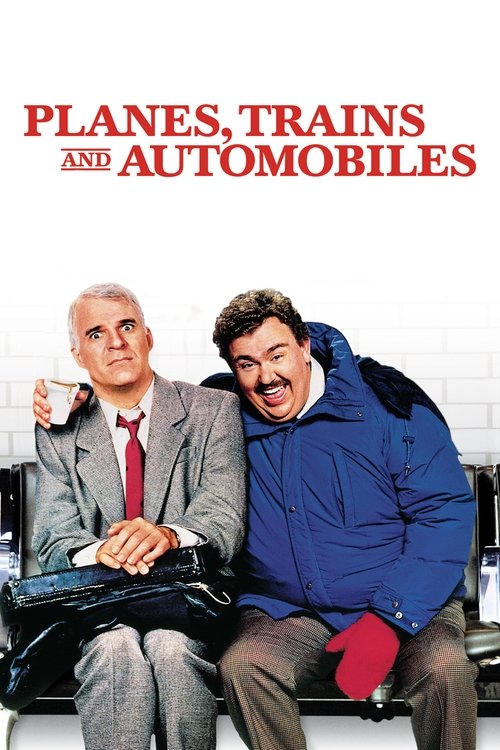
Planes, Trains and Automobiles (1987)
Directed by John Hughes
No — Planes, Trains and Automobiles is not woke, scoring 0 out of 100 on our wokeness meter.
Two men spend ninety minutes failing to get from New York to Chicago, and the film has no interest in anything else.
Consciousness Markers
The cast is almost entirely white, with the only notable non-white presence being a brief uncredited shuttle driver; no meaningful representation casting effort is present.
There are no LGBTQ+ characters, themes, or subtext anywhere in the film.
Women appear only as wives, mothers, and a rental agent; the film is a two-hander about men and makes no feminist argument.
Race is never addressed or thematized; the film operates in a uniformly white milieu without comment.
The blizzard is a pure plot device to strand the travelers, carrying no environmental message whatsoever.
The protagonists are an ad executive and a salesman; the film is affectionate toward commerce and offers no eat-the-rich critique.
Del's self-acceptance speech concerns his personality, not his body, and the film makes no body-positivity argument.
No neurodivergent characters or themes are present; Del's chattiness is framed as personality, not condition.
The film is a contemporary fictional comedy with no historical subject matter to revise.
The film's sentiment arrives through character and slapstick rather than any preachy messaging or moralizing.
Why it received this score
Two men spend ninety minutes failing to get from New York to Chicago, and the film has no interest in anything else. Neal Page sells advertising, Del Griffith sells shower curtain rings, and the snow that strands them exists to strand them. John Hughes built his comedy on a blizzard, a stolen cab, a shared motel bed, and a credit card mix-up, and he never once stops to explain what any of it means. The result is a road movie that trusts its two performers to carry the emotional weight without assistance from a thesis.
Consider what the film declines to do. Del's speech about liking himself concerns his chattiness and his trunk, not his body, and the film treats his loneliness as biography instead of diagnosis. The women in the cast are wives, mothers, and one memorably beleaguered rental agent. Race never enters the frame. The corporate world of expense accounts and first class seats is presented with affection, not indictment. When the state trooper impounds the burnt car, the joke is about paperwork. When Del drives the wrong way down a freeway, the joke is about terror. Nobody learns a lesson about society.
The final act reveals that Del has been living on the road since his wife died eight years earlier, and the film earns that revelation through accumulated exhaustion instead of sermonizing. Neal brings him home for Thanksgiving. That is the whole argument. A tidy, generous, uncomplicated specimen of 1980s studio comedy, and a useful control group for anyone cataloguing the era.
Analysis generated by our Consciousness Algorithm
Part of


Synopsis
An irritable marketing executive, Neal Page, is heading home to Chicago for Thanksgiving when a number of delays force him to travel with a well meaning but overbearing shower curtain ring salesman, Del Griffith.
Questions about Planes, Trains and Automobiles
Is Planes, Trains and Automobiles woke?
No — Planes, Trains and Automobiles is not woke, scoring 0 out of 100 on our wokeness meter. That earns it a verdict of Ultra Based.
Does Planes, Trains and Automobiles have any woke elements?
No. All 10 markers score zero.
How does Planes, Trains and Automobiles compare to other 1987 movies?
It ranks #50 of the 59 films from 1987 we've scored; their average is 8. The wokest is Maurice (68).
How is the Woke Score calculated?
An AI-assisted process researches the film and its reception, scores it 0–100 on ten markers, then combines those into one 0–100 Woke Score. It measures a specific set of 2020s cultural themes, not film quality.