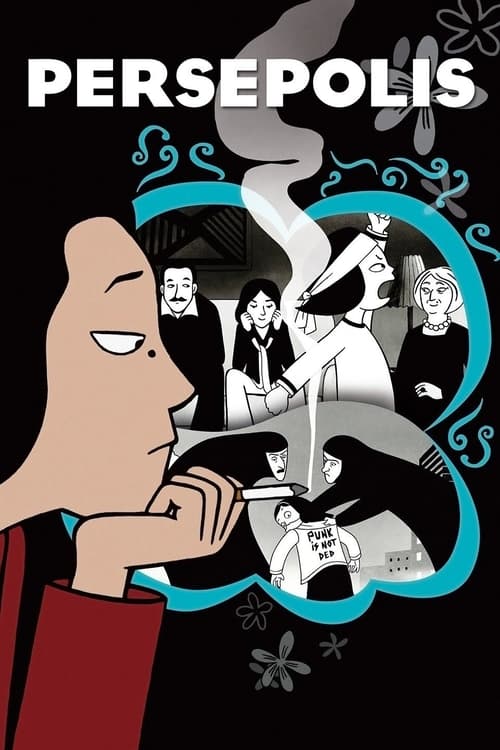
Persepolis (2007)
Directed by Marjane Satrapi
No — Persepolis is not especially woke, scoring 29 out of 100 on our wokeness meter.
Persepolis (2007) is an animated memoir of Marjane Satrapi's girlhood in Iran during revolution, war, exile, and return.
Consciousness Markers
Strong feminist undercurrents: critiques forced hijab, sexist double standards, and patriarchal repression, with a woman director and female coming-of-age perspective.
Centers on an Iranian female protagonist and Middle Eastern experience, but the voice cast is largely European and the film predates modern diversity-casting initiatives.
Explores Iranian identity, exile, and Western prejudice, but not through the lens of modern racial-justice consciousness.
Political and personal themes are present but delivered through memoir and character, not preachy didacticism.
No LGBTQ+ characters or themes are present in the narrative.
No environmental or climate-related themes.
Critiques authoritarianism and fundamentalism, not capitalism or economic inequality in a modern woke sense.
No body-positivity themes or messaging.
No neurodivergence representation or themes.
A personal memoir offering a dissident view of Iranian history, but not a revisionist historical narrative in the modern cultural sense.
Why it received this score
Persepolis (2007) is an animated memoir of Marjane Satrapi's girlhood in Iran during revolution, war, exile, and return. It is a serious, hand-drawn work, and it has been justly praised. Our task, however, is classification. The film centers an Iranian girl and woman, which gives it some representational weight. The voice cast is largely European, with Chiara Mastroianni, Catherine Deneuve, and Danielle Darrieux, so modern diversity casting is not its project. It predates that vocabulary. The result is partial representation, not a landmark of it.
Feminist currents are strong. The film critiques forced hijab, sexist double standards, the morality police, and a university forum that polices women's bodies. A woman co-director and a female coming-of-age perspective are central. That earns real credit. Racial consciousness is present through Iranian identity, exile, and Western prejudice, including Marjane's lie that she is French. But this is personal memoir, not a modern racial-justice tract. There are no LGBTQ themes. No climate crusade. No eat-the-rich angle. Its villains are authoritarian clerics and fundamentalists, not capitalism. No body positivity. No neurodivergence.
Lecture energy is mild. The politics arrive through memory, humor, punk rock, and family argument, not a sermon. The film can be preachy about freedom and integrity, but it earns that through character. Revisionist history? It offers a dissident view of Iranian history from an exile. That is not the modern cultural meaning of revisionist history. So it sits at zero there. The final product is a landmark of adult animation and a humane memoir. As a vessel for contemporary progressive checklist items, it is mostly a document from 2007. It has feminist and identity currents, but it predates the modern vocabulary that would later be applied to it. The Academy nominated it. The Iranian government objected. Both reactions make sense. We file it under serious cinema, not social crusade.
Analysis generated by our Consciousness Algorithm
Part of


Synopsis
In 1970s Iran, Marjane 'Marji' Satrapi watches events through her young eyes and her idealistic family of a long dream being fulfilled of the hated Shah's defeat in the Iranian Revolution of 1979. However as Marji grows up, she witnesses first hand how the new Iran, now ruled by Islamic fundamentalists, has become a repressive tyranny on its own.
Questions about Persepolis
Is Persepolis woke?
No — Persepolis is not especially woke, scoring 29 out of 100 on our wokeness meter. That earns it a verdict of Based.
Does Persepolis have any woke elements?
3 of the 10 markers register at 30 or above, led by Feminist Agenda (65), Representation Casting (35) and Racial Consciousness (30). On Feminist Agenda: Strong feminist undercurrents: critiques forced hijab, sexist double standards, and patriarchal repression, with a woman director and female coming-of-age perspective.
How does Persepolis compare to other 2007 movies?
It ranks #15 of the 201 films from 2007 we've scored; their average is 12. The wokest is Like Stars on Earth (92).
How is the Woke Score calculated?
An AI-assisted process researches the film and its reception, scores it 0–100 on ten markers, then combines those into one 0–100 Woke Score. It measures a specific set of 2020s cultural themes, not film quality.