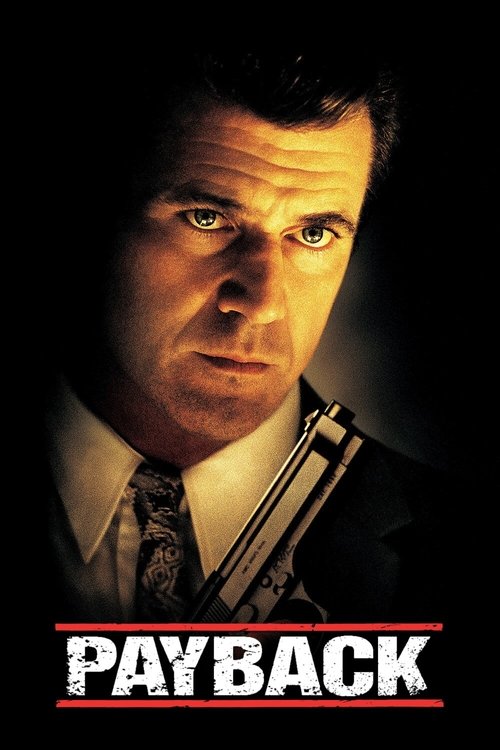
Payback (1999)
Directed by Brian Helgeland
No — Payback is not woke, scoring 6 out of 100 on our wokeness meter.
Payback arrives from 1999 with a tagline that announces its intentions and never apologizes for them: get ready to root for the bad guy.
Consciousness Markers
The cast is overwhelmingly white, with Bill Duke and Lucy Liu appearing in supporting roles that exist naturally within the crime narrative and carry no commentary. This is standard ensemble casting for a 1999 studio thriller, not a deliberate diversity statement.
Rosie is given a measure of interiority and a bittersweet romantic thread, but the film is a macho revenge fantasy in which women are largely escorts, addicts, or dominatrices. There is no feminist argument being advanced.
Greed and money drive the plot, but the film treats them as the mechanics of a criminal underworld rather than as a critique of capitalism. There is no eat-the-rich thesis here.
Chinese Triad gangsters and a Black detective appear as stock genre figures with no engagement with race as a subject. The film has no racial consciousness to speak of.
Payback is a lean, cynical revenge thriller that never pauses to moralize or instruct the audience. Its tagline, 'Get Ready to Root for the Bad Guy,' is the opposite of a lecture.
There are no LGBTQ+ characters, relationships, or themes anywhere in the film. The dominatrix subplot and the Porter/Rosie dynamic are entirely heterosexual.
Environmental concerns are entirely absent from this urban crime thriller.
No body-positivity themes or messaging of any kind appear in the film.
No neurodivergent characters or themes are present.
The film is a contemporary crime story with no historical subject matter to revise.
Why it received this score
Payback arrives from 1999 with a tagline that announces its intentions and never apologizes for them: get ready to root for the bad guy. Porter, played by Mel Gibson with a flat affect and a scarred jaw, wants his seventy thousand dollars. That is the entire thesis. His wife shot him, his partner left him for dead, and the syndicate that swallowed the money has no plan to give it back, so he climbs the org chart with a pistol and a willingness to be beaten senseless along the way. The film, adapted from Donald Westlake's The Hunter, has no interest in teaching us anything, which places it in a category of entertainment that has largely gone extinct.
The cast is white by default, the way studio ensembles of the era were, with Bill Duke and Lucy Liu filling detective and Triad-adjacent slots the plot requires and the script never comments upon. Maria Bello's Rosie gets the closest thing to an inner life, a bittersweet thread about a man who drove her to an appointment after sleeping with her, but she remains a fixture in a macho fantasy where women are escorts, addicts, or dominatrices. Race exists as geography, not as subject. Money drives everything and means nothing beyond the next double cross, which is an inventory of capital instead of a critique of it. Nobody in this film is neurodivergent, nobody is thinking about the climate, and nobody is on a journey of body acceptance.
There is no sermon here, no moment where the picture stops to instruct its audience on how to feel about the bodies on the pavement, and that restraint earns a grudging nod. It is a lean, ugly, efficient machine, and it knows exactly what it is. The sommelier's note: a blunt instrument, served at room temperature, with a finish of gasoline and regret. Nothing in the glass is trying to improve us, and after two hours of it, we are inclined to be grateful.
This is a 1999 film, and it behaves like one: cynical, propulsive, and entirely uninterested in the moral curriculum of a later decade. Its pleasures are narrow and its politics are nonexistent. There is something almost restful in that. We grade it accordingly, with the sober appreciation of a man tasting a wine that was never meant to be paired with anything at all.
Analysis generated by our Consciousness Algorithm


Synopsis
With friends like these, who needs enemies? That's the question bad guy Porter is left asking after his wife and partner steal his heist money and leave him for dead -- or so they think. Five months and an endless reservoir of bitterness later, Porter's partners and the crooked cops on his tail learn how bad payback can be.
Questions about Payback
Is Payback woke?
No — Payback is not woke, scoring 6 out of 100 on our wokeness meter. That earns it a verdict of Ultra Based.
Does Payback have any woke elements?
Very few. None of the 10 markers reaches 30, the level where a marker counts as present; the highest is Representation Casting at 18.
How does Payback compare to other 1999 movies?
It ranks #72 of the 103 films from 1999 we've scored; their average is 14. The wokest is Boys Don't Cry (60).
How is the Woke Score calculated?
An AI-assisted process researches the film and its reception, scores it 0–100 on ten markers, then combines those into one 0–100 Woke Score. It measures a specific set of 2020s cultural themes, not film quality.