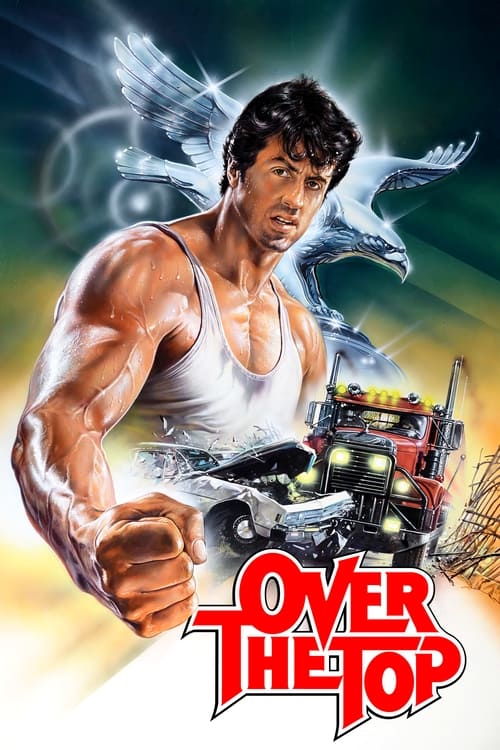
Over the Top (1987)
Directed by Menahem Golan
No — Over the Top is not woke, scoring 7 out of 100 on our wokeness meter.
Over the Top arrives from the Cannon Group in 1987, which is to say it arrives with the sound of synthesizers and the smell of a rental cassette.
Consciousness Markers
The villainous father-in-law Cutler is a wealthy, ruthless industrialist who drove the family apart, giving a faint working-class-vs-rich-man undercurrent, but it is a stock 1980s melodrama trope rather than an 'eat the rich' thesis.
The cast is uniformly white, led by Stallone and a supporting roster of Caucasian actors; no meaningful representation casting is present.
No LGBTQ+ characters, themes, or subtext appear anywhere in this arm-wrestling father-son drama.
The lone female character of note, Christina, dies early to motivate the male leads; the film is a father-son redemption story with no feminist framing.
No engagement with race or racial consciousness whatsoever; the film is entirely a white working-class melodrama.
No environmental or climate themes are present.
The film celebrates hyper-masculine muscular arm-wrestling physiques; no body positivity messaging exists.
No neurodivergent characters or themes are depicted.
A wholly fictional story with no historical revisionism.
The film is a cheesy, song-driven 1980s sports melodrama that preaches nothing; it aims to entertain, not lecture.
Why it received this score
Over the Top arrives from the Cannon Group in 1987, which is to say it arrives with the sound of synthesizers and the smell of a rental cassette. Sylvester Stallone plays Lincoln Hawk, a truck driver who arm-wrestles for gas money and hopes to reclaim the son he abandoned, a boy currently being raised by a wealthy grandfather who owns a mansion and a grudge. The plot moves from a military academy to a hospital deathbed to a Las Vegas tournament floor, pausing only for a Kenny Loggins ballad. It is a film of enormous sincerity and very little shame.
Assessed against the modern cultural ledger, the picture offers almost nothing to discuss. The cast is uniformly white, the women exist to die or to be mourned, and the emotional architecture rests entirely on a father and son learning to grunt at each other with feeling. The arm-wrestling sequences celebrate a very specific physique, the sort built in a garage with a bench press and a cassette of motivational rock, and no countervailing message about body acceptance intrudes. There is a single thematic thread here: the villain, Cutler, is a rich industrialist who intercepted Hawk's letters and sabotaged a marriage, which gives the film a faint whiff of class resentment. It is a stock melodrama device, inherited from a hundred pictures about a poor man and a powerful father-in-law, and it never hardens into an argument about wealth itself.
The film preaches nothing. It wants to sell soundtrack albums and tickets, and it does so with a straight face and a montage. The result is a relic of a moment when a studio would finance a movie about competitive arm-wrestling on the strength of one star's biceps, and audiences would shrug and hand it a B+. We classify it accordingly: a curiosity, harmless, and entirely uninterested in instructing anyone about anything.
Analysis generated by our Consciousness Algorithm
Part of


Synopsis
Lincoln Hawk a hard-luck big-rig trucker takes us under the glaring Las Vegas lights for all the boisterous action of the World Armwrestling Championship. Relying on wits and willpower, Hawk tries to rebuild his life by capturing the first-place prize money, and the love of the son he abandoned years earlier into the keeping of his rich, ruthless father-in-law.
Questions about Over the Top
Is Over the Top woke?
No — Over the Top is not woke, scoring 7 out of 100 on our wokeness meter. That earns it a verdict of Ultra Based.
Does Over the Top have any woke elements?
Very few. None of the 10 markers reaches 30, the level where a marker counts as present; the highest is Eat the Rich at 12.
How does Over the Top compare to other 1987 movies?
It ranks #23 of the 59 films from 1987 we've scored; their average is 8. The wokest is Maurice (68).
How is the Woke Score calculated?
An AI-assisted process researches the film and its reception, scores it 0–100 on ten markers, then combines those into one 0–100 Woke Score. It measures a specific set of 2020s cultural themes, not film quality.