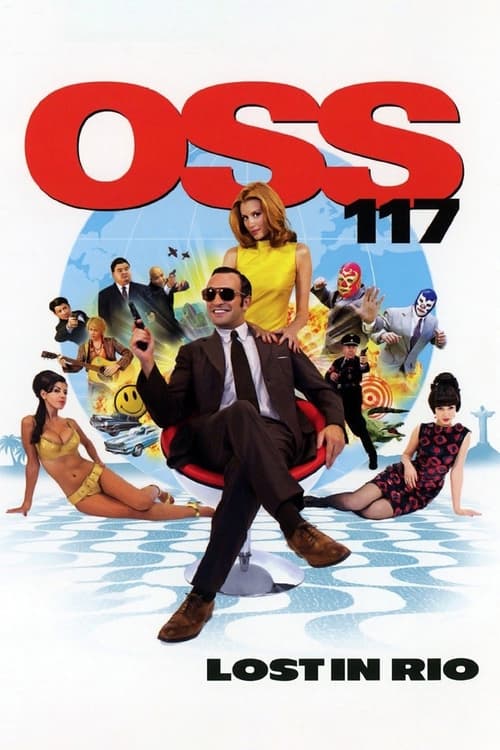
OSS 117: Lost in Rio (2009)
Directed by Michel Hazanavicius
No — OSS 117: Lost in Rio is not woke, scoring 16 out of 100 on our wokeness meter.
Michel Hazanavicius returns to the Eurospy sandbox with a sequel that strands Jean Dujardin's Hubert Bonisseur de La Bath in 1967 Rio de Janeiro, hunting a microfilm and a fugitive Nazi.
Consciousness Markers
Colonel Dolorès Koulechov is a competent Israeli officer who repeatedly rebukes OSS 117's misogyny, and the film toys with gender-role conflict, though this is played for satirical comedy rather than feminist advocacy.
The film openly stages the protagonist's colonial and racist assumptions and contrasts them with Brazil's political reality, but the racial content functions as a target of parody rather than a vehicle for racial consciousness.
Dialogue about dictatorships, French state hypocrisy, and prejudice appears chiefly through Dolorès's exasperated corrections, giving it a mildly didactic streak, but it is delivered as comic banter rather than sermon.
The cast is largely white French with a few supporting roles for Middle Eastern and Asian actresses; diversity is incidental to the period spy-comedy setting rather than a deliberate representational program.
The film uses the historical reality of escaped Nazis in South America and the Eichmann-style capture as period texture rather than revising or reinterpreting history for a modern message.
There are no meaningful LGBTQ+ themes or characters; the film's sexual content centers on the womanizing male lead and heterosexual flirtation.
There is no environmental or climate theme anywhere in the film.
No critique of capitalism or class politics; the plot concerns Nazi-hunting and Cold War intrigue, not economics.
The film features no body-positivity messaging or fat-acceptance themes.
No exploration of neurodivergence or mental health conditions.
Why it received this score
Michel Hazanavicius returns to the Eurospy sandbox with a sequel that strands Jean Dujardin's Hubert Bonisseur de La Bath in 1967 Rio de Janeiro, hunting a microfilm and a fugitive Nazi. The machinery is immaculate: rear projection, split screens lifted from The Thomas Crown Affair, Dean Martin on the soundtrack. The film knows exactly which 1960s spy pictures it is borrowing from, and it borrows with affection. Dujardin plays a man of bottomless confidence and negligible self-awareness, which remains the central joke.
That joke carries the film's social content, and the content is mostly aimed at its own hero. Louise Monot's Colonel Dolorès Koulechov, an Israeli officer working the Eichmann playbook, spends the running time correcting his colonial assumptions about Brazil, his casual misogyny, and his cheerful faith in French institutions. The corrections land as banter, not as instruction. When she lists the features of a dictatorship and he answers that he calls that France, the film is having its cake and eating it. The racism and sexism on display are targets, which means they are also the material, and the audience is invited to laugh at the gap between the man and the era.
Beyond that, the cupboard is bare. There is no environmental concern, no argument about capital, no interest in body image or mental health, no queer subtext worth the name. The historical furniture of escaped Nazis in South America serves as period texture, not as reinterpretation. A few supporting players of Middle Eastern and Asian descent appear, and the film does not pause to congratulate itself. This is a well-made pastiche with a sour streak, and it earns its laughs the old way: by letting a fool talk.
Analysis generated by our Consciousness Algorithm


Synopsis
In 1967, OSS 117 is sent to Brazil in order to retrieve a microfilm list of French Nazi sympathizers, only to once again unknowingly set foot into a bigger international intrigue.
Questions about OSS 117: Lost in Rio
Is OSS 117: Lost in Rio woke?
No — OSS 117: Lost in Rio is not woke, scoring 16 out of 100 on our wokeness meter. That earns it a verdict of Ultra Based.
Does OSS 117: Lost in Rio have any woke elements?
1 of the 10 markers register at 30 or above, led by Feminist Agenda (30). On Feminist Agenda: Colonel Dolorès Koulechov is a competent Israeli officer who repeatedly rebukes OSS 117's misogyny, and the film toys with gender-role conflict, though this is played for satirical comedy rather than feminist advocacy.
How does OSS 117: Lost in Rio compare to other 2009 movies?
It ranks #61 of the 230 films from 2009 we've scored; their average is 14. The wokest is Home (79).
Is OSS 117: Lost in Rio the most woke OSS 117 movie?
No. It ranks #2 of the 3 OSS 117 films we've scored; the wokest is OSS 117: From Africa with Love (22).