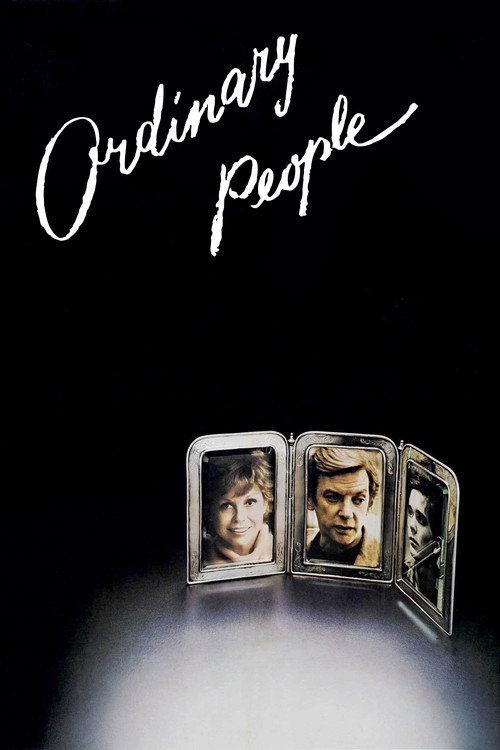
Ordinary People (1980)
Directed by Robert Redford
No — Ordinary People is not woke, scoring 15 out of 100 on our wokeness meter.
Ordinary People (1980) is Robert Redford's directorial debut, adapted by Alvin Sargent from Judith Guest's novel.
Consciousness Markers
Conrad suffers from PTSD, depression, and survivor's guilt, and the film sympathetically depicts therapy and mental health recovery, though it predates modern neurodivergence discourse.
The cast is entirely white and the film is set in an affluent white suburb; there is no attempt at diverse or color-conscious casting.
No LGBTQ+ characters, themes, or subtext are present.
The film features a complex female character in Beth, but her portrayal is a psychological study of narcissism and cold motherhood, not a feminist critique or agenda.
Race is entirely absent as a theme; the story concerns a white upper-middle-class family's grief.
No environmental or climate themes appear.
The film examines a wealthy family's emotional dysfunction without critiquing capitalism or wealth itself; Ebert noted it avoids cheap shots against affluence.
No body-positive themes or diverse body representation.
No historical revisionism; the film is a contemporary fictional drama.
The film is an emotional family drama with therapeutic dialogue, but it does not preach about social issues or deliver ideological lectures.
Why it received this score
Ordinary People (1980) is Robert Redford's directorial debut, adapted by Alvin Sargent from Judith Guest's novel. A wealthy family in Lake Forest, Illinois, comes apart after one son drowns and the other attempts suicide. It won four Academy Awards, including Best Picture. The film regards affluence with flat, unjudging eyes. There are no cheap shots at the suburbs, no snickering at the lacquered furniture. The interest is interior: grief, guilt, and the cold machinery of a mother who preferred the dead boy.
The cast is uniformly white, the suburb uniformly white, and the film never turns its head toward that fact. Race, environmental ruin, queer life, economic grievance: absent, and absent without comment. Beth Jarrett is a formidable creation, a portrait of narcissism so complete that journalists were still writing about it decades after Mary Tyler Moore's death. Her coldness is diagnosed as personal pathology, not as an indictment of motherhood or patriarchy. Nobody eats the rich. The Jarretts keep their money and lose each other, and the screenplay declines to draw a lesson from the transaction. Dr. Berger listens instead of lecturing, which is a form of restraint now nearly extinct in the genre.
The one place the film brushes against contemporary sensibilities is its handling of Conrad's illness. Post-traumatic stress, survivor's guilt, depression, a hospital stay, a therapist depicted as a decent and useful man. The psychiatric community praised that depiction at the time, grateful for once to be shown without horns. It is a sympathetic portrait of a mind in recovery, which is not the same as the modern vocabulary of neurodivergence, a framework the film predates by decades. We credit it partially, and reluctantly, and observe that the credit belongs to 1980. Elsewhere the film asks nothing of its audience except attention. It earns that. Goodness, however, is not a marker.
Analysis generated by our Consciousness Algorithm
Part of


Synopsis
Beth, Calvin, and their son Conrad are living in the aftermath of the death of the other son. Conrad is overcome by grief and misplaced guilt to the extent of a suicide attempt. He is in therapy. Beth had always preferred his brother and is having difficulty being supportive to Conrad. Calvin is trapped between the two trying to hold the family together.
Questions about Ordinary People
Is Ordinary People woke?
No — Ordinary People is not woke, scoring 15 out of 100 on our wokeness meter. That earns it a verdict of Ultra Based.
Does Ordinary People have any woke elements?
Very few. None of the 10 markers reaches 30, the level where a marker counts as present; the highest is Neurodivergence at 25.
How does Ordinary People compare to other 1980 movies?
It ranks #10 of the 37 films from 1980 we've scored; their average is 10. The wokest is Nine to Five (42).
How is the Woke Score calculated?
An AI-assisted process researches the film and its reception, scores it 0–100 on ten markers, then combines those into one 0–100 Woke Score. It measures a specific set of 2020s cultural themes, not film quality.