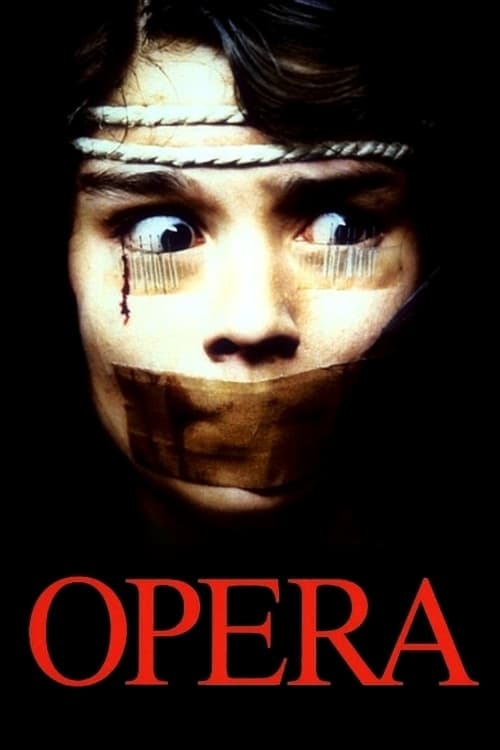
Opera (1987)
Directed by Dario Argento
No — Opera is not woke, scoring 0 out of 100 on our wokeness meter.
Dario Argento's Opera arrives from 1987 with the confidence of a film that has no interest in our contemporary moral ledger.
Consciousness Markers
The cast is a naturally assembled European ensemble for a 1987 Italian production, with no deliberate diversity casting or commentary on representation.
No LGBTQ+ characters, themes, or subtext appear anywhere in the film.
While the protagonist is a woman, she is primarily a victim subjected to voyeuristic torture; the film offers no feminist critique or agenda.
The film contains no engagement with race or racial consciousness whatsoever.
There is no environmental or climate theme in the film.
The film's thematic subtext concerns the death of classical art at the hands of pop culture, not economic critique or class warfare.
No body positivity themes are present; the film trades in conventional horror imagery of the female body as spectacle and victim.
No neurodivergence is depicted or addressed in the film.
The film is a fictional giallo with no historical revisionism of any kind.
Opera is a stylized horror-thriller that aims to shock and unsettle rather than to instruct or moralize; it contains no lecture energy.
Why it received this score
Dario Argento's Opera arrives from 1987 with the confidence of a film that has no interest in our contemporary moral ledger. A young soprano is stalked by a masked killer who forces her to watch his murders by taping needles beneath her eyes. The cast is a naturally assembled European ensemble, the kind that occurs when you hire Italians and a Spaniard for an Italian production. No diversity casting initiative is in evidence. No LGBTQ+ subtext. No racial consciousness. The film's lone thematic gesture, according to one critic, is a lament for classical art drowning in pop culture, which is a complaint about heavy metal, not an economic critique. We searched for an anti-capitalist reading and found only a man in a mask with a knife.
The feminist question requires a moment of silence. Betty is a woman in peril, subjected to voyeuristic torture, and the film offers no critique of that arrangement. It simply presents it. Body positivity is absent, as the female form here serves as spectacle and victim, not as a site of affirmation. Neurodivergence is not depicted. Climate anxiety does not intrude upon the opera house. Revisionist history is irrelevant to a giallo about a childhood nightmare. And lecture energy, that unmistakable urge to instruct the audience in proper social conduct, is nowhere to be found. This is a film that wants to shock you, not educate you.
We are left with a pristine specimen of pre-2010 genre filmmaking, a relic from a time when a director could stage a murder without also staging a seminar. The ravens are real. The needles are real. The social consciousness is not. Opera is many things: stylish, cruel, occasionally tedious. It is not, by any measure we recognize, a vehicle for progressive sensibilities. We note this without judgment, only with the fatigue of a sommelier who has been handed a vintage that tastes exactly as labeled.
Analysis generated by our Consciousness Algorithm


Synopsis
A young opera singer is stalked by a deranged fan bent on killing the people associated with her to claim her for himself.
Questions about Opera
Is Opera woke?
No — Opera is not woke, scoring 0 out of 100 on our wokeness meter. That earns it a verdict of Ultra Based.
Does Opera have any woke elements?
No. All 10 markers score zero.
How does Opera compare to other 1987 movies?
It ranks #50 of the 59 films from 1987 we've scored; their average is 8. The wokest is Maurice (68).
How is the Woke Score calculated?
An AI-assisted process researches the film and its reception, scores it 0–100 on ten markers, then combines those into one 0–100 Woke Score. It measures a specific set of 2020s cultural themes, not film quality.