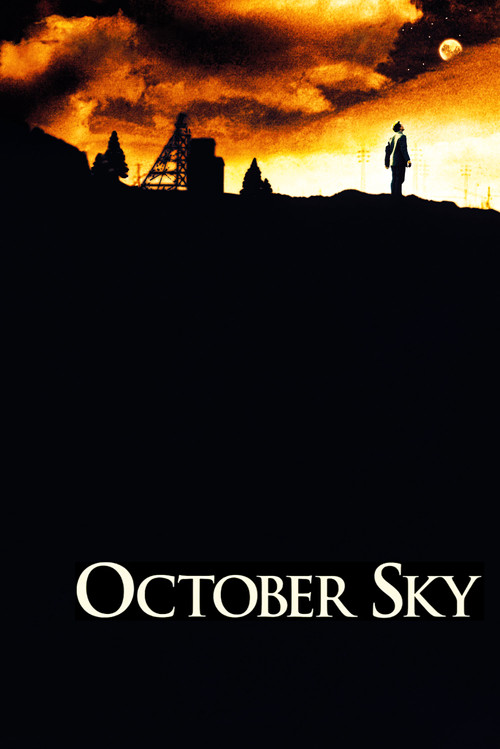
October Sky (1999)
Directed by Joe Johnston
No — October Sky is not woke, scoring 5 out of 100 on our wokeness meter.
October Sky arrives from 1999, a year when a studio could still change a memoir's title because focus groups suggested women over thirty would not buy tickets to something called Rocket Boys.
Consciousness Markers
Laura Dern's Miss Riley is a supportive teacher who champions the boys, but she functions as an inspirational mentor figure rather than a vehicle for any feminist argument about gender and power.
The film is earnestly inspirational and occasionally sentimental, but its lessons are about perseverance and father-son reconciliation rather than modern social instruction.
The company-town structure (the mine owning homes, schools, and futures) is depicted, and the father's subservience to the company is mildly critiqued, but there is no systemic anti-capitalist argument.
The cast is overwhelmingly white, reflecting the actual demographics of 1950s Appalachian coal country; the only notable non-Anglo presence is Elya Baskin as a Russian-adjacent machine shop manager, which is period-appropriate rather than a diversity statement.
No LGBTQ+ characters, themes, or subtext of any kind.
The film concerns a white Appalachian community and makes no attempt to engage with race, segregation, or racial justice.
Coal mining is the economic backdrop, but the film treats it as a livelihood and a source of paternal conflict, never as an environmental indictment.
No body-positivity themes or messaging present.
Quentin is a bookish social outcast, but the film frames his intelligence as a personality trait, not as neurodivergence.
The film is a sincere biographical dramatization with acknowledged composite characters and timeline changes, but it makes no ideological revision of the historical record.
Why it received this score
October Sky arrives from 1999, a year when a studio could still change a memoir's title because focus groups suggested women over thirty would not buy tickets to something called Rocket Boys. That anecdote tells us more about the era's cultural machinery than anything in the film itself. Joe Johnston directs the true story of Homer Hickam, a coal miner's son in Coalwood, West Virginia, who watches Sputnik cross the sky and decides to build rockets. The camera loves the soot, the picket fences, the steam locomotive. It does not love an argument.
What the film offers in place of argument is sincerity. The cast is white because 1950s Appalachian coal country was white, and the screenplay never pauses to comment on the fact. There is no engagement with race, none with sexuality, none with the body, none with the mind's varied wiring. Quentin, the bespectacled outcast who supplies the mathematics, is a brainy kid, which the film treats as a personality, not a diagnosis. The coal company owns the houses, the school, and the futures, and the screenplay notices this just enough to make the father's obedience poignant. It stops well short of an indictment. The mine is a livelihood and a wound between a man and his son, never a climate parable.
Laura Dern's Miss Riley champions the boys, and the film lets her be kind without turning her kindness into a thesis about power. The lessons here are perseverance, curiosity, and a father finally showing up to watch a rocket climb thirty thousand feet. Those are old virtues, delivered without a syllabus. We classify this one as a relic of an earlier dispensation, and we do so with something close to affection.
Analysis generated by our Consciousness Algorithm
Part of


Synopsis
The true story of Homer Hickam, a coal miner's son who was inspired by the first Sputnik launch to take up rocketry against his father's wishes.
Questions about October Sky
Is October Sky woke?
No — October Sky is not woke, scoring 5 out of 100 on our wokeness meter. That earns it a verdict of Ultra Based.
Does October Sky have any woke elements?
Very few. None of the 10 markers reaches 30, the level where a marker counts as present; the highest is Feminist Agenda at 10.
How does October Sky compare to other 1999 movies?
It ranks #79 of the 103 films from 1999 we've scored; their average is 14. The wokest is Boys Don't Cry (60).
How is the Woke Score calculated?
An AI-assisted process researches the film and its reception, scores it 0–100 on ten markers, then combines those into one 0–100 Woke Score. It measures a specific set of 2020s cultural themes, not film quality.