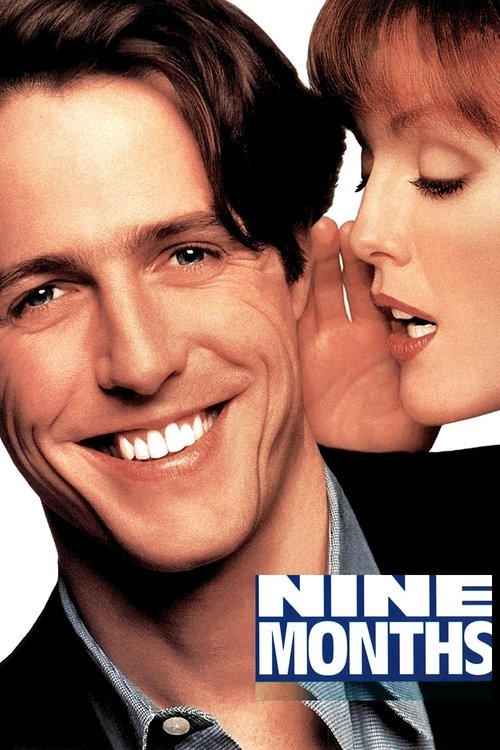
Nine Months (1995)
Directed by Chris Columbus
No — Nine Months is not woke, scoring 3 out of 100 on our wokeness meter.
Nine Months presents a remarkably predictable rendering of mid-nineties romantic anxiety.
Consciousness Markers
Julianne Moore's character is a working ballet teacher who asserts her desire for a child, but the film frames her chiefly as the emotional foil to a commitment-phobic man and resolves into traditional marriage and motherhood.
The cast is overwhelmingly white, led by Hugh Grant and Julianne Moore, with no meaningful diverse representation or casting commentary.
There are no LGBTQ+ characters or themes anywhere in this conventional 1990s romantic comedy.
Race is entirely absent as a subject; the film concerns itself solely with white, affluent San Francisco Bay Area professionals.
No environmental or climate themes appear in the film.
The protagonist's Porsche-to-family-car trade is a personal maturity arc, not a critique of wealth or capitalism.
Pregnancy is treated as a plot device for comedic anxiety rather than any body-positive messaging.
No neurodivergent characters or themes are present.
The film is a contemporary domestic comedy with no historical subject matter to revise.
The film is a lightweight farce that never pauses to deliver social or political messaging to the audience.
Why it received this score
Nine Months presents a remarkably predictable rendering of mid-nineties romantic anxiety. The narrative follows a man who, upon discovering his girlfriend is pregnant, cycles through the standard phases of domestic panic. He oscillates between fear and sudden, decisive maturity, a trajectory so well-worn it verges on the insulting. The film is a charming, if utterly conventional, piece of Bay Area satire, though its satire is aimed solely at personal indecision rather than any broader cultural phenomenon. The setting is restricted to a demographic of affluent, largely white professionals, making any discussion of systemic social issues entirely absent. We find no critical engagement with issues of climate, finance, or race; these matters remain outside the frame. The film’s emotional beats are heavy, yet they deliver zero substantive commentary on modern social consciousness.
Julianne Moore's character provides the film's only moment of actual agency, asserting her desires before the narrative pulls her back into the expected orbit of traditional marriage and motherhood. This small glimmer of progressive sensibility is largely swallowed by the surrounding commitment-phobic farce. The film refuses to engage with anything beyond a standard relationship conflict, offering no intellectual provocation or progressive challenge to the viewer. It is a lightweight spectacle of suburban compromise.
Ultimately, Nine Months functions as a comfortable, if slightly ponderous, piece of genre cinema. It is a masterclass in the avoidance of the contemporary cultural moment. Its focus remains squarely on the personal whims of its leads, failing to incorporate any themes of neurodiversity, body autonomy, or any of the more complex progressive sensibilities that define modern filmmaking. It is a clean, polite, and deeply unchallenging viewing experience.
Analysis generated by our Consciousness Algorithm
Synopsis
When he finds out his longtime girlfriend is pregnant, a commitment-phobe realizes he might have to change his lifestyle for better or much, much worse.
Questions about Nine Months
Is Nine Months woke?
No — Nine Months is not woke, scoring 3 out of 100 on our wokeness meter. That earns it a verdict of Ultra Based.
Does Nine Months have any woke elements?
Very few. None of the 10 markers reaches 30, the level where a marker counts as present; the highest is Feminist Agenda at 5.
How does Nine Months compare to other 1995 movies?
It ranks #94 of the 108 films from 1995 we've scored; their average is 12. The wokest is Total Eclipse (60).
How is the Woke Score calculated?
An AI-assisted process researches the film and its reception, scores it 0–100 on ten markers, then combines those into one 0–100 Woke Score. It measures a specific set of 2020s cultural themes, not film quality.