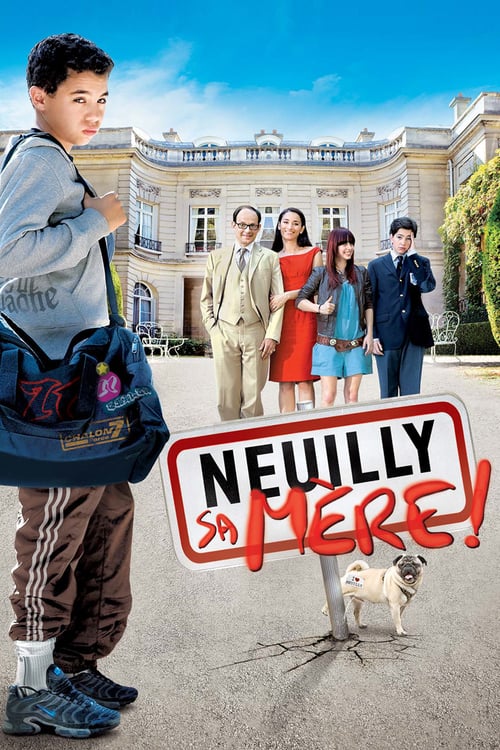
Neuilly Yo Mama! (2009)
Directed by Gabriel Julien-Laferrière
Partly — Neuilly Yo Mama! is somewhat woke, scoring 43 out of 100 on our wokeness meter.
The premise arrives with the tidy confidence of a fable: a fourteen-year-old beur named Sami is lifted from the projects of Chalon-sur-Saône and set down among the manicured hedges of Neuilly-sur-Seine, where his aunt Djamila has married into the de Chazelle family and their two unsettlingly blond children.
Consciousness Markers
The film is built around a beur (Maghrebi-descended) teenager played by Samy Seghir, with a substantially non-white supporting cast including Rachida Brakni, Farida Khelfa, and Booder, placing a minority lead at the center of a mainstream French comedy.
The entire premise turns on the cultural and ethnic clash between a Maghrebi teen from the projects and the wealthy white Neuilly elite, including a haraam-pork humiliation gag and recurring mockery of the outsider.
The film mines the gulf between the crime-ridden banlieue and the riches of Neuilly for comedy, but it treats class difference as a source of farce rather than mounting an anti-capitalist argument.
The film carries some political jokes and allusions to French political figures, but it is a broad comedy rather than a preachy message film.
Female characters like Marie and Djamila exist and occasionally push back on Sami's behavior, but the film offers no feminist framework or gender critique.
No LGBTQ+ characters, themes, or subtext appear anywhere in the plot or cast.
No environmental or climate themes are present.
No body-positivity themes or messaging appear in the film.
No neurodivergent characters or themes are depicted.
The film is a contemporary fictional comedy with no historical revisionism.
Why it received this score
The premise arrives with the tidy confidence of a fable: a fourteen-year-old beur named Sami is lifted from the projects of Chalon-sur-Saône and set down among the manicured hedges of Neuilly-sur-Seine, where his aunt Djamila has married into the de Chazelle family and their two unsettlingly blond children. The film understands exactly what it is doing. It places a Maghrebi teenager at the center of a mainstream French comedy and surrounds him with a supporting cast that is notably not white, then mines the collision for laughs. A pork gag lands on the haraam diet. A class election becomes a proxy war. The outsider is mocked, absorbs the mockery, and wins the girl. The machinery is visible and it hums along without apology.
The social consciousness on display is real but narrow. Race and class are the entire engine, and the film keeps its eye on the gulf between the banlieue and the sixteenth arrondissement, though it treats that gulf as material for farce instead of argument. Nobody is lectured. The wealthy are ridiculous, the poor are resourceful, and the whole arrangement resolves in a schoolyard vote and a violinist's forgiveness. There is a faint current of gender friction in Marie's refusal to tolerate violent boys, and in Djamila's authority over the household, but the film has no framework for it and does not want one. Political jokes flicker past, as Libération noted, without settling into a message.
What remains is a competent, agreeable comedy of manners that knows its audience and flatters them gently. It is not preachy. It is not angry. It is a 2009 French crowd-pleaser that happened to cast its minority lead with genuine charisma and let the culture clash do the heavy lifting. A sommelier would call it quaffable. It will not be remembered, as one critic observed, but it goes down without complaint.
Analysis generated by our Consciousness Algorithm
Synopsis
Samy moves from the underdeveloped crime-ridden French suburb to the riches of Neuilly.
Questions about Neuilly Yo Mama!
Is Neuilly Yo Mama! woke?
Partly — Neuilly Yo Mama! is somewhat woke, scoring 43 out of 100 on our wokeness meter. That earns it a verdict of Woke-Adjacent.
What makes Neuilly Yo Mama! woke?
3 of the 10 markers register at 30 or above, led by Representation Casting (65), Racial Consciousness (62) and Eat the Rich (30). On Representation Casting: The film is built around a beur (Maghrebi-descended) teenager played by Samy Seghir, with a substantially non-white supporting cast including Rachida Brakni, Farida Khelfa, and Booder, placing a minority lead at the center of a mainstream French comedy.
How does Neuilly Yo Mama! compare to other 2009 movies?
It ranks #12 of the 230 films from 2009 we've scored; their average is 14. The wokest is Home (79).
How is the Woke Score calculated?
An AI-assisted process researches the film and its reception, scores it 0–100 on ten markers, then combines those into one 0–100 Woke Score. It measures a specific set of 2020s cultural themes, not film quality.