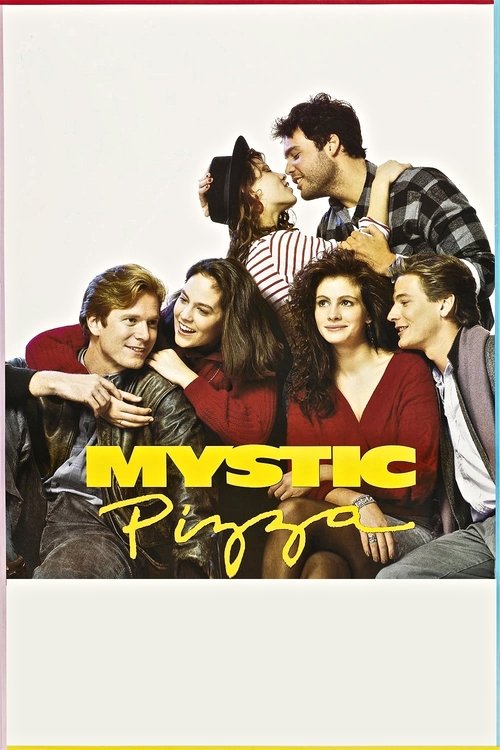
Mystic Pizza (1988)
Directed by Donald Petrie
No — Mystic Pizza is not woke, scoring 16 out of 100 on our wokeness meter.
Mystic Pizza arrives from 1988, a decade before anyone thought to audit a romantic comedy for its ideological commitments.
Consciousness Markers
The three leads are explicitly Portuguese-American, a specific ethnic community rarely centered in mainstream film, and the casting reflects that milieu. However, the roles are played by white actresses and the representation is organic to the story rather than a modern diversity mandate.
Daisy's relationship with the wealthy Charles includes a scene where his relatives make insensitive remarks about her Portuguese ethnicity, giving the film a genuine thread of ethnic/class consciousness, though it is handled as personal drama rather than systemic commentary.
A female-driven coming-of-age story with three women at its center and a sisterly reconciliation, but their arcs are largely defined through romance and marriage rather than any feminist critique of patriarchy.
Class differences between Daisy and the wealthy Windsor family are noted, but the film has no anti-capitalist or 'eat the rich' agenda; wealth is simply a backdrop for romantic tension.
The film is a gentle, character-driven dramedy that observes rather than preaches; it carries no explicit social messaging or moralizing.
No LGBTQ+ characters, themes, or subtext appear anywhere in the film.
No environmental or climate themes are present.
No body positivity themes or messaging.
No neurodivergent characters or themes.
No historical revisionism; the film is a contemporary (1980s) fictional story.
Why it received this score
Mystic Pizza arrives from 1988, a decade before anyone thought to audit a romantic comedy for its ideological commitments. Donald Petrie's directorial debut follows three Portuguese-American waitresses in a Connecticut fishing town, and it does something quietly specific: it centers a community that mainstream cinema had largely ignored, without ever announcing that it is doing so. Kat wants to study astronomy at Yale. Daisy wants to have fun. JoJo faints at her own wedding. The ethnic texture is genuine and unforced, drawn from the actual life of the region, and the casting reflects that milieu even if the leads themselves are not drawn from it.
On the question of gender politics, the film builds itself around three women and grants them friendship, friction, and a reconciliation that lands. But their destinies resolve through men. JoJo marries Bill. Daisy reconciles with Charles. Kat's affair with a married architect ends in rejection and a torn-up check. The film notices the patriarchy the way a waitress notices a customer: briefly, and then moves on to the next order. The one moment of real social friction comes at the Windsor family dinner, where relatives make snide remarks about Daisy's Portuguese background. That thread is present and pointed, though it plays as personal wound, not systemic indictment. Class difference exists here as scenery for romantic tension, nothing more.
What the film lacks is the sermon. There is no climate anxiety, no body-positivity messaging, no neurodivergent subplot, no queer presence of any kind. Nobody lectures. Nobody explains the moral of the story to the people living it. Mystic Pizza observes its characters with affection and lets them be small, flawed, and occasionally foolish. It trusts an audience to draw its own conclusions, which may be why it now feels like a transmission from another planet, faint, warm, and entirely uninterested in being good for us. A pleasant evening at the movies. Nothing more is claimed for it, and nothing more is needed.
Thematic tags: none apply. The film is an original screenplay, not an adaptation, not a sequel, not a remake, not a superhero property, not a true story, and it did not win Academy Awards or reach the top of the domestic box office during its run. It simply existed, sold a few tickets, and made Julia Roberts a star, which is its own kind of historical event, though not one this classification system recognizes.
Analysis generated by our Consciousness Algorithm


Synopsis
Three teenage girls come of age while working at a pizza parlor in Mystic, Connecticut.
Questions about Mystic Pizza
Is Mystic Pizza woke?
No — Mystic Pizza is not woke, scoring 16 out of 100 on our wokeness meter. That earns it a verdict of Ultra Based.
Does Mystic Pizza have any woke elements?
2 of the 10 markers register at 30 or above, led by Representation Casting (40) and Racial Consciousness (30). On Representation Casting: The three leads are explicitly Portuguese-American, a specific ethnic community rarely centered in mainstream film, and the casting reflects that milieu.
How does Mystic Pizza compare to other 1988 movies?
It ranks #15 of the 73 films from 1988 we've scored; their average is 10. The wokest is Stand and Deliver (58).
How is the Woke Score calculated?
An AI-assisted process researches the film and its reception, scores it 0–100 on ten markers, then combines those into one 0–100 Woke Score. It measures a specific set of 2020s cultural themes, not film quality.