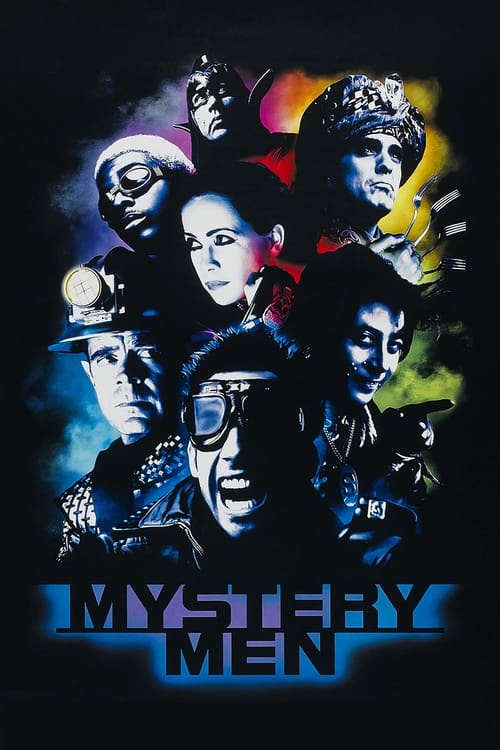
Mystery Men (1999)
Directed by Kinka Usher
No — Mystery Men is not woke, scoring 12 out of 100 on our wokeness meter.
Mystery Men arrived in 1999 as a superhero spoof with a budget it could not recoup and a joke density that critics found tiring.
Consciousness Markers
The plot satirizes superhero commercialism — Captain Amazing engineers a crisis because his corporate sponsorships are drying up — and the film flaunts a pronounced anti-gun, non-lethal-weaponry streak, though it's comedic texture rather than a coherent economic critique.
The ensemble is modestly diverse for 1999 — Kel Mitchell and Wes Studi appear among a mostly white cast — but the casting is driven by comedy instincts, not any deliberate representational program.
Janeane Garofalo's Bowler and Claire Forlani's Monica are competent presences, but the film is a boys'-club spoof with no feminist thesis to speak of.
The Sphinx's pseudo-profound aphorisms ('when you can balance a tack hammer on your head...') are a parody of fortune-cookie wisdom, not earnest preaching.
No LGBTQ+ themes, characters, or subtext appear anywhere in the film.
Race is never a subject or theme; the Sphinx's mystical-mentor shtick carries no racial commentary.
No environmental themes or climate messaging whatsoever.
No body-positivity themes; the Spleen's flatulence gags are the opposite of affirming.
No neurodivergence framing or representation.
The film is a comic-book spoof with no historical subject matter to revise.
Why it received this score
Mystery Men arrived in 1999 as a superhero spoof with a budget it could not recoup and a joke density that critics found tiring. The premise, a trio of inept crimefighters recruiting further inept crimefighters to rescue a corporate-sponsored hero from Casanova Frankenstein, remains a sturdy comic engine. The ensemble is modestly diverse for its era, with Kel Mitchell and Wes Studi among a largely white cast, though the casting reflects comedy instincts, not a deliberate representational program. No queerness of any kind appears in the proceedings. Janeane Garofalo's Bowler and Claire Forlani's Monica hold their own, but this is a boys'-club romp with no argument to make about gender, and it does not pretend otherwise.
The sharpest satirical edge concerns commerce. Captain Amazing engineers a crisis because his sponsorship deals are drying up, and the heroes arm themselves with Doc Heller's non-lethal gadgets, an anti-gun streak that reviewers flagged at the time. This is comedic texture, not a coherent economic critique. The film never follows the money anywhere uncomfortable. The Sphinx dispenses fortune-cookie aphorisms about tack hammers and balance, and the joke lands on the aphorisms themselves. Whatever mysticism Wes Studi brings to the role, the screenplay never converts it into racial commentary. Race is simply not a subject here.
The Spleen's flatulence remains the film's idea of a punchline, which places it at a distance from any affirming treatment of the body, and no character is framed through neurodivergence. The environment goes unmentioned. History is not revised, because there is no history to revise. The film offers a scattershot comic revue, admired more than loved, destined for cult status on home video. Its progressive gestures are incidental, born of the cast's chemistry and the writers' affection for oddballs. A harmless artifact, then. The classification is straightforward.
Analysis generated by our Consciousness Algorithm
Part of


Synopsis
When Champion City's hero Captain Amazing is kidnapped by the recently paroled supervillain Casanova Frankenstein, a trio of average, everyday superheroes -- Mr. Furious, the Shoveler and the Blue Raja -- assemble a new super team to save him.
Questions about Mystery Men
Is Mystery Men woke?
No — Mystery Men is not woke, scoring 12 out of 100 on our wokeness meter. That earns it a verdict of Ultra Based.
Does Mystery Men have any woke elements?
Very few. None of the 10 markers reaches 30, the level where a marker counts as present; the highest is Eat the Rich at 25.
How does Mystery Men compare to other 1999 movies?
It ranks #39 of the 103 films from 1999 we've scored; their average is 14. The wokest is Boys Don't Cry (60).
How is the Woke Score calculated?
An AI-assisted process researches the film and its reception, scores it 0–100 on ten markers, then combines those into one 0–100 Woke Score. It measures a specific set of 2020s cultural themes, not film quality.