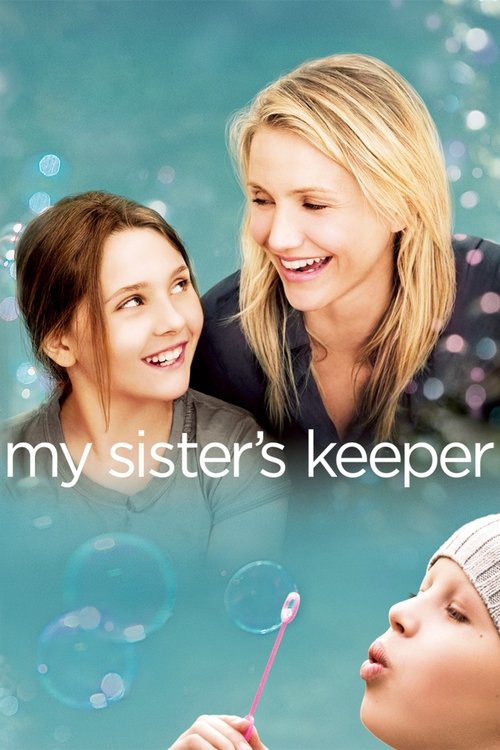
My Sister's Keeper (2009)
Directed by Nick Cassavetes
No — My Sister's Keeper is not woke, scoring 16 out of 100 on our wokeness meter.
Nick Cassavetes takes Jodi Picoult's novel about a girl conceived in vitro to serve as a donor for her leukemic sister and steers it directly toward the shoreline of tears.
Consciousness Markers
The plot centers on a girl suing for control over her own body against a mother who would use it as a medical resource, giving the film a genuine bodily-autonomy thread, though it is framed as family melodrama rather than explicit feminist argument.
The film raises ethical and moral questions about savior siblings and medical consent, but delivers them through tearjerker melodrama rather than preachy messaging.
Jesse's dyslexia is noted as having gone unnoticed for years while Kate received all the attention, a brief but concrete nod to a learning difference.
The cast is almost entirely white, with no meaningful diverse representation and no commentary on it. Standard 2009 Hollywood ensemble.
No LGBTQ+ characters or themes appear anywhere in the film.
No engagement with race or racial dynamics; the story is a white family's medical and legal drama.
No environmental or climate content whatsoever.
No critique of capitalism, wealth, or class structures; the legal system is treated as a neutral arena for a family dispute.
The film deals with illness and bodies but never engages body-positivity or body-image themes in the modern sense.
No historical revisionism; the film is a contemporary fictional drama.
Why it received this score
Nick Cassavetes takes Jodi Picoult's novel about a girl conceived in vitro to serve as a donor for her leukemic sister and steers it directly toward the shoreline of tears. Anna Fitzgerald, eleven years old and running out of spare organs, hires a lawyer and sues her parents for medical emancipation. The film turns into a courtroom drama where the legal question (can a parent compel a child to surrender a kidney) is handled with reasonable seriousness before it remembers it would like us to weep. It gets its weeping. Audiences handed it an A- while critics, less moved, split roughly down the middle.
The autonomy thread is real. Anna wants jurisdiction over her own body, and her mother regards that body as a resource to be spent on the daughter she has already decided to save. That is a genuine argument, though the film arrives at it through family melodrama instead of declaring any such intention. A quieter detail lands harder: Jesse's dyslexia went undiagnosed for years while his sister absorbed every ounce of parental attention, a small, uninsisted observation about what a sick child costs the healthy ones. The cast, meanwhile, is uniformly white, and the film has no interest whatsoever in noticing this.
The rest is competence in service of manipulation. Alec Baldwin's attorney has epilepsy, which the script deploys as a tidy parallel about bodies that misbehave without permission. Kate finds a boyfriend in the chemo ward, loses him, and the beach trip arrives on schedule. The direction is heavy-handed, the score is not subtle, and the ethics get dissolved into grief. It is a sincere film about a sincere question, and sincerity, in this genre, is its own kind of anesthesia.
Analysis generated by our Consciousness Algorithm


Synopsis
Sara and Brian live an idyllic life with their young son and daughter. But their family is rocked by sudden, heartbreaking news that forces them to make a difficult and unorthodox choice in order to save their baby girl's life. The parents' desperate decision raises both ethical and moral questions and rips away at the foundation of their relationship. Their actions ultimately set off a court case that threatens to tear the family apart, while revealing surprising truths that challenge everyone's perceptions of love and loyalty and give new meaning to the definition of healing.
Questions about My Sister's Keeper
Is My Sister's Keeper woke?
No — My Sister's Keeper is not woke, scoring 16 out of 100 on our wokeness meter. That earns it a verdict of Ultra Based.
Does My Sister's Keeper have any woke elements?
1 of the 10 markers register at 30 or above, led by Feminist Agenda (30). On Feminist Agenda: The plot centers on a girl suing for control over her own body against a mother who would use it as a medical resource, giving the film a genuine bodily-autonomy thread, though it is framed as family melodrama rather than explicit feminist argument.
How does My Sister's Keeper compare to other 2009 movies?
It ranks #61 of the 230 films from 2009 we've scored; their average is 14. The wokest is Home (79).
How is the Woke Score calculated?
An AI-assisted process researches the film and its reception, scores it 0–100 on ten markers, then combines those into one 0–100 Woke Score. It measures a specific set of 2020s cultural themes, not film quality.