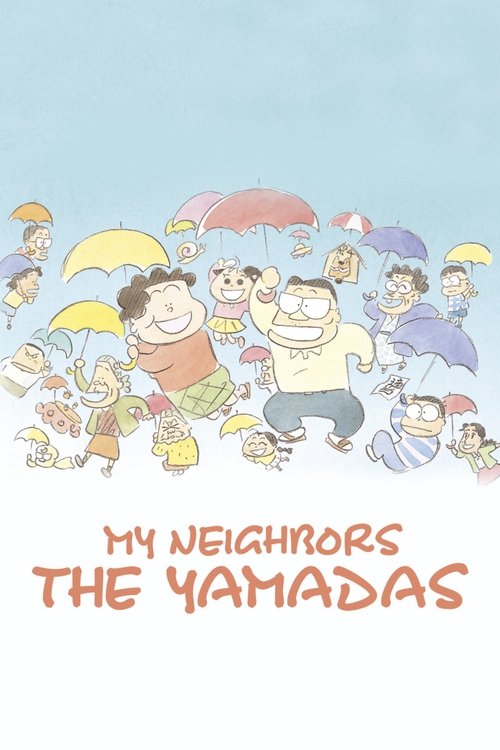
My Neighbors the Yamadas (1999)
Directed by Isao Takahata
No — My Neighbors the Yamadas is not woke, scoring 2 out of 100 on our wokeness meter.
Isao Takahata's 1999 slice-of-life comedy arrives as a watercolor curiosity, a Studio Ghibli production that trades the soaring orchestral grandeur of its studio siblings for short piano motifs and the domestic static of one Tokyo household.
Consciousness Markers
Matsuko and the grandmother Shige are strong-willed presences and the ironic vignette title 'Patriarchal Supremacy Restored' gently ribs domestic gender roles, but this is observational humor rather than an agenda.
An entirely Japanese cast portraying a Japanese family, with no casting choices made as a statement or comment; the homogeneity is simply the setting.
No LGBTQ+ characters, themes, or subtext of any kind appear in these domestic vignettes.
No engagement with race, racism, or racial identity; the film is a culturally specific but racially unexamined portrait of one Tokyo household.
No environmental or climate themes whatsoever.
Consumer life (department stores, televisions) is depicted as ordinary middle-class texture, not critiqued as a system.
No body-image themes or body-diversity messaging.
No neurodivergent characters or themes are present or implied.
A contemporary slice-of-life comedy with no historical subject matter to revise.
The film is deliberately anti-didactic, offering haiku-like observations and gentle humor with no moral instruction to the audience.
Why it received this score
Isao Takahata's 1999 slice-of-life comedy arrives as a watercolor curiosity, a Studio Ghibli production that trades the soaring orchestral grandeur of its studio siblings for short piano motifs and the domestic static of one Tokyo household. The Yamadas argue over the television remote, lose a child in a department store, and endure the grandmother's proverbs. The title cards promise drama ('A Family Torn Apart') and deliver a spilled cup of tea. This is observational comedy at its most patient, and it makes no effort to instruct us in anything. The film simply watches. We watch with it.
On the matter of social consciousness, the cupboard is bare, and the film is content to leave it that way. The cast is entirely Japanese and entirely unremarkable in its composition: a family, played by a family, with no commentary attached. Matsuko and her mother Shige are forceful presences, and the vignette title 'Patriarchal Supremacy Restored' lands as a dry wink at domestic gender roles, but the film treats this as material for a joke about who controls the remote, not as a thesis. Consumer life, department stores and televisions alike, appears as ordinary middle-class texture, never as a target. There are no questions of race, no environmental lament, no body-image sermon, no framework of neurodivergence, no history to correct. The film has no interest in the lecture hall.
What it does have is a haiku-like calm, as one critic put it, and a willingness to let a family be ordinary. That restraint reads today as almost radical, though the film predates any such reading. It won an Excellence Award at the Japan Media Arts Festival and then quietly underperformed at the box office, which feels appropriate for a work this allergic to grand statement. A gentle, funny, beautifully drawn portrait of nothing much happening. We could use more of it.
Analysis generated by our Consciousness Algorithm


Synopsis
The Yamadas are a typical middle class Japanese family in urban Tokyo and this film shows us a variety of episodes of their lives. With tales that range from the humorous to the heartbreaking, we see this family cope with life's little conflicts, problems, and joys in their own way.
Questions about My Neighbors the Yamadas
Is My Neighbors the Yamadas woke?
No — My Neighbors the Yamadas is not woke, scoring 2 out of 100 on our wokeness meter. That earns it a verdict of Ultra Based.
Does My Neighbors the Yamadas have any woke elements?
Very few. None of the 10 markers reaches 30, the level where a marker counts as present; the highest is Feminist Agenda at 5.
How does My Neighbors the Yamadas compare to other 1999 movies?
It ranks #90 of the 103 films from 1999 we've scored; their average is 14. The wokest is Boys Don't Cry (60).
How is the Woke Score calculated?
An AI-assisted process researches the film and its reception, scores it 0–100 on ten markers, then combines those into one 0–100 Woke Score. It measures a specific set of 2020s cultural themes, not film quality.