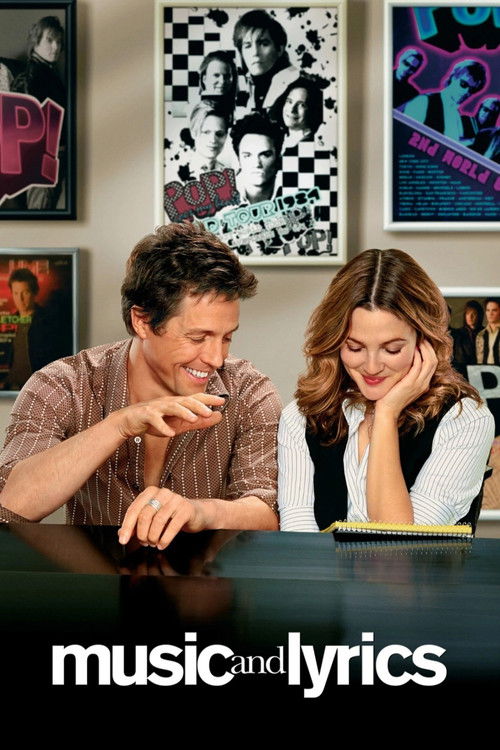
Music and Lyrics (2007)
Directed by Marc Lawrence
No — Music and Lyrics is not woke, scoring 12 out of 100 on our wokeness meter.
Music and Lyrics arrives from 2007, a year when a romantic comedy could still be sold on the premise of two attractive people in a room with a piano.
Consciousness Markers
A largely white leading cast, though Aasif Mandvi appears in a supporting role and the film stages a Bollywood-style production number for Cora Corman, treated as exotic spectacle rather than representation.
A mild art-versus-commerce thread runs through the plot, with Sophie accusing Alex of selling out and Cora's commercial instincts clashing with the song's integrity, but it resolves comfortably within the industry it critiques.
Sophie has a modest arc about reclaiming her creative voice after being exploited by a professor, but the film remains a conventional romcom where the heroine's fulfillment arrives via the male lead.
The film occasionally sermonizes about artistic authenticity versus selling out, but it is a light romantic comedy that prioritizes charm over preaching.
The Bollywood-flavored staging gestures at global pop culture but engages no racial themes or commentary; minority characters exist without comment.
No LGBTQ+ characters, themes, or subtext of any kind.
No environmental or climate content whatsoever.
No body positivity themes or messaging.
No neurodivergent characters or themes.
No historical revisionism; the film is a contemporary fictional romance.
Why it received this score
Music and Lyrics arrives from 2007, a year when a romantic comedy could still be sold on the premise of two attractive people in a room with a piano. Hugh Grant plays Alex Fletcher, a former eighties pop idol reduced to state fairs, and Drew Barrymore plays Sophie, the plant waterer with a gift for rhyme. The film's central joke, that the machinery of pop stardom is absurd and mildly corrupting, is delivered with a shrug. Marc Lawrence directs as though the audience might wander off at any moment, and he is probably right to worry.
The picture gestures toward a wider world without committing to it. Aasif Mandvi appears in support, and Cora Corman's big production number is staged in Bollywood colors, treated as spectacle from a safe distance. This is decoration, not representation. Sophie does have an arc about recovering her voice after a professor turned her into a character in his novel, and the film grants her a small victory over that man. Her fulfillment still arrives through the male lead, and the arrangement is thoroughly conventional. The art-versus-commerce thread is present, with Sophie accusing Alex of selling out, but it dissolves into a comfortable ending inside the very industry it teased.
Elsewhere the film is a clean slate. No environmental concerns, no body politics, no neurodivergent characters, no historical revisionism, no engagement with race as a subject. The sermonizing about authenticity is brief and gentle, more charm than instruction. There is little else here beyond a competent, lightly cynical romance that asks nothing of its audience and offers little to classify. A period piece, in its way, though it was made only a few years ago.
Analysis generated by our Consciousness Algorithm


Synopsis
A washed-up '80s pop star gets a chance at a comeback when reigning pop diva Cora Corman invites him to write & record a duet with her, but there's a problem--Alex hasn't written a song in years; he's never written lyrics and he has to come up with a hit in a matter of days.
Questions about Music and Lyrics
Is Music and Lyrics woke?
No — Music and Lyrics is not woke, scoring 12 out of 100 on our wokeness meter. That earns it a verdict of Ultra Based.
Does Music and Lyrics have any woke elements?
Very few. None of the 10 markers reaches 30, the level where a marker counts as present; the highest is Eat the Rich at 18.
How does Music and Lyrics compare to other 2007 movies?
It ranks #66 of the 201 films from 2007 we've scored; their average is 12. The wokest is Like Stars on Earth (92).
How is the Woke Score calculated?
An AI-assisted process researches the film and its reception, scores it 0–100 on ten markers, then combines those into one 0–100 Woke Score. It measures a specific set of 2020s cultural themes, not film quality.