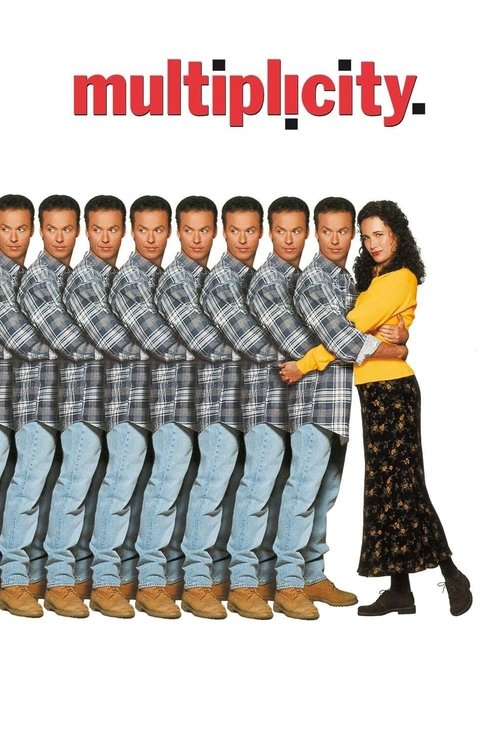
Multiplicity (1996)
Directed by Harold Ramis
No — Multiplicity is not woke, scoring 0 out of 100 on our wokeness meter.
Multiplicity arrives from 1996 with the confidence of a studio comedy that has nothing on its mind beyond the mechanics of its own premise.
Consciousness Markers
The cast is uniformly white, led by Michael Keaton and Andie MacDowell, with no meaningful racial or ethnic diversity and no commentary on representation.
There are no LGBTQ+ characters, themes, or subtext anywhere in the film.
The film's gender play is regressive rather than feminist: the 'feminine' clone Rico is a domestic-stereotype punchline, and Laura is largely a frustrated-wife trope.
Race is never addressed or thematized; the story is a white suburban cloning farce with no racial consciousness.
No environmental or climate themes appear in the film.
The film is indifferent to economics; Doug's arc ends with him starting his own contracting business and the clones running a successful pizzeria, an entrepreneurial rather than anti-capitalist resolution.
No body-positivity themes or messaging are present.
Lenny's low intelligence is played purely as slapstick comedy, not as any depiction or advocacy of neurodivergence.
The film makes no historical claims and does not revise or reinterpret any historical record.
This is a light 1996 studio comedy with no didactic messaging or moral lecturing of any kind.
Why it received this score
Multiplicity arrives from 1996 with the confidence of a studio comedy that has nothing on its mind beyond the mechanics of its own premise. Harold Ramis directs Michael Keaton as Doug Kinney, a Los Angeles construction worker whose job and family are incompatible, and who solves the problem by having himself cloned. The result is a farce about scheduling. It opened seventh against Independence Day and a Nutty Professor remake, and its reputation has not grown since. Placed against the current cultural ledger, it is a blank page, and the page is not hiding anything.
The film's gender play is the closest it comes to a theme, and that theme is a punchline. Rico, the clone who inherits Doug's softer side, cooks, cleans, and fusses over the household, and the film's position on this is that it is funny. Lance, the exaggerated masculine duplicate, chases women. Lenny, a copy of a copy, is dim, and his diminished intellect exists solely to fuel slapstick, with no interest in what it might suggest about a mind. Laura, the wife, is a study in frustration, and she sleeps with three of her husband's duplicates in sequence without noticing, which the screenplay treats as a complication and not a catastrophe. Nothing here is offered as argument. It is all material.
The resolution is entrepreneurial. Doug announces his own contracting business, and the clones decamp to Miami to run a successful pizzeria while passing as triplets. There is no economics to interrogate, no environment to fret over, no race in the frame, no effort at representation beyond a uniformly white cast in a comfortable suburb. The film asks nothing of its audience and teaches nothing. It is a movie about a man who could not find time to fix the house. Our instruments register silence, and there is something restful in that.
Analysis generated by our Consciousness Algorithm


Synopsis
Construction worker Doug Kinney finds that the pressures of his working life, combined with his duties to his wife Laura and daughter Jennifer leaves him with little time for himself. However, he is approached by geneticist Dr. Owen Leeds, who offers Doug a rather unusual solution to his problems: cloning.
Questions about Multiplicity
Is Multiplicity woke?
No — Multiplicity is not woke, scoring 0 out of 100 on our wokeness meter. That earns it a verdict of Ultra Based.
Does Multiplicity have any woke elements?
No. All 10 markers score zero.
How does Multiplicity compare to other 1996 movies?
It ranks #84 of the 93 films from 1996 we've scored; their average is 11. The wokest is Bound (60).
How is the Woke Score calculated?
An AI-assisted process researches the film and its reception, scores it 0–100 on ten markers, then combines those into one 0–100 Woke Score. It measures a specific set of 2020s cultural themes, not film quality.