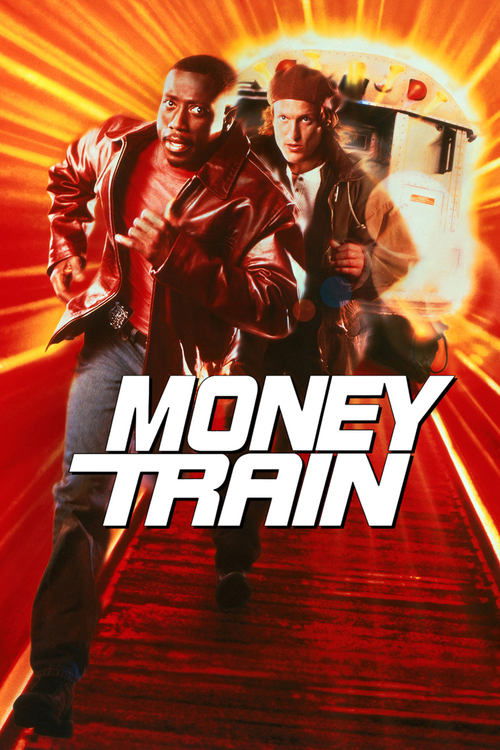
Money Train (1995)
Directed by Joseph Ruben
No — Money Train is not woke, scoring 17 out of 100 on our wokeness meter.
Money Train arrives from 1995 with the confidence of a film that studied the buddy cop template and decided the study was sufficient.
Consciousness Markers
A Black male lead (Wesley Snipes) and a Latina female co-lead (Jennifer Lopez) anchor a major 1995 studio action film, with the two leads cast as interracial foster brothers. The diversity is present but unremarked upon, functioning as natural casting rather than a deliberate representational statement.
Jennifer Lopez's Grace Santiago is a competent decoy officer who handles stings, fights, and ultimately arrests the corrupt captain, but she is largely a romantic prize and supporting player in a male buddy narrative with no feminist thesis.
The foster-brother relationship crosses racial lines, but the film never engages with race as a subject, offering no commentary or consciousness on the matter.
The plot centers on robbing a subway revenue train and features an abusive transit captain, but the theft is motivated by personal gambling debt rather than any systemic critique of wealth or capitalism.
A loud, by-the-numbers buddy action comedy that preaches nothing; there is no didactic or moralizing impulse beyond standard cop-movie platitudes.
No LGBTQ+ characters, themes, or subtext appear anywhere in the film.
No environmental or climate themes are present.
No body-positivity themes or messaging appear in the film.
No neurodivergent characters or themes are depicted.
The film is a fictional action comedy with no historical revisionism.
Why it received this score
Money Train arrives from 1995 with the confidence of a film that studied the buddy cop template and decided the study was sufficient. Wesley Snipes and Woody Harrelson, fresh from White Men Can't Jump, are pressed into service as foster brothers and decoy transit officers patrolling the New York subway. Joseph Ruben directs with a workman's efficiency. The screenplay concerns a gambling debt, a mobster named Mr. Brown, and a plan to rob the armored train hauling the system's fare revenue. Gene Siskel and Roger Ebert put it on their worst-of-the-year lists. They were not wrong, though the film has since acquired a modest cult following among people who enjoy the sound of screeching metal.
On the matter of social consciousness, the picture is nearly inert. Snipes and Harrelson play brothers across racial lines, and the casting of Jennifer Lopez as a capable decoy officer gives the ensemble a demographic breadth unusual for its era, yet the film never pauses to consider any of it. Grace Santiago fights, works stings, and ultimately arrests the abusive Captain Patterson, but she is also the romantic reward in a story owned by two men. Race is present as a fact of casting and absent as a subject. There is no queer presence, no environmental concern, no body politics, no attention to neurodivergence, and no historical argument of any kind. The theft at the center is motivated by personal debt, not by grievance against wealth. The film lectures no one, which is arguably its only restraint.
The Torch subplot, in which a villain douses a token booth attendant with gasoline, inspired several copycat crimes and a brief national outcry. Chris Cooper has said he regrets taking the role. That is the closest the film comes to a moral position, and it arrived by accident. What remains is a loud, competent, aimless thing, agreeable enough if we are in the mood for sparks and shouting, and empty of anything we might mistake for a message.
Analysis generated by our Consciousness Algorithm


Synopsis
When a vengeful New York transit cop decides to steal a trainload of subway fares, his foster brother—a fellow cop—tries to protect him.
Questions about Money Train
Is Money Train woke?
No — Money Train is not woke, scoring 17 out of 100 on our wokeness meter. That earns it a verdict of Ultra Based.
Does Money Train have any woke elements?
1 of the 10 markers register at 30 or above, led by Representation Casting (35). On Representation Casting: A Black male lead (Wesley Snipes) and a Latina female co-lead (Jennifer Lopez) anchor a major 1995 studio action film, with the two leads cast as interracial foster brothers.
How does Money Train compare to other 1995 movies?
It ranks #23 of the 108 films from 1995 we've scored; their average is 12. The wokest is Total Eclipse (60).
How is the Woke Score calculated?
An AI-assisted process researches the film and its reception, scores it 0–100 on ten markers, then combines those into one 0–100 Woke Score. It measures a specific set of 2020s cultural themes, not film quality.