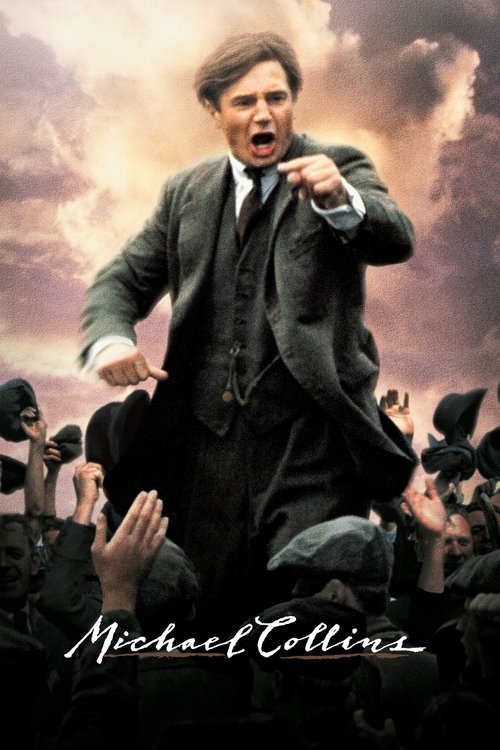
Michael Collins (1996)
Directed by Neil Jordan
No — Michael Collins is not woke, scoring 5 out of 100 on our wokeness meter.
Neil Jordan's Michael Collins arrives from 1996 with the bearing of a monument: fog, gunpowder, and Liam Neeson in an enormous overcoat.
Consciousness Markers
The film carries a sober moral lesson about the tragedy of civil war and the futility of internal division, delivered with some earnest didactic weight, though not in a modern activist register.
The film openly alters and fictionalizes historical events (the deaths of Harry Boland and Ned Broy, and especially the unflattering portrayal of de Valera), but this is nationalist/artistic license rather than a modern progressive reframing of history.
Kitty Kiernan exists primarily as a romantic interest, and the film is a male-dominated political and military narrative with no feminist framing.
The cast is almost entirely white Irish and British performers. There is no deliberate diverse or color-conscious casting; Julia Roberts and the ensemble reflect a standard 1990s historical-epic lineup.
No LGBTQ+ characters or themes appear at any point in the narrative.
The film concerns Irish anti-colonial struggle and Anglo-Irish conflict, framed in national rather than racial terms. No modern racial-consciousness commentary is present.
There is no environmental or climate theme anywhere in the film.
The struggle is anti-imperial and nationalist rather than a critique of capitalism or class-based wealth redistribution.
No body-positivity themes or messaging are present.
No neurodivergent characters or themes are portrayed.
Why it received this score
Neil Jordan's Michael Collins arrives from 1996 with the bearing of a monument: fog, gunpowder, and Liam Neeson in an enormous overcoat. It concerns the birth of the Irish Free State, the Treaty, and the civil war that followed, which means its interests are national, military, and tragic. The film has no patience for the modern vocabulary of identity. Its grievance is with London, not with power in the abstract. A story about anti-colonial struggle would today be filtered through a racial lens. This one is not. It is a story about the Irish, told by the Irish, for an international audience that required footnotes.
The cast is a wall of pale Irish and British faces, Julia Roberts included, assembled the way historical epics were assembled in that decade: by availability and gravity. No color-conscious accounting was performed, and none was expected. Kitty Kiernan drifts through the proceedings as a romantic obligation, a woman to be loved and then mourned, granted no interiority beyond that function. There are no queer currents here, no environmental anxieties, no sermons about bodies or brains. The film's deviations from the record are real and documented. Boland dies the wrong death, Broy meets a fate invented for him, and de Valera is rendered as a preening martyr to his own vanity. Those liberties serve a nationalist melodrama, not a progressive rereading of the past.
What the film does carry is an old-fashioned moral, delivered with a straight face and a full orchestra: brothers who split over a treaty will bury each other. That lesson lands with some weight. It is the weight of a history teacher, not an activist. The camera lingers on Collins's death in the Cork rain, and the film asks us to feel the waste of it. It does not ask us to examine our complicity in anything. There is something restful in that, and something faintly antique. The picture belongs to an era when a serious film about a revolution could simply be about the revolution.
{"thematic_tags": ["true_story"]}
Analysis generated by our Consciousness Algorithm


Synopsis
Michael Collins plays a crucial role in the establishment of the Irish Free State in the 1920s, but becomes vilified by those hoping to create a completely independent Irish republic.
Questions about Michael Collins
Is Michael Collins woke?
No — Michael Collins is not woke, scoring 5 out of 100 on our wokeness meter. That earns it a verdict of Ultra Based.
Does Michael Collins have any woke elements?
Very few. None of the 10 markers reaches 30, the level where a marker counts as present; the highest is Lecture Energy at 20.
How does Michael Collins compare to other 1996 movies?
It ranks #63 of the 93 films from 1996 we've scored; their average is 11. The wokest is Bound (60).
How is the Woke Score calculated?
An AI-assisted process researches the film and its reception, scores it 0–100 on ten markers, then combines those into one 0–100 Woke Score. It measures a specific set of 2020s cultural themes, not film quality.