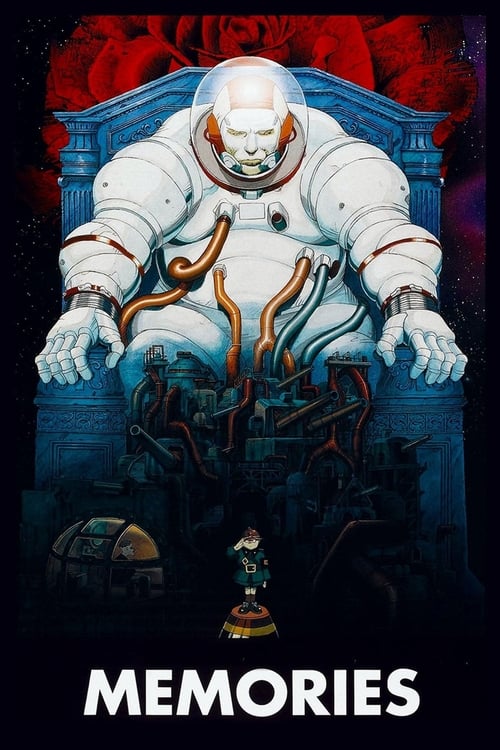
Memories (1995)
Directed by Katsuhiro Otomo
No — Memories is not woke, scoring 7 out of 100 on our wokeness meter.
Memories arrived in 1995, three anime shorts packaged under a single title, and it has aged into something close to a museum piece.
Consciousness Markers
Cannon Fodder satirizes a war-driven economy and the gulf between a lavishly dressed officer and a lowly cannon-loader, and Stink Bomb skewers a research corporation, but the critique is anti-militarist rather than an 'eat the rich' class polemic.
Cannon Fodder carries an allegorical anti-war and anti-propaganda message, but it is delivered through visual storytelling and implication rather than explicit sermonizing.
Magnetic Rose centers on Eva Friedel, a murderous opera diva with considerable agency, but she functions as a classic femme-fatale horror archetype rather than a vehicle for feminist messaging.
A 1995 Japanese anthology with an all-Japanese voice cast; the characters are predominantly white European or Japanese without any modern diversity-casting intent or commentary.
No LGBTQ+ characters, themes, or subtext appear across any of the three segments.
None of the segments engage with race, racial identity, or racial politics in any form.
Stink Bomb features a toxic chemical and Cannon Fodder a blasted wasteland, but these serve sci-fi comedy and anti-war allegory, not environmental/climate advocacy.
No body-positivity themes or messaging are present.
No depiction or discussion of neurodivergence appears in the film.
The film is a speculative sci-fi anthology with no revisionist re-framing of historical events.
Why it received this score
Memories arrived in 1995, three anime shorts packaged under a single title, and it has aged into something close to a museum piece. Katsuhiro Otomo oversees; Koji Morimoto, Tensai Okamura and Otomo himself direct. The anthology format means the film never settles into one argument, which works in its favor. Three voices pull in three directions, and the friction keeps any of them from hardening into a platform. It is a speculative triptych, assembled by craftsmen, with no apparent interest in instructing anyone.
Magnetic Rose is the strongest of the three, a haunted-house story relocated to a derelict space station. Eva Friedel, an opera diva who murdered her fiance and has spent decades trapping men inside her grief, is a villain of real appetite and agency. She is also a femme fatale of the oldest lineage, Puccini by way of gothic horror. Her power is not offered as commentary on anything. It is the engine of a ghost story, and the film has no interest in making her mean more than she does. The other two segments fare less well as drama, though they are not without teeth.
Stink Bomb turns a hapless lab technician into a walking chemical weapon and lets the corporate and military machinery flail at him, a broad joke with a sour aftertaste about institutions that treat people as inventory. Cannon Fodder, a single unbroken take of a city built entirely around its cannons, is the sharpest of the bunch. A lavishly dressed officer fires the great red gun while a loader stands beside it without safety gear, and the propaganda blares about an enemy nobody has seen. The critique lands through imagery and implication, never a speech. The boy asks why they fight. His father says he will understand when he is older. That is the entire sermon, and it is enough.
Analysis generated by our Consciousness Algorithm


Synopsis
Three back-to-back anime films by three different directors make up this sci-fi trilogy three years in the making.
Questions about Memories
Is Memories woke?
No — Memories is not woke, scoring 7 out of 100 on our wokeness meter. That earns it a verdict of Ultra Based.
Does Memories have any woke elements?
Very few. None of the 10 markers reaches 30, the level where a marker counts as present; the highest is Eat the Rich at 15.
How does Memories compare to other 1995 movies?
It ranks #56 of the 108 films from 1995 we've scored; their average is 12. The wokest is Total Eclipse (60).
How is the Woke Score calculated?
An AI-assisted process researches the film and its reception, scores it 0–100 on ten markers, then combines those into one 0–100 Woke Score. It measures a specific set of 2020s cultural themes, not film quality.