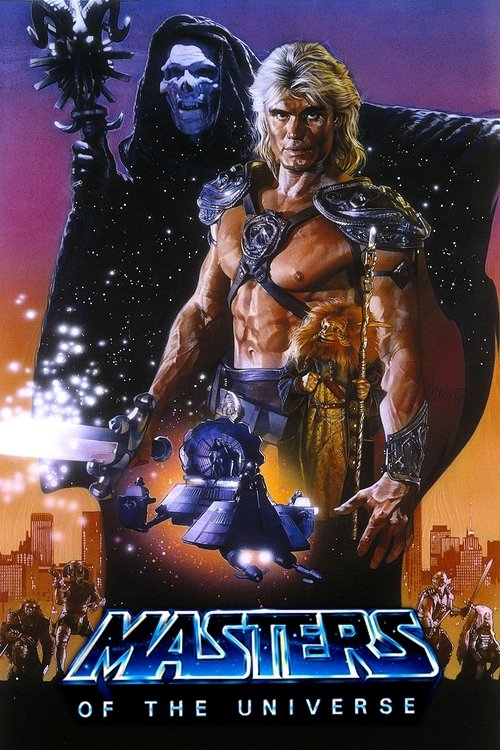
Masters of the Universe (1987)
Directed by Gary Goddard
No — Masters of the Universe is not woke, scoring 6 out of 100 on our wokeness meter.
Masters of the Universe arrives from 1987 with the confidence of a toy commercial that has borrowed a sword and a fog machine.
Consciousness Markers
The cast is predominantly white, but features several women in action-oriented roles (Teela, Evil-Lyn, Sorceress) and a little person actor (Billy Barty) as Gwildor. This is not modern inclusive casting, but there is some gender diversity.
Female characters like Teela and Evil-Lyn are capable warriors and villains, but the film does not advance a feminist agenda or critique patriarchy.
No LGBTQ+ characters, themes, or subtext.
No exploration of race, racism, or racial identity; the cast is entirely white.
No environmental or climate themes.
The film is a commercial toy adaptation with no anti-capitalist critique.
No body positivity themes; characters are conventionally muscular or slender.
No neurodivergent characters or themes.
Not based on historical events; no revisionist history.
A campy action fantasy with no preachy or lecture-like messaging.
Why it received this score
Masters of the Universe arrives from 1987 with the confidence of a toy commercial that has borrowed a sword and a fog machine. Gary Goddard's film strands He-Man on Earth, where two teenagers and a cosmic key become the center of a conflict that should have stayed on Eternia. The cast is overwhelmingly white, which places it firmly outside any modern representation project. There is, however, a minor allowance to be made. Teela, Evil-Lyn, and the Sorceress occupy action and authority positions, and Billy Barty appears as Gwildor. This is not inclusive casting in the contemporary sense. It is simply a genre film from an era when a woman with a sword and a little person with a key could pass for variety.
The film's feminist credentials are similarly thin. Evil-Lyn schemes with real appetite, and Teela is competent in a fight, but the story never questions the order that surrounds them. No LGBTQ themes surface. No racial reckoning occurs. The environment is not a concern, unless we count the desolate matte paintings of Grayskull. Capitalism is not critiqued. The enterprise is capitalism, complete with Mattel oversight and a toy line waiting at the register. Body positivity and neurodivergence are absent. History is not revised because history is not present. The film does not lecture. It does not preach. It wants to entertain children and move merchandise, and it pursues those goals with a directness that borders on honesty.
A camp artifact remains, memorable mainly for Frank Langella treating Skeletor like a Shakespearean tyrant trapped in a Halloween mask. The action is choppy, the Earth sequences are slack, and the whole production carries the scent of a Cannon Group accounting error. Yet it never asks for our approval on moral grounds. It asks for our allowance money. For that reason, its social consciousness is negligible, with only the faintest nods toward capable women and a diverse body type in the cast. The rest is swords, lasers, and a key that plays music. We classify it accordingly, with a straight face and a mild headache.
Analysis generated by our Consciousness Algorithm


Synopsis
When He-Man is driven from Eternia after Skeletor seizes Castle Grayskull, a stolen portal device strands the fight on Earth, where a pair of teenagers become entangled in a war that spans worlds.
Questions about Masters of the Universe
Is Masters of the Universe woke?
No — Masters of the Universe is not woke, scoring 6 out of 100 on our wokeness meter. That earns it a verdict of Ultra Based.
Does Masters of the Universe have any woke elements?
Very few. None of the 10 markers reaches 30, the level where a marker counts as present; the highest is Feminist Agenda at 10.
How does Masters of the Universe compare to other 1987 movies?
It ranks #26 of the 59 films from 1987 we've scored; their average is 8. The wokest is Maurice (68).
How is the Woke Score calculated?
An AI-assisted process researches the film and its reception, scores it 0–100 on ten markers, then combines those into one 0–100 Woke Score. It measures a specific set of 2020s cultural themes, not film quality.