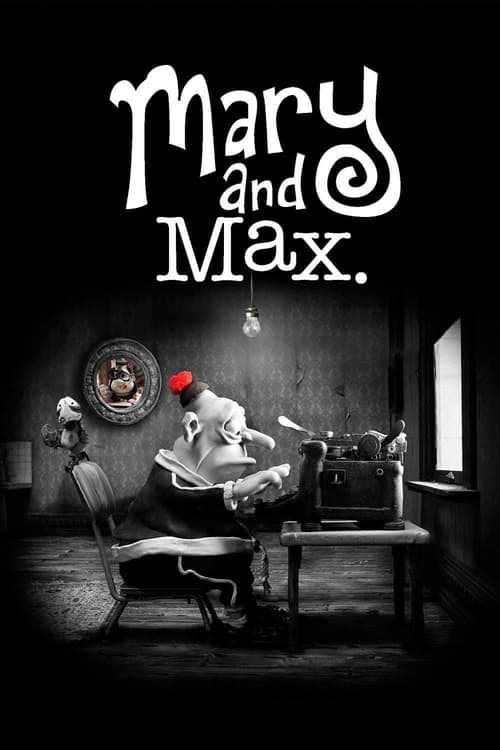
Mary and Max (2009)
Directed by Adam Elliot
No — Mary and Max is not especially woke, scoring 26 out of 100 on our wokeness meter.
Adam Elliot's claymation tragedy about two pen pals, one an eight-year-old girl in suburban Melbourne and one a forty-four-year-old man in New York, arrives with a sorrow so patient it feels almost geological.
Consciousness Markers
Max's Asperger syndrome is a central, deeply explored subject, and the film critiques Mary's attempt to 'cure' him, ultimately affirming his self-acceptance.
Max's severe obesity is portrayed with empathy and dignity, and his eating disorder is treated as part of his humanity rather than a punchline, though the film does not advance a body-positivity message.
A minor subplot has Damien leaving Mary for his male pen pal Desmond, a New Zealand sheep farmer, treated matter-of-factly but never developed as a theme.
Mary is a female protagonist with agency who pursues psychology and writing, but the film advances no feminist argument or critique of patriarchy.
Themes of loneliness, mental illness, and friendship are conveyed through melancholy storytelling rather than direct moral instruction.
The voice cast and characters are almost entirely white Australian and white Jewish-American; no deliberate diverse or color-conscious casting is present.
The film engages no racial themes or commentary whatsoever; the story is entirely about class, loneliness, and mental health.
There is no environmental or climate content in the film.
No economic critique is present; Max's lottery win is used for personal goals and charity, not as a statement about capital.
The film is a personal character study with no historical revisionism or reframing of past events.
Why it received this score
Adam Elliot's claymation tragedy about two pen pals, one an eight-year-old girl in suburban Melbourne and one a forty-four-year-old man in New York, arrives with a sorrow so patient it feels almost geological. The film is a study in loneliness, chocolate, and the postal service, and it takes Max's Asperger syndrome as its central subject. This is where the film earns its cultural weight. Max's diagnosis is not decoration. It is the architecture of his character, and the film treats his routines, his anxiety attacks, his literal reading of the world with an empathy that never condescends. When Mary, grown into a psychologist, writes a dissertation proposing a cure for him, the film sides with Max. His fury is the moral center. He does not want to be fixed, and the film agrees with him.
Max's weight is rendered with a tenderness that refuses both pity and punchline. His eating is part of his humanity, not a joke, though the film never mounts a campaign about it. Elsewhere, the progressive content is thin and matter-of-fact. Mary pursues psychology and writing with real agency, but the film argues nothing about patriarchy. Her husband Damien departs for a male pen pal, a New Zealand sheep farmer, and the film notes this with the same shrug it gives the weather. No theme is developed. No lesson is extracted.
The absences are as telling as the presences. There is no racial consciousness here, no climate anxiety, no critique of capital, no revisionist reading of history. The cast is uniformly white, and no effort is made to correct that. The film's social instruction is minimal; it prefers to let melancholy do the talking. A homeless man is strangled. A mother drinks embalming fluid. A suicide is interrupted by a neighbour who has conquered his agoraphobia. None of it lectures. The final image, Mary seated beside Max's body while his ceiling blooms with decades of her letters, is a quiet argument for the imperfect and the enduring. It is a lovely film. It is barely a message.
Analysis generated by our Consciousness Algorithm


Synopsis
A tale of friendship between two unlikely pen pals: Mary, a lonely, eight-year-old girl living in the suburbs of Melbourne, and Max, a forty-four-year old, severely obese man living in New York.
Questions about Mary and Max
Is Mary and Max woke?
No — Mary and Max is not especially woke, scoring 26 out of 100 on our wokeness meter. That earns it a verdict of Based.
Does Mary and Max have any woke elements?
1 of the 10 markers register at 30 or above, led by Neurodivergence (75). On Neurodivergence: Max's Asperger syndrome is a central, deeply explored subject, and the film critiques Mary's attempt to 'cure' him, ultimately affirming his self-acceptance.
How does Mary and Max compare to other 2009 movies?
It ranks #29 of the 230 films from 2009 we've scored; their average is 14. The wokest is Home (79).
How is the Woke Score calculated?
An AI-assisted process researches the film and its reception, scores it 0–100 on ten markers, then combines those into one 0–100 Woke Score. It measures a specific set of 2020s cultural themes, not film quality.