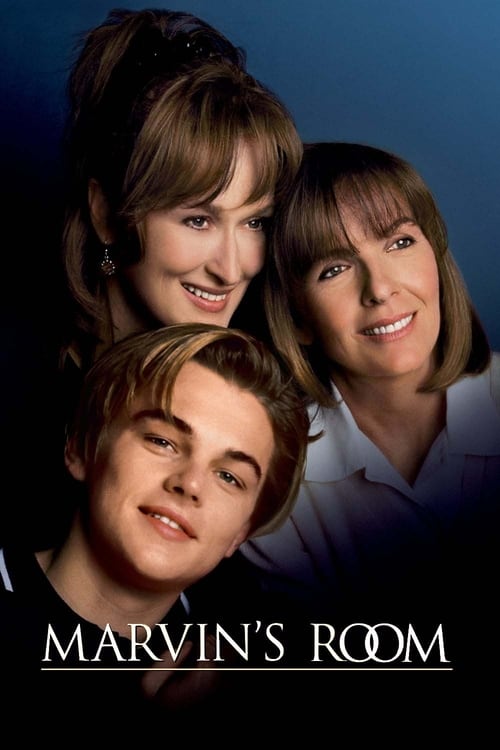
Marvin's Room (1996)
Directed by Jerry Zaks
No — Marvin's Room is not woke, scoring 7 out of 100 on our wokeness meter.
Marvin's Room arrived in 1996 with a pedigree that would seem to invite grand statements.
Consciousness Markers
Two sisters anchor the story and the film foregrounds unpaid caregiving labor, but it does so as domestic melodrama rather than as a conscious feminist thesis.
The ensemble is overwhelmingly white, with only Dan Hedaya (Syrian descent) and Margo Martindale as minor variations; casting was driven by star pedigree, not representational intent.
This is a restrained, character-driven chamber drama that observes rather than preaches; it delivers no explicit social message to the audience.
The film contains no LGBTQ+ characters or themes, despite the source playwright's biography; the on-screen narrative is entirely about a heterosexual family.
Race is entirely absent from the film's concerns; the family drama unfolds in a uniformly white milieu with no commentary on racial dynamics.
No environmental or climate themes appear anywhere in the narrative.
The film offers no critique of wealth, class, or capitalism; its conflicts are familial and medical, not economic.
Illness and physical decline are treated as tragedy rather than through any body-acceptance or body-positivity lens.
Hank's institutionalization stems from trauma and arson, not from any neurodivergence framing; the film makes no such identification.
The film is a contemporary fictional family drama with no historical subject matter to revise.
Why it received this score
Marvin's Room arrived in 1996 with a pedigree that would seem to invite grand statements. It came from Scott McPherson's acclaimed play, written while he cared for his partner during the AIDS epidemic, and it was adapted for the screen with Meryl Streep and Diane Keaton in the leads. The film, directed by Jerry Zaks, keeps its source's origins almost entirely out of frame. Left on screen is a domestic chamber piece about two estranged sisters, a failing body in the back bedroom, and a bone marrow transplant that may or may not arrive in time.
The caregiving falls to Bessie, played by Keaton, who has spent two decades tending a father who no longer recognizes her. The film treats this unpaid labor with quiet attention, and there is a case to be made that it registers a feminine burden without ever announcing itself as such. This is melodrama, not manifesto. Streep's Lee arrives from Ohio with a surly teenage son (DiCaprio) and a nursing home brochure, and the reunion plays out in small domestic gestures: a wig restyled, a dinner served, a drive along the beach. Nobody delivers a speech about the meaning of it all.
Racial dynamics, economic critique, environmental anxiety: none of these are present, and none seem to be missed. The cast is uniformly white and the conflicts are medical and familial. The film's most radical gesture is restraint. It trusts the audience to feel the weight of a family rearranging itself around a dying woman, and it never once turns to the camera to explain what we should conclude. In an era when even the quietest dramas tend to arrive with a thesis attached, that refusal reads as almost quaint. Marvin's Room is not a sermon. It is a room, and we are simply asked to sit in it.
Analysis generated by our Consciousness Algorithm


Synopsis
A leukemia patient attempts to end a 20-year feud with her sister to get her bone marrow.
Questions about Marvin's Room
Is Marvin's Room woke?
No — Marvin's Room is not woke, scoring 7 out of 100 on our wokeness meter. That earns it a verdict of Ultra Based.
Does Marvin's Room have any woke elements?
Very few. None of the 10 markers reaches 30, the level where a marker counts as present; the highest is Feminist Agenda at 20.
How does Marvin's Room compare to other 1996 movies?
It ranks #46 of the 93 films from 1996 we've scored; their average is 11. The wokest is Bound (60).
How is the Woke Score calculated?
An AI-assisted process researches the film and its reception, scores it 0–100 on ten markers, then combines those into one 0–100 Woke Score. It measures a specific set of 2020s cultural themes, not film quality.