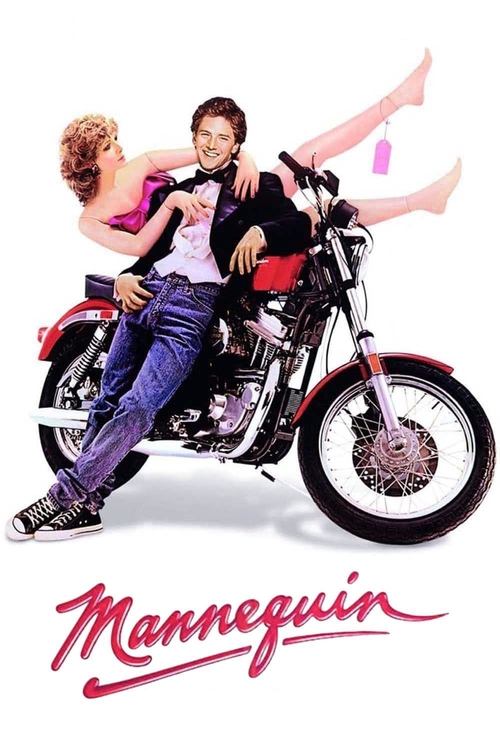
Mannequin (1987)
Directed by Michael Gottlieb
No — Mannequin is not woke, scoring 17 out of 100 on our wokeness meter.
Mannequin arrives from 1987 bearing a premise that would not survive a modern pitch meeting: a chronically underemployed sculptor falls in love with a department store dummy inhabited by an ancient Egyptian muse.
Consciousness Markers
Hollywood Montrose is an unashamedly gay-coded character who befriends the lead and becomes heroic in the finale, a genuinely progressive portrayal for a 1987 mainstream comedy, though it relies on stereotypical flamboyance.
The cast is overwhelmingly white, with Meshach Taylor as the notable exception playing the flamboyant window dresser Hollywood Montrose; his presence adds some diversity but the film makes little of it.
Emmy is a centuries-old muse whose stated goal is finding true love and inspiring a male artist, and Claire Timkin runs the store, but the film's gender politics remain conventional rom-com fare.
The plot features a rival department store secretly paying the manager to sabotage a struggling family store, offering mild corporate-villainy shading, but the film is ultimately a pro-retail fantasy.
No racial themes or commentary are present; Hollywood Montrose's Blackness is incidental to the story rather than explored.
The film is a featherweight farcical romantic comedy with no didactic or preachy tendencies.
No environmental themes whatsoever.
No body positivity themes; the film leans on conventional glamour and the physical perfection of a mannequin.
No neurodivergence themes are present.
The Ancient Egypt prologue is pure fantasy framing, not a revisionist reworking of historical events.
Why it received this score
Mannequin arrives from 1987 bearing a premise that would not survive a modern pitch meeting: a chronically underemployed sculptor falls in love with a department store dummy inhabited by an ancient Egyptian muse. The film is a featherweight farce, and it knows it. Kim Cattrall spent six weeks posing for a sculptor and six more building muscle to match the fiberglass, which is the most rigorous commitment anyone brought to the production. The critics of the day sharpened their knives. Roger Ebert gave it half a star and noted the wake lasts ninety minutes. The audience, as ever, disagreed, and a cult formed around the thing.
The social ledger here is thin but not empty. Meshach Taylor's Hollywood Montrose, a flamboyant window dresser, is the film's one genuine gesture toward progressive portraiture: unashamed, loyal, and heroic in the climactic fire-hose rescue. For a mainstream 1987 comedy, that registers. The portrayal leans on stereotype, and his Blackness goes unexamined, so the gesture is partial. Elsewhere the plot offers a mild corporate-villainy thread, a rival store bribing a manager to sabotage a family business, though the film's true allegiance is to the redemptive power of retail display. The cast is otherwise a wall of whiteness.
The rest of the cultural checklist goes untouched. No environmental conscience, no body-diverse casting, no neurodivergent characters, no reworking of history. Emmy's motivation is finding true love and inspiring a male artist, which keeps the gender politics squarely conventional. The film lectures no one. It wants to sell a song and a fantasy, and it does both with a straight face. The sacred duty of classification is satisfied. We may all go home.
Analysis generated by our Consciousness Algorithm
Synopsis
Jonathan Switcher, an unemployed artist, finds a job as an assistant window dresser for a department store. When Jonathan happens upon a beautiful mannequin he previously designed, she springs to life and introduces herself as Emmy, an Egyptian under an ancient spell. Despite interference from the store's devious manager, Jonathan and his mannequin fall in love while creating eye-catching window displays to keep the struggling store in business.
Questions about Mannequin
Is Mannequin woke?
No — Mannequin is not woke, scoring 17 out of 100 on our wokeness meter. That earns it a verdict of Ultra Based.
Does Mannequin have any woke elements?
1 of the 10 markers register at 30 or above, led by LGBTQ+ Themes (50). On LGBTQ+ Themes: Hollywood Montrose is an unashamedly gay-coded character who befriends the lead and becomes heroic in the finale, a genuinely progressive portrayal for a 1987 mainstream comedy, though it relies on stereotypical flamboyance.
How does Mannequin compare to other 1987 movies?
It ranks #9 of the 59 films from 1987 we've scored; their average is 8. The wokest is Maurice (68).
How is the Woke Score calculated?
An AI-assisted process researches the film and its reception, scores it 0–100 on ten markers, then combines those into one 0–100 Woke Score. It measures a specific set of 2020s cultural themes, not film quality.