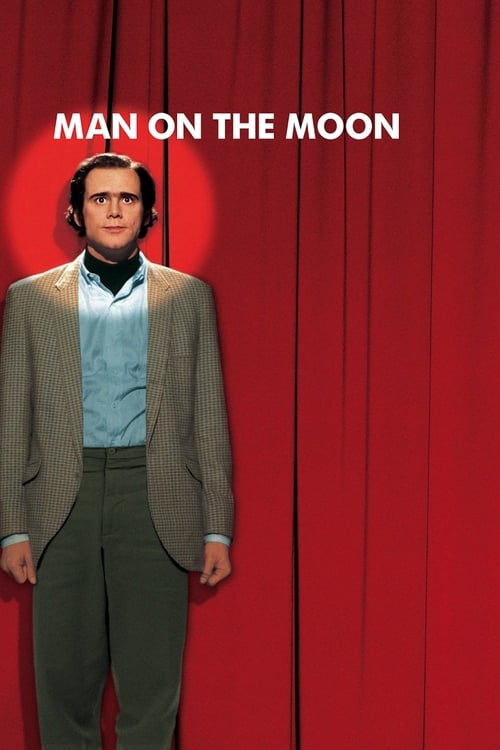
Man on the Moon (1999)
Directed by Miloš Forman
No — Man on the Moon is not woke, scoring 0 out of 100 on our wokeness meter.
The biopic is a form that rewards legibility, and Andy Kaufman spent his career declining to be legible.
Consciousness Markers
The cast is overwhelmingly white, led by Jim Carrey, Danny DeVito, Courtney Love, and Paul Giamatti, with no diverse casting choices made for representational purposes.
The film contains no LGBTQ+ characters, themes, or subtext whatsoever.
Kaufman's inter-gender wrestling gimmick and his berating of women are depicted as part of his provocative villain persona, not framed through any feminist lens or critique.
Race is entirely absent as a theme; the film is a portrait of a white entertainer with no engagement with racial issues.
There is no environmental or climate-related content in the film.
Kaufman's distaste for the Taxi sitcom is a personal artistic grievance, not a critique of capitalism or wealth inequality.
The film makes no statements about body image, size acceptance, or related themes.
Kaufman's eccentricity and the keyword 'mentally unstable' are portrayed as performance art and personal idiosyncrasy, not as a neurodivergence-affirming narrative.
The film alters biographical facts for dramatic effect, but this is conventional biopic license rather than ideologically motivated historical revisionism.
The film is a character study that resists moralizing or delivering social messages to the audience.
Why it received this score
The biopic is a form that rewards legibility, and Andy Kaufman spent his career declining to be legible. Miloš Forman, a director who has watched empires, asylums, and Mozart come and go, approaches the material with the patience of a man sorting through someone else's receipts. Jim Carrey vanishes into the role with an intensity that reportedly required medical attention, and the film's central joke is that no punchline waits at the end of it. The audience is fooled, repeatedly, and the film never apologizes for the deception.
There is no instruction manual attached. Kaufman's inter-gender wrestling gimmick, in which he berated women he had hired to lose, plays as villainous theater and nothing else. Nobody steps forward to contextualize it. His contempt for the Taxi writers' room is framed as an artist's grievance, not as a lesson about labor and capital. Race never enters the frame, and the cast is uniformly white, a fact the film does not address because it has no interest in addressing anything. The camera simply watches a man sabotage his own career and enjoy it.
The deviations from the historical record are the ordinary kind. Dates get shuffled. The Carnegie Hall milk-and-cookies stunt moves to the final months, and the film admits as much in its prologue. This is biopic housekeeping, not ideological renovation. In 1999 a studio could spend fifty-two million dollars on a movie about a man reading The Great Gatsby aloud for four hours, and nobody demanded that it mean something. By the accounting standards of the present moment, the ledger comes up empty. That emptiness has a certain integrity. Not every film needs to instruct us. This one declines, and then dares us to keep watching anyway.
That is the whole transaction. A performer who treated his audience as an adversary, rendered by a performer who briefly became him, in a film that offers no moral at the end of the ride. Twenty-five years on, it reads as an artifact from a period when a major studio could bankroll a two-hour shrug. We classify it, file it, and move on to the next one.
Analysis generated by our Consciousness Algorithm
Part of


Synopsis
The story of the life and career of eccentric avant-garde comedian, Andy Kaufman.
Questions about Man on the Moon
Is Man on the Moon woke?
No — Man on the Moon is not woke, scoring 0 out of 100 on our wokeness meter. That earns it a verdict of Ultra Based.
Does Man on the Moon have any woke elements?
No. All 10 markers score zero.
How does Man on the Moon compare to other 1999 movies?
It ranks #94 of the 103 films from 1999 we've scored; their average is 14. The wokest is Boys Don't Cry (60).
How is the Woke Score calculated?
An AI-assisted process researches the film and its reception, scores it 0–100 on ten markers, then combines those into one 0–100 Woke Score. It measures a specific set of 2020s cultural themes, not film quality.