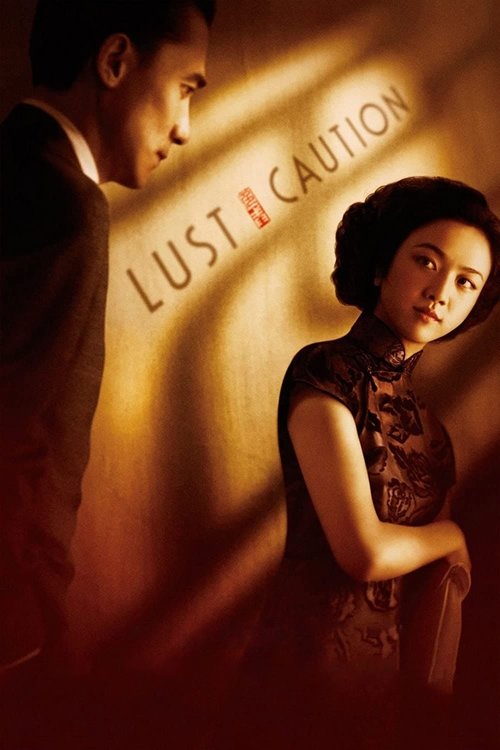
Lust, Caution (2007)
Directed by Ang Lee
No — Lust, Caution is not woke, scoring 18 out of 100 on our wokeness meter.
Ang Lee’s Lust, Caution offers a highly stylized, aesthetically rich examination of espionage set against the backdrop of a Japanese-occupied Shanghai.
Consciousness Markers
The film examines a woman's sexuality as a tool conscripted by the state and charts her gradual reclaiming of desire and agency, but it does so through a tragic, ambivalent register rather than an activist one.
The film reimagines a patriotic assassination plot as a tale of erotic entanglement and betrayal, a fictionalization that the real-life family of Zheng Pingru publicly denounced as a defamatory rewrite of the historical record.
The cast is overwhelmingly Chinese, drawn from mainland China, Hong Kong, Taiwan, and the diaspora, but this reflects the story's authentic Shanghai/Hong Kong setting rather than any deliberate diversity-casting agenda.
The opulent world of the collaborationist elite — mahjong parlors, jewels, a six-carat pink diamond — carries a faint critique of luxury and complicity, but it is atmospheric rather than ideological.
Ang Lee's direction is cool, atmospheric, and restrained; the film observes and suggests rather than preaching to its audience.
The story deals with Chinese resistance to Japanese occupation, but its concerns are national and patriotic rather than framed through modern racial-consciousness discourse.
There are no LGBTQ+ characters or themes; the narrative centers on a heterosexual honey-trap affair.
No environmental or climate themes are present.
Despite its explicit NC-17 sex scenes, the film portrays the body through shame, violation, and coercion, the opposite of body-positivity messaging.
No neurodivergent characters or themes appear.
Why it received this score
Ang Lee’s Lust, Caution offers a highly stylized, aesthetically rich examination of espionage set against the backdrop of a Japanese-occupied Shanghai. It is a film that prioritizes atmosphere over ideological pronouncement, a trait that makes its cultural positioning fascinating. We find little in this narrative to satisfy the contemporary appetite for explicit social messaging or modern progressive sensibilities. The protagonist’s journey is one of personal entanglement and historical fiction, which is far removed from contemporary activist cinema. The film’s approach to female desire is tragic, charting a complicated reclamation of agency rather than providing a neat, celebratory progressive arc. It is a study in luxurious complication.
The film avoids the typical clutter of modern social commentary. While the narrative engages with themes of power and the complexities of wartime collaboration, it does so through the highly charged language of erotic melodrama. The opulent settings and the sheer physicality of the central relationship suggest a subtle critique of the decadent elite, yet this is purely atmospheric and lacks the sharp ideological edges found in more overtly political works. We find the film’s historical reimagining of real-life events to be its most aggressively revisionist element, transforming a tragic historical failure into a highly sensual, if morally ambiguous, tale of betrayal. The restrained direction suggests the film prefers suggestion to the heavy-handed sermonizing of modern progressive storytelling.
Ultimately, Lust, Caution functions as a piece of exquisitely crafted historical fiction, not a manifesto for cultural change. The cast is beautifully assembled for its setting, but the narrative refuses to engage with broader modern discourse on identity or systemic reform. Its concerns remain localized, focused on the immediate tension between desire and duty. The result is a sophisticated, if emotionally detached, period piece that successfully sidesteps the cultural flashpoints of today. It is a beautiful machine, clockwork running perfectly without needing to preach a single lesson.
Analysis generated by our Consciousness Algorithm
Part of


Synopsis
During World War II, a secret agent must seduce, then assassinate an official who works for the Japanese puppet government in Shanghai. Her mission becomes clouded when she finds herself falling in love with the man she is assigned to kill.
Questions about Lust, Caution
Is Lust, Caution woke?
No — Lust, Caution is not woke, scoring 18 out of 100 on our wokeness meter. That earns it a verdict of Ultra Based.
Does Lust, Caution have any woke elements?
1 of the 10 markers register at 30 or above, led by Feminist Agenda (35). On Feminist Agenda: The film examines a woman's sexuality as a tool conscripted by the state and charts her gradual reclaiming of desire and agency, but it does so through a tragic, ambivalent register rather than an activist one.
How does Lust, Caution compare to other 2007 movies?
It ranks #40 of the 201 films from 2007 we've scored; their average is 12. The wokest is Like Stars on Earth (92).
How is the Woke Score calculated?
An AI-assisted process researches the film and its reception, scores it 0–100 on ten markers, then combines those into one 0–100 Woke Score. It measures a specific set of 2020s cultural themes, not film quality.