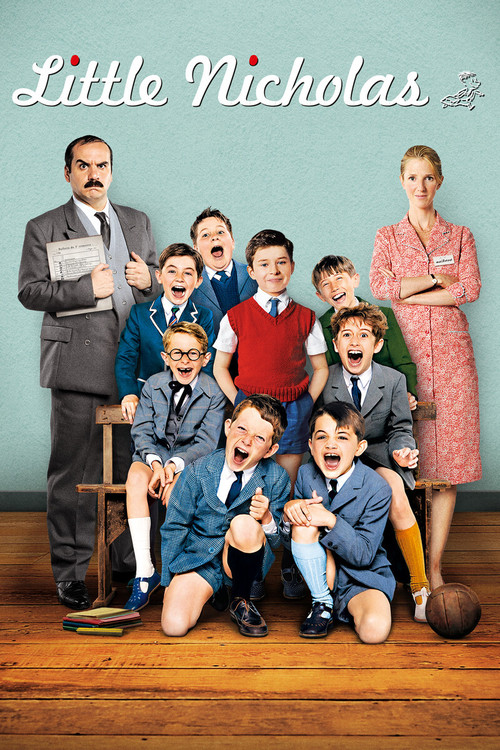
Little Nicholas (2009)
Directed by Laurent Tirard
No — Little Nicholas is not woke, scoring 2 out of 100 on our wokeness meter.
Little Nicholas arrives from 2009 France with no agenda beyond the modest business of making an audience smile, and it pursues that goal with a single-mindedness that borders on the monastic.
Consciousness Markers
The cast is a standard French ensemble drawn from the country's comic acting pool; no deliberate diversity casting or commentary on representation is present.
No LGBTQ+ characters, themes, or subtext appear anywhere in this 1960s-set children's comedy.
Female characters (mother, teacher, Marie-Edwige) exist as conventional figures of a nostalgic childhood tale with no feminist framing or critique.
The film is entirely unconcerned with race or racial dynamics; no such themes are raised.
No environmental or climate themes whatsoever.
The father's boss and promotion subplot is played for gentle farce, not as a critique of capitalism or class.
The gluttonous Alceste is a comic archetype played for laughs, not a vehicle for body-positivity messaging.
No neurodivergent characters or themes are present or addressed.
The film is a warm, nostalgic evocation of 1960s French childhood rather than any revisionist re-reading of history.
The film aims purely to charm and amuse; it contains no didactic social messaging or moralizing.
Why it received this score
Little Nicholas arrives from 2009 France with no agenda beyond the modest business of making an audience smile, and it pursues that goal with a single-mindedness that borders on the monastic. Laurent Tirard adapts René Goscinny and Jean-Jacques Sempé's children's books into a warm, sunlit stroll through the Paris suburbs of the 1960s, where a boy named Nicolas misreads his parents' dinner-party plans as the announcement of a sibling and mobilizes his schoolyard cohort in a campaign of increasingly absurd self-improvement. The plot is a misunderstanding, sustained with the patience of a bedtime story. Nothing here wants to teach anyone anything.
The ensemble is drawn from the deep bench of French comic acting, and the children are sturdy archetypes: the glutton, the rich one, the dunce, the fighter. Alceste's appetite is a running gag, not a statement. Geoffroy's butler exists to be tricked. Marie-Edwige attends a tea party and is never asked to carry a thesis about girlhood. When the father courts his impossible boss over dinner, the scene plays as farce about a nervous man and a difficult guest, and the class politics of the arrangement go unexamined, because examination is not what anyone involved came to do. The film regards its own era through a soft-focus lens and finds nothing in it to indict.
The picture earned a fortune in France and mostly kind notices abroad, which feels proportionate. It offers blue skies, good manners, and not a hair out of place, to borrow a phrase from an admiring critic, and it means every pleasant thing it says. There is no sermon in the final reel, no pointed glance at the audience, no moral delivered over the credits. The boy simply decides he wants to make people laugh, and the film takes his side. We have spent so long sorting films by the arguments they pick that a movie this content to merely charm can seem almost exotic. It is not ambitious. It is not instructive. It is, in its quiet way, a relief.
Analysis generated by our Consciousness Algorithm

Synopsis
Nicolas has a happy existence, parents who love him, a great group of friends with whom he has great fun, and all he wants is that nothing changes. However, one day, he overhears a conversation that leads him to believe that his life might change forever, his mother is pregnant! He panics and envisions the worst.
Questions about Little Nicholas
Is Little Nicholas woke?
No — Little Nicholas is not woke, scoring 2 out of 100 on our wokeness meter. That earns it a verdict of Ultra Based.
Does Little Nicholas have any woke elements?
No. All 10 markers score zero.
How does Little Nicholas compare to other 2009 movies?
It ranks #198 of the 230 films from 2009 we've scored; their average is 14. The wokest is Home (79).
How is the Woke Score calculated?
An AI-assisted process researches the film and its reception, scores it 0–100 on ten markers, then combines those into one 0–100 Woke Score. It measures a specific set of 2020s cultural themes, not film quality.