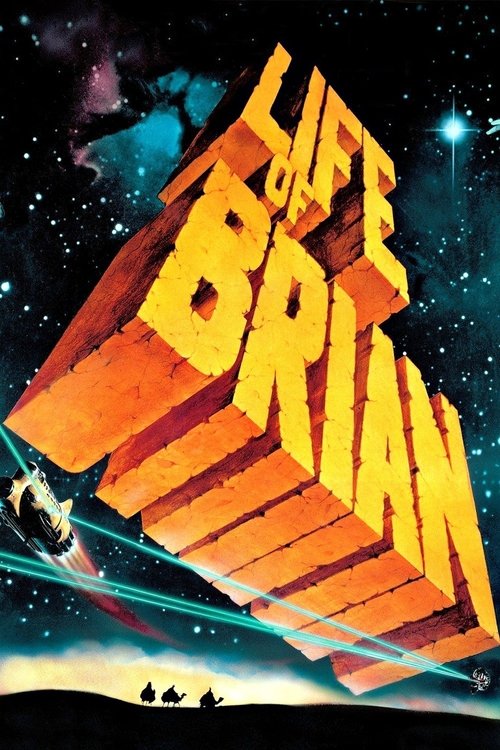
Life of Brian (1979)
Directed by Terry Jones
No — Life of Brian is not woke, scoring 7 out of 100 on our wokeness meter.
Monty Python's Life of Brian arrives from 1979, a vintage that predates the cultural flashpoint under examination here.
Consciousness Markers
The character Stan/Loretta declares a desire to become a woman and have babies, which is played for comedy. It touches on gender identity but is not presented as an affirming LGBTQ+ theme.
Judith is a rebel and Mandy Cohen is a strong-willed mother, and there is a brief debate about women's rights within the People's Front of Judea. However, the film does not advance a feminist agenda.
The film includes satirical speeches and debates, such as Reg's 'What have the Romans ever done for us?' routine, but it is not preachy or lecture-driven in a modern activist sense.
The cast is almost entirely white British men, with women in supporting roles. There is no meaningful racial or ethnic diversity in the casting.
The film features Jewish and Roman characters in ancient Judea, but it does not engage with modern racial consciousness or racial justice themes.
There is no environmental or climate-related content in the film.
The film satirizes revolutionary factions and Roman occupation, but it does not critique capitalism or promote an anti-capitalist message.
There is no body positivity theme or messaging in the film.
Speech impediments are used for comedic effect, but the film does not address neurodivergence as a social or identity theme.
The film is a comedic parody of biblical history, not a serious revisionist historical narrative aimed at reframing past events through a modern ideological lens.
Why it received this score
Monty Python's Life of Brian arrives from 1979, a vintage that predates the cultural flashpoint under examination here. Its target is organized religion, specifically the New Testament era, which it lampoons with a troupe of white British men in multiple roles and a supporting cast of women whose primary function is to scold or be scolded. Brian Cohen, born next door to Jesus and mistaken for the Messiah, stumbles through Roman-occupied Judea pursued by followers he never wanted. The film's blasphemy is well documented. Its engagement with contemporary social consciousness is not.
There are flickers worth cataloguing. Eric Idle's Stan announces a wish to become a woman called Loretta and to have babies, a passage played entirely for laughs and offered as a punchline about revolutionary nomenclature, not as an affirming statement of gender identity. Judith, the rebel Brian pines for, has opinions and a temper, and Mandy Cohen, Brian's mother, dominates every room she enters. A brief debate about women's participation in the People's Front of Judea surfaces and then dissolves. None of this amounts to an agenda. The film's political energy is spent mocking the factional absurdity of independence movements, not the machinery of capital, and the climate goes unmentioned because the climate did not yet require mentioning.
Reg's speech asking what the Romans ever did for the people of Judea is a satirical set piece of real craft, and it deflates itself before the audience can mistake it for a sermon. The film's instinct is to puncture earnestness wherever it finds it, including the earnestness of its own heroes. It ends with men singing cheerfully while nailed to crosses, which is about as far from lecturing as cinema gets. What remains is a comedy of theological mischief, largely innocent of the markers we are obliged to tally, and all the better preserved for it.
Analysis generated by our Consciousness Algorithm


Synopsis
Brian Cohen is an average young Jewish man, but through a series of ridiculous events, he gains a reputation as the Messiah. When he's not dodging his followers or being scolded by his shrill mother, the hapless Brian has to contend with the pompous Pontius Pilate and acronym-obsessed members of a separatist movement. Rife with Monty Python's signature absurdity, the tale finds Brian's life paralleling Biblical lore, albeit with many more laughs.
Questions about Life of Brian
Is Life of Brian woke?
No — Life of Brian is not woke, scoring 7 out of 100 on our wokeness meter. That earns it a verdict of Ultra Based.
Does Life of Brian have any woke elements?
Very few. None of the 10 markers reaches 30, the level where a marker counts as present; the highest is LGBTQ+ Themes at 15.
How does Life of Brian compare to other 1979 movies?
It ranks #14 of the 33 films from 1979 we've scored; their average is 6. The wokest is Hair (30).
How is the Woke Score calculated?
An AI-assisted process researches the film and its reception, scores it 0–100 on ten markers, then combines those into one 0–100 Woke Score. It measures a specific set of 2020s cultural themes, not film quality.