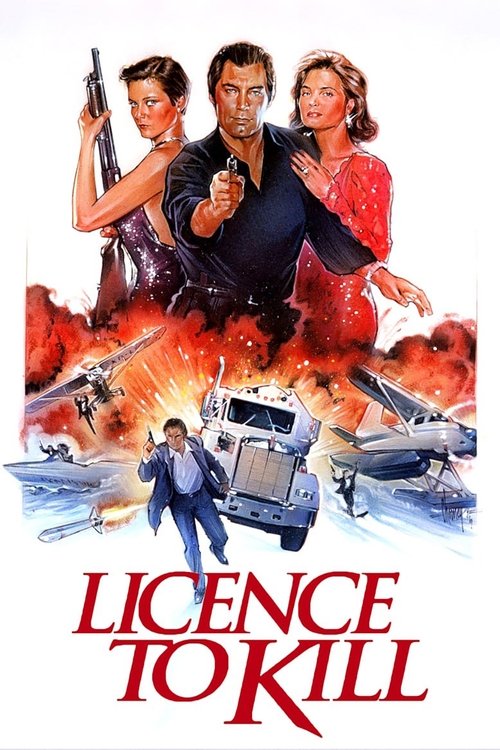
Licence to Kill (1989)
Directed by John Glen
No — Licence to Kill is not woke, scoring 10 out of 100 on our wokeness meter.
Licence to Kill arrives as a grim, revenge-driven Bond entry, with Timothy Dalton's agent resigning from MI6 after Felix Leiter is maimed and Leiter's wife is murdered.
Consciousness Markers
Pam Bouvier is unusually competent for the era—an ex-Army pilot and DEA informant who flies the pursuit plane, shoots Dario, and rescues Bond—but the film still routes her through a makeover and a romantic prize ending, and Lupe is largely decorative.
The cast is notably multiethnic for 1989 (Talisa Soto, Benicio del Toro, Cary-Hiroyuki Tagawa, Frank McRae, Grand L. Bush), but this is organic casting for a drug-cartel thriller rather than representation pursued as a statement.
Latin American and Asian characters populate the story naturally as villains and narcotics agents, but the film makes no racial argument or commentary.
No LGBTQ+ characters, themes, or subtext of any kind appear in the film.
No environmental themes or climate concerns whatsoever; the tanker chase is about cocaine, not carbon.
Drug trafficking, televangelist fronts, and banana-republic corruption are present as criminality, not as a critique of capitalism or wealth itself.
No body-positivity themes; the film trades in conventional Bond glamour imagery.
No neurodivergent characters or themes are present.
The Republic of Isthmus is a fictional banana republic loosely echoing Manuel Noriega, but the film presents no revisionist historical thesis.
A grim revenge thriller that shows rather than preaches; there is no sermonizing or message-delivery to the audience.
Why it received this score
Licence to Kill arrives as a grim, revenge-driven Bond entry, with Timothy Dalton's agent resigning from MI6 after Felix Leiter is maimed and Leiter's wife is murdered. The film is lean, violent, and almost joyless. It predates the modern habit of turning blockbusters into instruction manuals, and it has no interest in addressing the audience directly. Drug trafficking, televangelist fronts, and banana-republic corruption are presented as criminality, not as an indictment of markets or wealth. The tanker chase is about cocaine, not carbon. The fictional Republic of Isthmus echoes Manuel Noriega without proposing any revisionist historical thesis. The film is too busy feeding people to sharks to lecture anyone.
The social consciousness on display is faint and mostly incidental. The cast is notably multiethnic for 1989, with Talisa Soto, Benicio del Toro, Cary-Hiroyuki Tagawa, Frank McRae, and Grand L. Bush. Those performers are organic to a drug-cartel thriller, not recruited as a statement. Latin American and Asian figures function as villains and narcotics agents, and the film makes no racial argument about them. Pam Bouvier is unusually capable for the era: an ex-Army pilot and DEA informant who flies the pursuit plane, shoots Dario, and rescues Bond. Yet the screenplay still routes her through a makeover and a romantic prize ending, while Lupe remains largely decorative. The result is a modest feminist flicker inside a very traditional Bond machine.
The remaining categories register nothing at all. There are no LGBTQ characters, themes, or subtext. There is no body-positivity angle, only conventional Bond glamour imagery. No neurodivergent characters or themes appear. The televangelist front and corrupt officials exist as plot furniture, not as systemic critique. The film's pleasures are mechanical and mean: shark tanks, decompression chambers, cocaine grinders. It is a revenge thriller with a revoked licence and no message attached. We can file it as a relic of a pre-enlightenment blockbuster, which is not a complaint. It simply had other business.
Analysis generated by our Consciousness Algorithm
Part of


Synopsis
After capturing the notorious drug lord Franz Sanchez, Bond's close friend and former CIA agent Felix Leiter is left for dead and his wife is murdered. Bond goes rogue and seeks vengeance on those responsible, as he infiltrates Sanchez's organization from the inside.
Questions about Licence to Kill
Is Licence to Kill woke?
No — Licence to Kill is not woke, scoring 10 out of 100 on our wokeness meter. That earns it a verdict of Ultra Based.
Does Licence to Kill have any woke elements?
1 of the 10 markers register at 30 or above, led by Feminist Agenda (30). On Feminist Agenda: Pam Bouvier is unusually competent for the era—an ex-Army pilot and DEA informant who flies the pursuit plane, shoots Dario, and rescues Bond—but the film still routes her through a makeover and a romantic prize ending, and Lupe is largely decorative.
How does Licence to Kill compare to other 1989 movies?
It ranks #24 of the 68 films from 1989 we've scored; their average is 10. The wokest is Do the Right Thing (72).
Is Licence to Kill the most woke James Bond movie?
No. It ranks #11 of the 26 James Bond films we've scored; the wokest is No Time to Die (42).