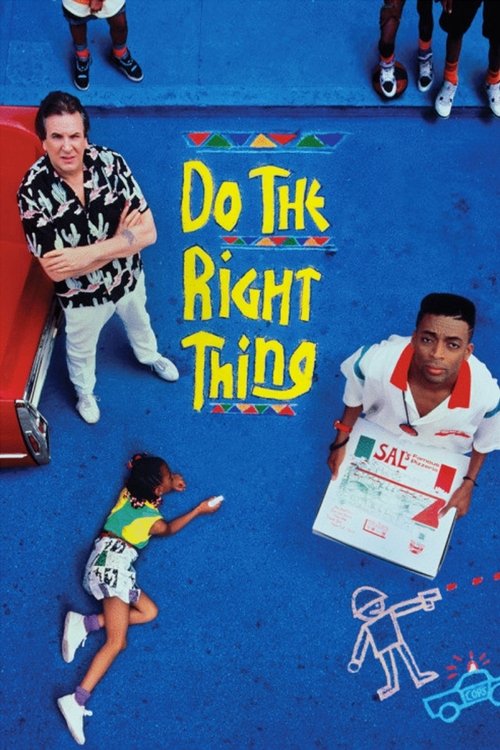
Do the Right Thing (1989)
Directed by Spike Lee
Yes · Woke
How we score movies →Consciousness Markers
The film centers Black and brown characters throughout the ensemble, with deliberate casting choices that foreground marginalized perspectives and refuses token representation.
The entire film is structured around racial consciousness and power dynamics. It interrogates representation, public space, and the right to cultural presence with uncompromising seriousness.
While the film is ideologically committed and does not shy from explicit statements of purpose (the opening credits, certain character speeches), it remains dramatically complex and resistant to simple preachiness.
The film depicts tensions between a small business owner and neighborhood residents, but does not mount a systematic critique of capitalism itself, focusing instead on racial power and representation.
Female characters exist in the narrative but are not central to the film's ideological concerns. Gender is not a primary axis of analysis.
The film engages with contemporary racial history and tensions but does not substantially revise or reinterpret historical narratives.
No significant LGBTQ+ themes or representation present in the film.
No climate-related themes or messaging present in the film.
No substantive engagement with body positivity messaging or representation of diverse body types.
No representation of neurodivergent characters or engagement with neurodivergence themes.


Synopsis
Sal is the Italian owner of a pizzeria in Brooklyn. A neighborhood local, Buggin' Out, becomes upset when he sees that the pizzeria's Wall of Fame exhibits only Italian actors. Buggin' Out believes a pizzeria in a black neighborhood should showcase black actors, but Sal disagrees. The wall becomes a symbol of racism and hate to Buggin' Out and to other people in the neighborhood, and tensions rise.
Why it received this score
Spike Lee's 1989 fever dream of a film remains one of the most deliberately constructed explorations of racial power dynamics and representation ever committed to celluloid. The central conflict, ostensibly about a wall of Italian actor photographs in a Black neighborhood pizzeria, functions as a densely layered meditation on whose image gets to occupy public space, whose aesthetic claims count as legitimate, and the calcified resentments that accumulate when one group insists on its right to invisibility while another demands recognition. Lee does not offer tidy resolutions or moral clarity. The film ends in fire and ambiguity, which is to say it ends in honesty.
The film's construction of its ensemble cast and its deliberate centering of Black and brown bodies, voices, and perspectives marks it as genuinely ahead of its time in terms of cultural consciousness. Lee refuses to make Sal a simple villain or Buggin' Out a simple hero. Every character exists in the texture of their contradictions. The film's interrogation of representation in public space, the way it treats the Wall of Fame as a site of genuine ideological contest rather than mere decoration, carries the weight of serious cultural argument. This is not a film interested in making white audiences comfortable.
Yet the film also resists the codification that would come later. It is interested in the specific, the local, the neighborhood as a living ecosystem of competing claims and genuine affections. It does not ask us to solve the problem so much as to sit in the discomfort of its irresolution. The famous opening sequence, with Public Enemy's "Fight the Power" laying out the ideological stakes in verse, announces the film's commitment to racial consciousness as an artistic and political imperative. By the standards of contemporary cultural production, this is precisely the kind of work that would accumulate the markers we now track.
Analysis generated by our Consciousness Algorithm
Critic Reviews
“Stirred up impassioned debate everywhere; it would seem the greatest compliment that could be paid a stunning entertainment. [30 June 1989, Calendar, p.6-1]”
“This is a sumptuous work, from its unconventional title sequence of a woman dancing hard in the streets to its provocative ending with conflicting quotes from Malcolm X and Martin Luther King Jr .[30 June 1989, Friday, p.A]”
“It comes closer to reflecting the current state of race relations in America than any other movie of our time.”
“To accept the film, though, one must first understand its point of view, and that is maddeningly difficult. All we know for certain is that Do the Right Thing is not naturalistic. [July 3, 1989]”