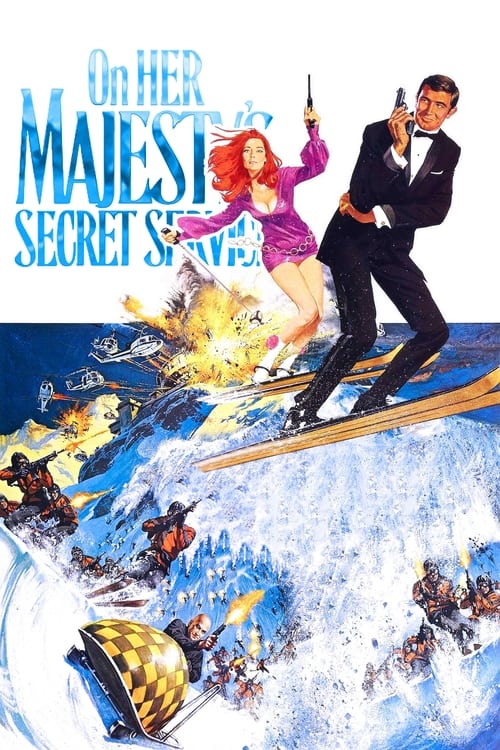
On Her Majesty's Secret Service (1969)
Directed by Peter R. Hunt
No — On Her Majesty's Secret Service is not woke, scoring 12 out of 100 on our wokeness meter.
On Her Majesty's Secret Service arrives from 1969 carrying a reputation as the Bond film that tried to be about something, which in this instance means feelings.
Consciousness Markers
The twelve 'angels of death' are drawn from a conspicuously international roster (English, Australian, Hungarian, American, Israeli, German, Irish, Scandinavian, Chinese, Jamaican, Indian), but this is the classic Bond trope of exotic beauties rather than a deliberate inclusive-casting statement.
Tracy di Vicenzo is unusually capable for a 1969 Bond heroine — she rescues Bond repeatedly, drives the getaway, and proposes nothing less than marriage on her own terms — but the film still frames her largely as a prize and a tragedy, with Bond bedding multiple clinic patients en route.
No LGBTQ+ characters, subtext, or themes of any kind.
No engagement with racial themes or racial consciousness; the international cast is decorative rather than thematic.
Blofeld's scheme involves bacteriological agents sterilising the world's food supply, but this is supervillain extortion, not environmental advocacy.
Draco heads a crime syndicate and Bond infiltrates a law firm, but there is no critique of wealth, class, or capitalism.
No body-positivity themes; the film's treatment of women's bodies is squarely of its era.
Tracy's 'troubled past' and suicide attempt are treated as romantic melodrama, not as neurodivergence.
A faithful adaptation of a Fleming novel with no revisionist reframing of history.
A straightforward espionage adventure that never pauses to instruct the audience on social or political matters.
Why it received this score
On Her Majesty's Secret Service arrives from 1969 carrying a reputation as the Bond film that tried to be about something, which in this instance means feelings. George Lazenby, a model with no prior acting credits, spends two hours proving that a suit and a barber can accomplish a great deal, while Diana Rigg supplies the competence the production otherwise lacks. The picture is a faithful adaptation of the Fleming novel, assembled with the solemnity of a man carrying an annotated copy, which the director reportedly did. The result is an espionage adventure with a wedding and a widow, and no interest in instructing anyone about anything.
The audit finds little to raise. Twelve women from a dozen nations populate Blofeld's alpine clinic as his angels of death: English, Australian, Hungarian, American, Israeli, German, Irish, Scandinavian, Chinese, Jamaican, Indian. This is not an inclusive casting statement. It is the older Bond habit of arranging foreign beauties as scenery, and the passport count matters only because Blofeld needs couriers. The film earns a modest nod for the roster and nothing more. On the question of gender, Tracy di Vicenzo rescues Bond more than once, drives the getaway car through a stock-car race, and proposes her own marriage terms. That is genuinely ahead of its decade. The film then hands her back to the plot as a prize and a corpse, having already sent Bond through the clinic's bedrooms. Progress, of a specific and limited kind.
Everything else reads as zero. No same-sex undertones. No racial consciousness beyond decorative geography. Blofeld threatens the world's food supply, but as extortion, not ecology. No critique of the syndicate money that funds the rescue, no body politics, no neurodivergent framing for Tracy's despair, no revisionist reframing of history, and no sermons. Even the famous final shot, a roadside murder and a cradled bride, asks for grief instead of instruction. The film is a well-tailored relic. Its progressive credentials amount to one capable woman and a crowded passport page.
Analysis generated by our Consciousness Algorithm
Part of


Synopsis
With the help of Marc-Ange Draco, head of the Unione Corse crime syndicate, and Draco's troubled daughter Tracy, James Bond tracks his archnemesis, Ernst Stravro Blofeld, to a mountaintop retreat in the Swiss Alps, where he is training an army of beautiful, lethal women.
Questions about On Her Majesty's Secret Service
Is On Her Majesty's Secret Service woke?
No — On Her Majesty's Secret Service is not woke, scoring 12 out of 100 on our wokeness meter. That earns it a verdict of Ultra Based.
Does On Her Majesty's Secret Service have any woke elements?
Very few. None of the 10 markers reaches 30, the level where a marker counts as present; the highest is Representation Casting at 25.
How does On Her Majesty's Secret Service compare to other 1969 movies?
It ranks #3 of the 13 films from 1969 we've scored; their average is 6. The wokest is Midnight Cowboy (22).
Is On Her Majesty's Secret Service the most woke James Bond movie?
No. It ranks #10 of the 26 James Bond films we've scored; the wokest is No Time to Die (42).