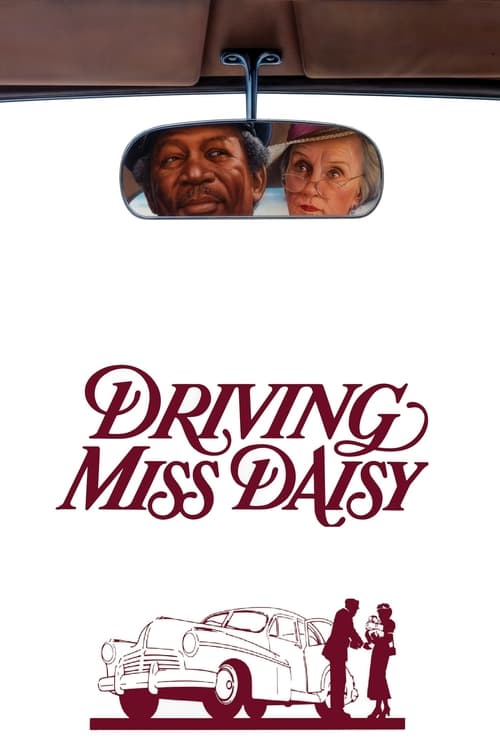
Driving Miss Daisy (1989)
Directed by Bruce Beresford
No · Based
How we score movies →Consciousness Markers
The film addresses race relations and segregation but does so through a lens of individual kindness rather than systemic critique. It avoids confronting structural racism in favor of personal reconciliation narratives.
Morgan Freeman appears in a prominent supporting role as the chauffeur, representing Black representation in mainstream cinema of 1989. However, the character is narratively subordinate to the white protagonist's arc.
The protagonist is an independent elderly woman, but the film does not engage with feminist themes or critique of gender dynamics in any substantive way.
Minimal preachy or preachy moments. The film relies primarily on emotional storytelling and character interaction rather than explicit moral instruction.
No LGBTQ+ themes, characters, or content present in the film.
No climate-related themes or environmental consciousness present in the film.
No anti-capitalist or class critique elements present. Economic systems are not examined.
No body positivity themes or commentary on body image present in the film.
No neurodivergence representation or themes present in the film.
The film does not engage in revisionist history. It presents a straightforward historical narrative without reframing or reinterpretation of historical events.


Synopsis
The story of an old Jewish widow named Daisy Werthan and her relationship with her black chauffeur, Hoke. From an initial mere work relationship grew in 25 years a strong friendship between the two very different characters, in a time when those types of relationships were shunned.
Why it received this score
Driving Miss Daisy occupies a curious position in the cultural landscape: a film about race relations that won Best Picture while systematically avoiding confrontation with the systems that perpetuate racial division. The narrative spans twenty-five years of deepening friendship between an elderly Jewish widow and her Black chauffeur, yet the emotional architecture privileges the white character's journey of self-discovery over any meaningful examination of structural inequality. Morgan Freeman provides a dignified presence, but the character of Hoke remains fundamentally reactive, a vehicle for the white protagonist's enlightenment rather than a complex figure with his own interior life demanding our attention.
The film's approach to racial consciousness is what might be termed the "polite racism" school of American cinema. It suggests that personal kindness and individual relationships can transcend prejudice, a comforting narrative that requires no systemic change or genuine reckoning. The Southern setting and historical timeframe provide cover for this avoidance, as though the film is merely documenting the past rather than making claims about human nature. In reality, the film's entire thesis rests on the proposition that racism is primarily a matter of individual attitude rather than institutional architecture, a thesis that has aged poorly in light of subsequent decades of social analysis.
The film contains minimal engagement with any contemporary progressive sensibilities. There is representation in Freeman's casting, though the role itself is constrained by narrative convention. Beyond this, the markers of modern social consciousness are largely absent. The lecture energy is muted, the feminist content negligible, and any interrogation of systems remains superficial. This is a film designed to make audiences feel good about themselves, to suggest that watching a story about kindness between races constitutes a form of moral engagement. It remains a masterclass in comforting evasion.
Analysis generated by our Consciousness Algorithm
Critic Reviews
“Driving Miss Daisy, about the deepening relationship between a Jewish matron in Atlanta and her black chauffeur, is a luminous joy of a film, heartbreakingly delicate, effortlessly able through indirection to invoke the civil rights era without ever once slipping into portentous pronouncements. [12 Jan. 1990, p.35]”
“Beresford is able to move us, one small step at a time, into the hearts of his characters. He never steps wrong on his way to a luminous final scene in which we are invited to regard one of the most privileged mysteries of life, the moment when two people allow each other to see inside.”
“Director Bruce Beresford's tightly focused adaptation retains all the impact of its Pulitzer Prize-winning stage original. Jessica Tandy and Morgan Freeman give exceptional performances as the aging widow and the sage black chauffeur who enlightens her in the segregated South.”
“Movies like Miss Daisy purport to be humanistic or aimed at a higher consciousness, but they're as self-righteous and silly as the one-dimensional characters they depict. [12 Jan. 1990, p.7]”