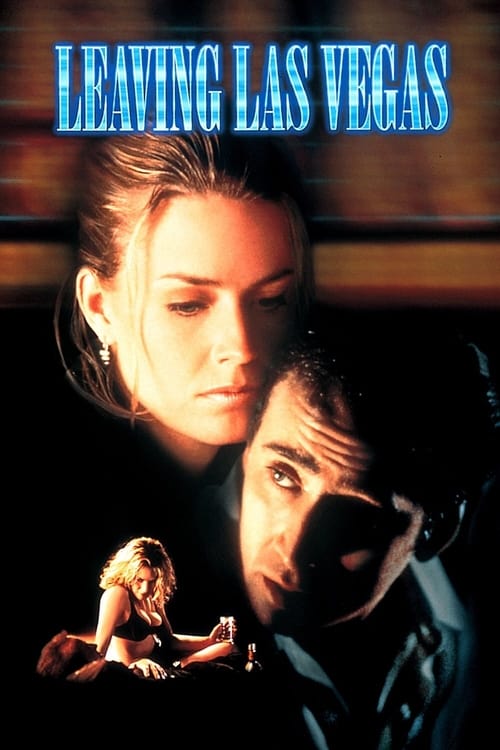
Leaving Las Vegas (1995)
Directed by Mike Figgis
No — Leaving Las Vegas is not woke, scoring 0 out of 100 on our wokeness meter.
Mike Figgis released a film in 1995 about a screenwriter who travels to Las Vegas to drink himself to death, and the prostitute who agrees to love him without interference.
Consciousness Markers
The cast is overwhelmingly white, with no meaningful diverse representation and no commentary on it. Standard mid-90s indie casting.
No LGBTQ+ characters, themes, or subtext of any kind.
Sera is a sympathetic prostitute with some agency, but the film is a study of a man's self-destruction and offers no feminist critique or agenda.
No engagement with race or racial politics whatsoever.
No environmental or climate themes present.
No critique of capitalism or wealth; the protagonist's money is simply a means to drink himself to death.
No body positivity themes; the film does not address body image or size acceptance.
Alcoholism is portrayed as addiction and self-destruction, not as neurodivergence, and the film makes no such framing.
No historical revisionism; the film is a contemporary character drama.
The film is a raw, unflinching portrait rather than a preachy one; it offers no moralizing lecture or social message.
Why it received this score
Mike Figgis released a film in 1995 about a screenwriter who travels to Las Vegas to drink himself to death, and the prostitute who agrees to love him without interference. It is a bleak, unflinching thing, and it remains effective because it refuses to explain itself. No thesis arrives to rescue us. Ben Sanderson simply disintegrates. Sera simply watches. The camera holds steady throughout, and the ruin is allowed to stand as ruin. For a certain kind of cultural auditor, this is a barren field. There is no lesson buried in the wreckage, and no attempt to plant one.
The cast is uniformly white, and nobody remarks on it. Sera is a sex worker with a measure of agency, but the film studies a man's collapse and offers no critique of the arrangements around him. Race goes unmentioned. The climate does not exist. Ben's severance check is a means to an end, not a symbol of late capitalism. Nobody discusses body image, and the drinking is framed as addiction and self-annihilation, not as a neurological identity to be celebrated or accommodated. History is not revised, because history is not consulted. The picture has no interest in any of this, and it makes no effort to pretend otherwise.
What remains is a portrait, and portraits do not lecture. Figgis shot on super 16mm and composed his own score, and the result is intimate and unrepentant. Elisabeth Shue interviewed real Las Vegas prostitutes. Nicolas Cage drank in Dublin for research. The craft is serious. The message is absent. In an era of narrative instruction, a film that simply lets a man die in a rented room can feel almost scandalous. I score it accordingly. The ledger stays empty, and the film is stronger for it.
Analysis generated by our Consciousness Algorithm


Synopsis
Ben Sanderson, an alcoholic Hollywood screenwriter who lost everything because of his drinking, arrives in Las Vegas to drink himself to death. There, he meets and forms an uneasy friendship and non-interference pact with prostitute Sera.
Questions about Leaving Las Vegas
Is Leaving Las Vegas woke?
No — Leaving Las Vegas is not woke, scoring 0 out of 100 on our wokeness meter. That earns it a verdict of Ultra Based.
Does Leaving Las Vegas have any woke elements?
No. All 10 markers score zero.
How does Leaving Las Vegas compare to other 1995 movies?
It ranks #98 of the 108 films from 1995 we've scored; their average is 12. The wokest is Total Eclipse (60).
How is the Woke Score calculated?
An AI-assisted process researches the film and its reception, scores it 0–100 on ten markers, then combines those into one 0–100 Woke Score. It measures a specific set of 2020s cultural themes, not film quality.