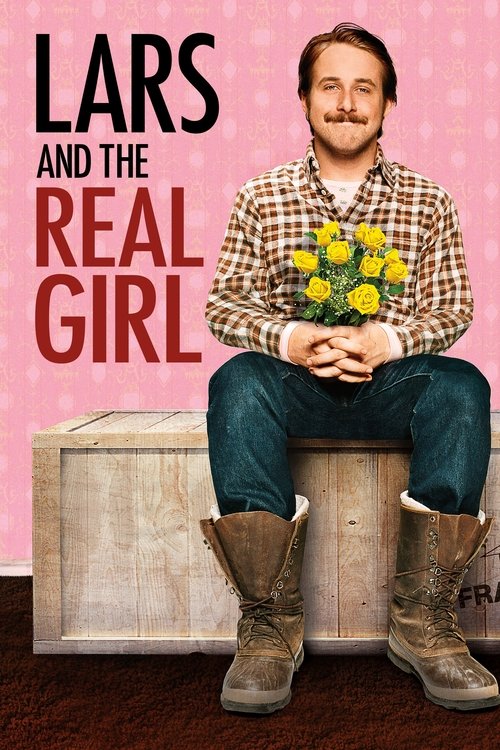
Lars and the Real Girl (2007)
Directed by Craig Gillespie
No — Lars and the Real Girl is not especially woke, scoring 27 out of 100 on our wokeness meter.
Lars and the Real Girl arrives from 2007 as a mild-mannered study of a Wisconsin man and his anatomically correct companion.
Consciousness Markers
Lars is depicted with pronounced social anxiety, haphephobia, avoidance behaviors, and a delusional attachment, and the film treats his condition with sustained compassion rather than mockery, functioning as a sympathetic portrait of a neurodivergent-coded protagonist.
The film is deliberately gentle and non-preachy, sidestepping moralizing; any thematic instruction about acceptance is embedded in story rather than delivered as a lecture.
The cast is overwhelmingly white and the film makes no effort at diverse or representative casting; the only 'Brazilian and Danish' character is a plastic doll.
There are no LGBTQ+ characters, themes, or subtext anywhere in the film.
Female characters (Karin, Margo, Dr. Berman) are supportive figures in a man's emotional journey, but the film advances no feminist thesis or critique.
Race is entirely absent as a subject; the film is set in a homogenous small-town Wisconsin milieu with no racial commentary.
No environmental or climate themes appear in the film whatsoever.
The film contains no critique of capitalism, wealth, or class; the RealDoll is a consumer product treated without economic commentary.
Despite centering on an anatomically correct doll, the film is not concerned with body image, self-acceptance, or body-positivity messaging.
The film engages no historical events and offers no revisionist reframing of the past.
Why it received this score
Lars and the Real Girl arrives from 2007 as a mild-mannered study of a Wisconsin man and his anatomically correct companion. The premise invites snickering. The film refuses it. Craig Gillespie and Nancy Oliver treat Bianca as a fact of Lars's inner life, not a punchline. Ryan Gosling plays Lars with a hushed, wounded courtesy. The town's decision to indulge the delusion becomes a community ritual. It is gentle, sincere, and almost aggressively unhip.
The film's sole area of genuine social sensitivity is its portrait of a neurodivergent-coded protagonist. Lars exhibits social anxiety, avoidance of touch, and a private architecture of grief. The narrative does not mock or cure him by force. Dr. Berman's therapy is patient. The neighbors accommodate. This compassion is real, though it belongs to an older humanist tradition, not a contemporary checklist. Elsewhere, the film is a cultural blank. The cast is white, the town is white, and race never enters the frame. No LGBTQ lives or themes. No feminist argument. No climate sermon. No critique of capital. No body-positive message, despite the doll. No historical revision. The film's moral instruction stays buried in story. It wants us to be kind to Lars, not to audit our own language.
That restraint is the film's saving grace. It could have been a lecture about loneliness, masculinity, or small-town conformity. Instead it stays small, odd, and tender. The result is a movie that feels pre-2010 in the best sense: it has progressive sympathy without a progressive agenda. It asks for patience with a person who cannot meet the world halfway. The final walk with Margo is earned. The film leaves no doctrine behind, only a quiet ache and a plastic woman in a grave. For a work so concerned with delusion, it is remarkably clear-eyed about its own limits.
Analysis generated by our Consciousness Algorithm


Synopsis
Extremely shy Lars finds it impossible to make friends or socialize. His brother and sister-in-law worry about him, so when he announces that he has a girlfriend he met on the Internet, they are overjoyed. But Lars' new lady is a life-size plastic woman. On the advice of a doctor, his family and the rest of the community go along with his delusion.
Questions about Lars and the Real Girl
Is Lars and the Real Girl woke?
No — Lars and the Real Girl is not especially woke, scoring 27 out of 100 on our wokeness meter. That earns it a verdict of Based.
Does Lars and the Real Girl have any woke elements?
1 of the 10 markers register at 30 or above, led by Neurodivergence (45). On Neurodivergence: Lars is depicted with pronounced social anxiety, haphephobia, avoidance behaviors, and a delusional attachment, and the film treats his condition with sustained compassion rather than mockery, functioning as a sympathetic portrait of a neurodivergent-coded protagonist.
How does Lars and the Real Girl compare to other 2007 movies?
It ranks #20 of the 201 films from 2007 we've scored; their average is 12. The wokest is Like Stars on Earth (92).
How is the Woke Score calculated?
An AI-assisted process researches the film and its reception, scores it 0–100 on ten markers, then combines those into one 0–100 Woke Score. It measures a specific set of 2020s cultural themes, not film quality.