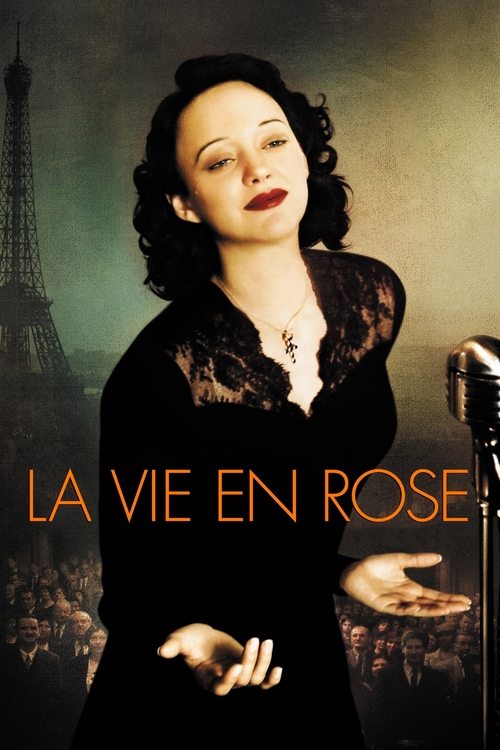
La Vie en Rose (2007)
Directed by Olivier Dahan
No — La Vie en Rose is not woke, scoring 6 out of 100 on our wokeness meter.
La Vie en Rose arrives from 2007 with the respectable weight of a European biographical musical, all trembling chansons and Oscar-winning makeup.
Consciousness Markers
Centers a female artist's life and independence, but without explicit feminist critique or agenda.
Cast is almost entirely white European actors; no notable diversity casting or race-conscious casting choices.
No LGBTQ+ characters, relationships, or themes; Piaf's romances are heterosexual.
No engagement with racial identity, racism, or racial justice; story is set in a white French cultural milieu.
No environmental or climate themes.
Depicts poverty and exploitation but does not advance an anti-capitalist or eat-the-rich critique.
No body-positivity themes; the film focuses on Piaf's physical decline and addiction.
No neurodivergence themes; childhood blindness and addiction are not framed as neurodivergence.
A conventional biopic with artistic liberties, not a revisionist social-justice reframing of history.
No preachy or lecture-like messaging; it is a dramatic musical biopic.
Why it received this score
La Vie en Rose arrives from 2007 with the respectable weight of a European biographical musical, all trembling chansons and Oscar-winning makeup. It follows Edith Piaf from a brothel childhood to international stages, and it does so with a non-linear structure that mistakes chronology shuffling for profundity. Marion Cotillard is genuinely remarkable, shrinking her body and voice into something raw and fragile. The film around her remains a conventional rise-and-fall portrait, content to let suffering stand for insight.
For those of us who catalogue contemporary social consciousness, the pickings are sparse. Piaf's story is female-centered and insists on her independence, yet the film offers no feminist argument beyond the fact of her existence. It shows poverty, exploitation, and hard living without turning them into an anti-capitalist parable. The identity categories that dominate current discourse are simply not present, and the film is set in a white French cultural milieu that it never interrogates. Addiction and illness are treated as personal tragedy, not as platforms for modern identity politics.
The film remains a handsomely mounted, occasionally moving tribute to a singular performer. It has no lecture to deliver, no historical revision to advance, and no casting choices designed to signal virtue. That may sound like faint praise. Here it is simply a description. The film belongs to an older tradition of prestige biography, a tradition that asks us to admire endurance and artistry without demanding that we audit them through current moral categories. As such, it registers as culturally quiet, almost quaint. A sommelier of social messaging would find this vintage dry, austere, and nearly free of additives.
Analysis generated by our Consciousness Algorithm


Synopsis
From the mean streets of the Belleville district of Paris to the dazzling limelight of New York's most famous concert halls, Edith Piaf's life was a constant battle to sing and survive, to live and love. Raised in her grandmother's brothel, Piaf was discovered in 1935 by nightclub owner Louis Leplee, who persuaded her to sing despite her extreme nervousness. Piaf became one of France's immortal icons, her voice one of the indelible signatures of the 20th century.
Questions about La Vie en Rose
Is La Vie en Rose woke?
No — La Vie en Rose is not woke, scoring 6 out of 100 on our wokeness meter. That earns it a verdict of Ultra Based.
Does La Vie en Rose have any woke elements?
Very few. None of the 10 markers reaches 30, the level where a marker counts as present; the highest is Feminist Agenda at 10.
How does La Vie en Rose compare to other 2007 movies?
It ranks #115 of the 201 films from 2007 we've scored; their average is 12. The wokest is Like Stars on Earth (92).
How is the Woke Score calculated?
An AI-assisted process researches the film and its reception, scores it 0–100 on ten markers, then combines those into one 0–100 Woke Score. It measures a specific set of 2020s cultural themes, not film quality.